Posted in 2025-2026, Books, Ceramic, Reading, Research, Uncategorized

Teapot #1

The bone-dry teapot and cups still waiting, as if holding a story yet to be told. The tea set idea emerged from the story of a Yemeni translator, Omar Bahabri, which led me to delve deeper into the history of beverages, particularly tea. I was already familiar with the history of coffee, its origins in Ethiopia, its early cultivation and consumption in Yemen, and its spread along pilgrimage routes to Mecca, then through Muslim traders to Turkey, and onward to Italy and the rest of Europe. However, tea carries a different, more complex, and more painful history.

In Yemen, tea exists in multiple forms: Adeni tea, influenced by Indian chai, and red/ black tea in the Turkish style. This diversity reflects Yemen’s social fabric, shaped by non Arab communities of Indian, African, and Turkish origin who have both contributed to and been shaped by Yemeni culture, particularly its cuisine. Yet, despite this richness, my focus is not on tea in Yemen. Although the idea began with Omar’s story, I instead return to tea’s original homeland, China, where the narrative unfolds differently.

In its early history, tea in China was a simple drink associated with medicine and daily ritual. By the 17th century, however, it had transformed into a globally desired commodity, particularly after being embraced by Britain, where it became central to social life. As demand grew rapidly, Britain faced a significant economic imbalance. It was importing vast quantities of tea from China without having sufficient goods to offer in return.

To resolve this imbalance, Britain turned to the opium trade, cultivating opium in India and exporting it to China on a massive scale. Opium became a tool of domination. Its spread led to widespread addiction across Chinese society, causing profound social and economic harm. In response, the Chinese state attempted to halt the crisis. The official Lin Zexu confiscated and destroyed large quantities of opium in an effort to protect the population. This act became the spark that ignited the First Opium War from 1839 to 1842. Britain with its superior naval and military defeated China and imposed the Treaty of Nanking. This marked the beginning of a period of political and economic subjugation. Chinese ports were forcibly opened to foreign trade, heavy reparations were imposed and Hong Kong was ceded to Britain.

In the Second Opium War from 1856 to 1860, Britain and France launched another campaign against China, advancing as far as Beijing and burning the Old Summer Palace, one of the country’s most significant cultural landmarks. China was then forced into further agreements that expanded foreign influence, legalised the opium trade, and granted extensive privileges to foreigners within its borders. These events deepened the weakening of the state, eroded economic control, and contributed to the eventual fall of the Qing dynasty.

This era is known in Chinese history as the Century of Humiliation, a period marked by repeated foreign intervention, internal fragmentation, and a profound loss of sovereignty. The impact of these wars was not only immediate but long lasting, shaping modern China’s political consciousness and its complex relationship with the West. In this context, tea is no longer just a drink. It becomes an entry point into a layered history of colonialism and coerced trade. A simple cup of tea conceals networks of power, economics, and violence, where demand alone was enough to ignite wars and reshape nations.

For this reason, I chose opium as the motif to be carried on the teapot and cups, so I experimented with pen and watercolour, searching for a visual language capable of expressing this narrative.

Then I realised that my project required a deeper level of research, which led me to visit the Victoria Gallery and Museum. As a space I’m already familiar with, particularly for its ceramics and china collection, it offered both a point of return and a site for re-reading objects through a more critical lens.

Upon entering the gallery, I experienced an immediate sense of recognition, I was drawn to the Willow pattern. Its storytelling operates as a form of visual fiction circulated, repeated, and widely accepted, yet detached from its cultural origins. The blue and white aesthetic, often perceived as timeless and decorative, began to reveal itself instead as a coded visual language shaped by histories of translation, imitation, and appropriation.

This encounter also sharpened my awareness of Liverpool’s historical entanglement with colonial trade. The city’s material culture cannot be separated from these conditions.. I became particularly interested in the development of transfer printing the process that enabled the mass reproduction of ceramic which was pioneered locally at the Herculaneum Pottery.

Extending this research, I visited few antique shops, observing ceramic objects more closely in terms of form, surface, and wear. These encounters grounded my understanding of how such objects exist not only as historical artefacts but also as carriers of layered narratives. I documented these visits through photographs and began a series of blue pen drawings as an initial visual response, testing how line, repetition, and colour might translate into my own practice.

I’m drawn to the seed capsule as a central motif, the origin of opium, and a form that holds both fragility and consequence. Its presence operates quietly, yet it carries a dense network of associations: trade, addiction, control, and empire… It functions as a more precise and restrained symbol, resisting overt representation while still holding critical weight. The decision to work with blue and white visual language reinforces this tension between surface beauty and underlying histories.

At this stage, I feel prepared to begin planning my final design. What feels significant is how this research, which initially seemed distant and external, has gradually folded back into both local history and my own practice. During my BA, I used a teapot for assembled sculpture featuring a Willow pattern titled Gossip. Revisiting this work now, it reads differently, less as a formal exploration and more as an early, intuitive engagement with themes of narrative, circulation, and miscommunication.

This process has also deepened my awareness of the responsibility embedded in design choices. Selecting what imagery appears on the tea set is not merely aesthetic, it’s conceptual and political. The act of placing an image becomes an act of framing meaning. I think of this as similar to cutting beetroot: the more carefully and precisely it’s handled, the more it stains.. The mark is unavoidable, just as histories do!

Posted in 2025-2026, Books, collaboration, Exhibitions, Moon, Social Sculpture, Writing

Dear Moon,

When I arrived in the UK, everything felt strange and new, but your face was the only one that remained old and familiar…

Today, I led a moon workshop at St George’s Hall, after weeks of preparing for the upcoming exhibition Home and Away, organised by artist Mariana Sequera. The project explores ideas of home, displacement, and migration. It’s a concepts that seem simple at first, but quickly unfold into something more complex the moment you invite others in.

Recently, images from Artemis II showing the Moon’s far side, pulled me back to the letters. I found myself rereading them, and with that came a quiet but firm feeling: it’s time to finish the book, and to stop collecting more.

While sharing the open call for Home and Away and encouraging people to participate, I noticed how easily themes like displacement are interpreted in narrow ways. There is often an assumption that such experiences belong only to certain groups, and not to others. This made me reflect on how art spaces frame experience, and how belonging is often defined, sometimes invisibly within those frames.

Since last year, I’ve chosen not to rush the second Dear Moon book. I’ve learned that timing is not separate from the work. Showing something in the wrong moment or context can mean it’s overlooked, or misunderstood. This awareness is shaped by my position as a woman, a mother, and a Muslim, identities that are often underestimated, even by those close to me.

I’m  learning to resist two opposing pressures: the demand to remain constantly visible, and the quiet acceptance of being marginalised. Somewhere between these, Dear Moon has become a space of its own. Writing to the Moon creates a particular kind of room, it allows for distance, but also intimacy. The letters themselves hold so much. They open memory, reflection, and connection. There is something therapeutic in that, but I try not to reduce it to therapy alone. Each contribution carries its own layers.

C, a retired nurse, shared a story she wrote in the 1970s, along with a receipt showing she was paid £8 when it was broadcast on Miri Mawar, a programme on Welsh HTV. Including her work now brings different times into conversation with each other, raising questions about value, recognition, and whose voices are remembered. In contrast, A’s drawing of the Moon’s phases offers another way of understanding participation. As a child with severe physical and learning difficulties, his contribution gently disrupts expectations of what artistic expression should look like. The Moon’s cycles, appearing and disappearing feel like a quiet reflection on resilience and change.

Through all of this, I’ve started to think of trust as a material within the work. People are not just contributing content..they are offering something personal. That comes with responsibility: to hold these contributions with care. As the book nears completion, I feel both excited and uncertain. I want to hold it, but Im still thinking about how to share it. In previous exhibitions, Dear Moon often felt unresolved, shaped by time pressure, or by divided attention.

Posted in 2025-2026, collaboration, Experiments, Social Sculpture, Visit

Reflection on Alex Schady Workshop Collaborative Making and Social Sculpture

I took part in a workshop led by Alex Schady as part of the Fine Art Digital Residency week which thoughtfully organised by Jonathan for both MA classes. 

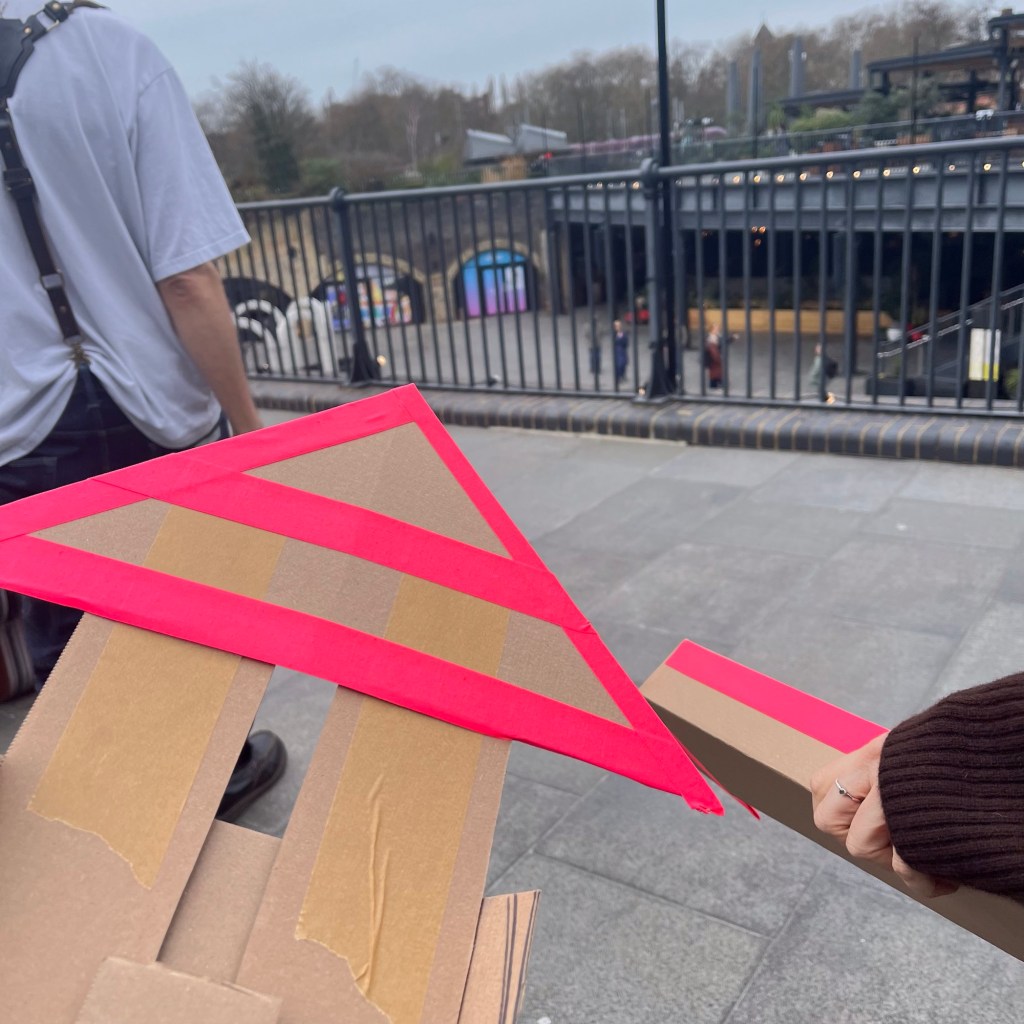
The session focused on collaborative making and began with a simple exercise: a flat sheet of cardboard was shared and each student created an arrow. I made a very simple arrow, similar to Alex’s example, while others explored more playful and experimental shapes. I noticed something familiar about my role in workshops I often observe more than I produce, watching how others approach the task becomes part of my learning process.

We then moved outside to the street and began performing with our objects, engaging with the urban environment and the people around us. The arrows shifted from being simple objects to becoming gestures in public space.. Accusatory fingers!

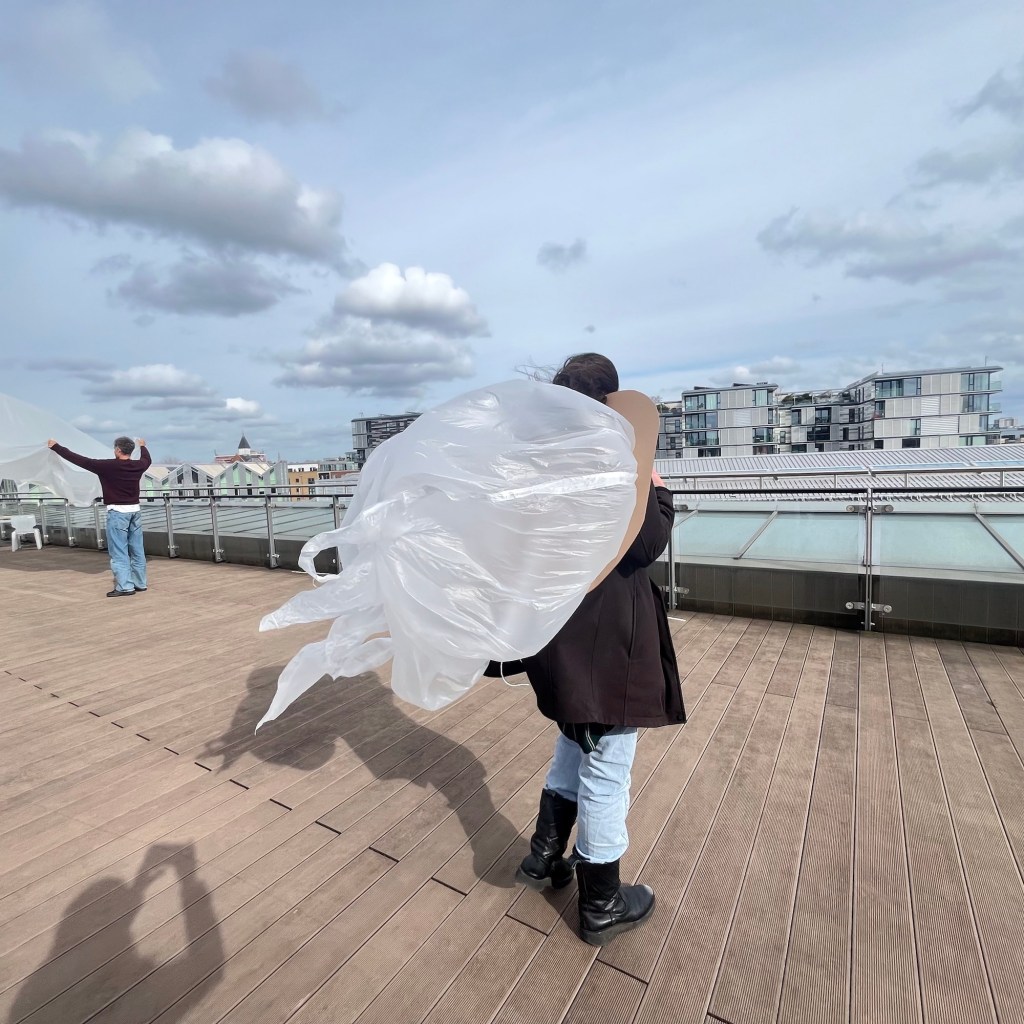
In the next stage we worked in pairs to create inflatable body extensions using plastic sheets. I collaborated with Rachael, and we agreed to make angel wings. The process was technically tricky, due to delicate material, but we managed to build them, and had a lot of fun experimenting with movement.

Afterwards we gathered outside for a collective performance where everyone presented their creations. Eventually groups merged and people began wearing multiple extensions, forming a kind of shared body. The performance ended with one large collective body.

What stayed with me most was the way Alex held the space. He allowed collaboration to happen naturally without pressure. No one felt forced to participate in a particular way. This made me think about concept of social sculpture and the idea that society itself can be shaped through collective processes.

The workshop felt like a small example of this idea. Through simple materials and shared actions we created a temporary social structure based on making, negotiating and performing together. 

Afterwards I visited the first-year MA students’ exhibition. It was interesting to see the space and reflect on how quickly time passes during the MA journey. It was also lovely meeting fellow artists in person for the first time there was an immediate sense of familiarity and trust. 

Although I could only stay for a few hours, the experience felt full. Sometimes a few meaningful hours can contain days of learning. Alex’s workshop demonstrated how much can happen in a short time  making, performing and collaborating and it left me wondering how much deeper this process could go if we had the opportunity to continue it over several sessions.

Posted in 2025-2026, collaboration, curation, Project, Social Sculpture

Iftar as Social Sculpture

Last year I was invited to organise a community iftar a few months after the Southport attack and the rise of far right protests. I accepted immediately, but I kept the first event simple. It felt important to move carefully. After it went well, we decided to make it a regular gathering that people in the community could expect and look forward to.

This year the project developed in three connected parts. The first was a shared reading session on the second day of Ramadan ( check previous post). The second was an anti racism cooking workshop. The third was a collective iftar meal at the library where around forty people gathered to break the fast together.

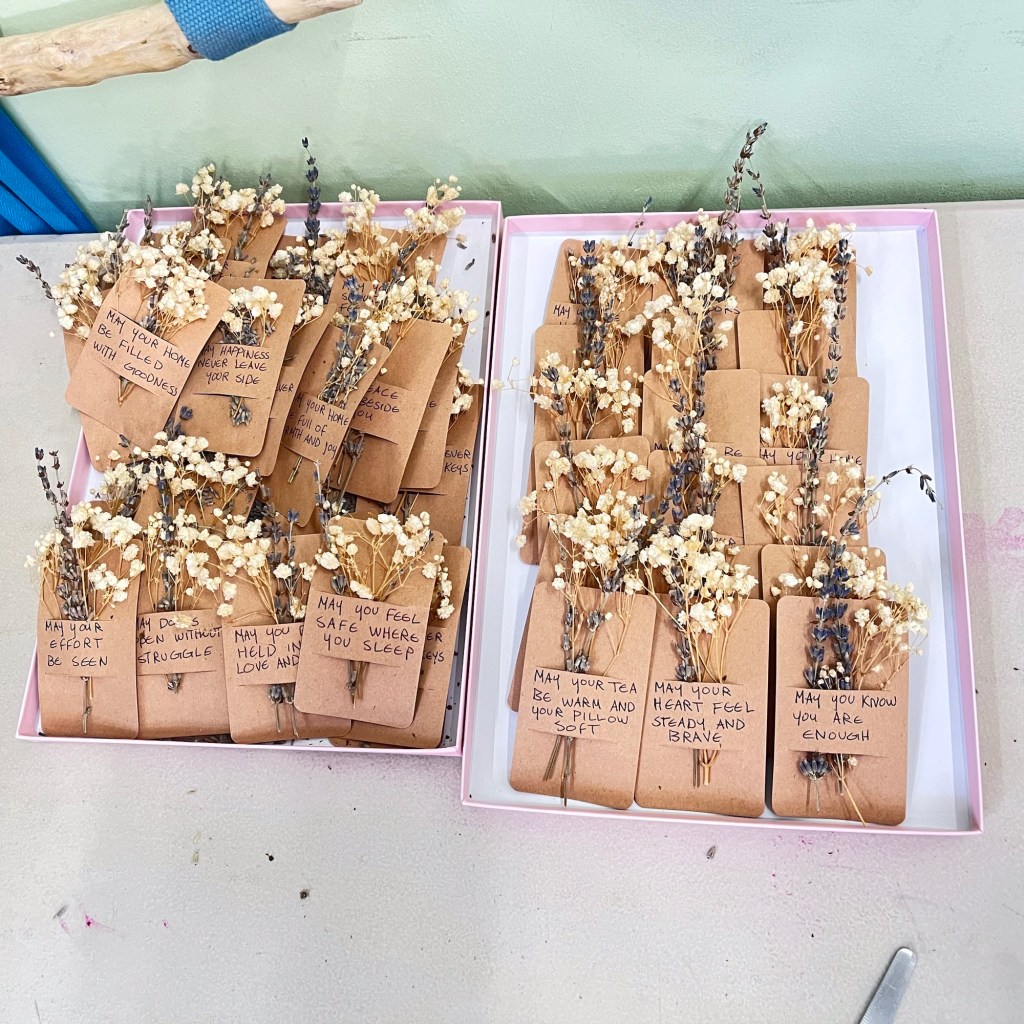
For the cooking session I invited an Iranian chef to lead a workshop where we prepared a vegetable curry. Participants from the Kitchen Library, mostly local English speaking volunteers, joined colleagues and other volunteers. People cooked together, shared food, and stayed to talk before leaving. Later that day I prepared small blessing cards for the following evening.

The next day my colleague Niamh, artist and producer for the Kitchen Library, and I went shopping for ingredients and refreshments. Back at the library we started preparing the meal. Niamh made stuffed dates for dessert. I cooked a vegan curry and bulgur while Greg and Joe helped with preparation and logistics. At the same time we rearranged the library space so it felt less like an institutional environment and more like a shared domestic space.

By the time the guests arrived everything was ready. Before breaking the fast I welcomed everyone and spoke briefly about Ramadan. I also shared this small story:

Recently I called my sister to ask how the first day of Ramadan had gone. She told me that her youngest daughter 4 yrs old  saw the dinner table prepared and suddenly asked “Where is he?” They asked, “Who?”.. She replied, “Ramadan! Everything is ready.. Why hasn’t he arrived?” 

For my niece, Ramadan was not an abstract period of time..it was a guest expected at the table!

In many ways this reflects how the month is often experienced. People prepare for it, welcome it, and look forward to its arrival. In Arabic we say Ahlan Ramadan. The phrase comes from Ahlan wa sahlan ( أهلا وسهلاً) which has been used to welcome guests in Arabic culture for centuries.

It is often translated as “welcome”, but the meaning is deeper. Ahlan comes from ahl (أهل) meaning family. It suggests that the guest is not a stranger but someone among their own people. Sahlan comes from (سهل)sahl, meaning ease or smooth ground. It suggests that the path between host and guest should be easy and open. Together the phrase expresses a form of hospitality that goes beyond politeness. It means you belong here and this space is open to you. Another common greeting is (مرحبا)marhaban. The word comes from (رحب) rahb, meaning wide or spacious. It also suggests openness and generosity. After sharing this, I invited people to say “welcome” in their own languages. We heard it in Chinese, Dari, Farsi, Urdu, German, Norwegian, and Portuguese. This small moment helped set the tone for the evening.

Ramadan is the ninth month of the Islamic lunar calendar, and fasting during this month is one of the five pillars of Islam. From before sunrise until sunset, Muslims do not eat or drink.. They also avoid smoking and intimacy. Not everyone fasts, children, people who are ill, elderly people, pregnant or breastfeeding women, women during menstruation, and travellers are exempt.

The fast is usually broken with dates and water. After a long day without food or drink the body returns to eating slowly. But fasting is not only about the body. It is also about awareness. It interrupts habits of consumption and invites reflection about what we need and what shapes our desires. Hunger changes how we feel and how we see the world. It makes the body more present, but it also reminds us of people who live with food insecurity every day. For a moment the difference between abundance and scarcity becomes more visible.. This can open space for empathy!

The project worked with the fragile conditions through which community is formed. Cooking, waiting, and breaking the fast together created a pause in everyday life. For a short time the library changed from an institutional space into a shared domestic space shaped by the people who were there. The iftar was not only an event. It became a temporary social form created through shared work, food, and conversation. Even small acts of welcome can change how a public space feels, even if only for a short time.

Posted in 2025-2026, collaboration, Project, Reading, Social Sculpture, Writing

March Shared Reading

We recently started a new group in my programme called International Shared Reading, with the support of The Reader. Instead of taking the training myself, I recommended two women from my group an assistant from Afghanistan and a volunteer from Portugal to take the paid training and co-lead the sessions alongside my co-producer, while I support them where needed. I believe that our strength comes from building a strong team rather than individual effort.

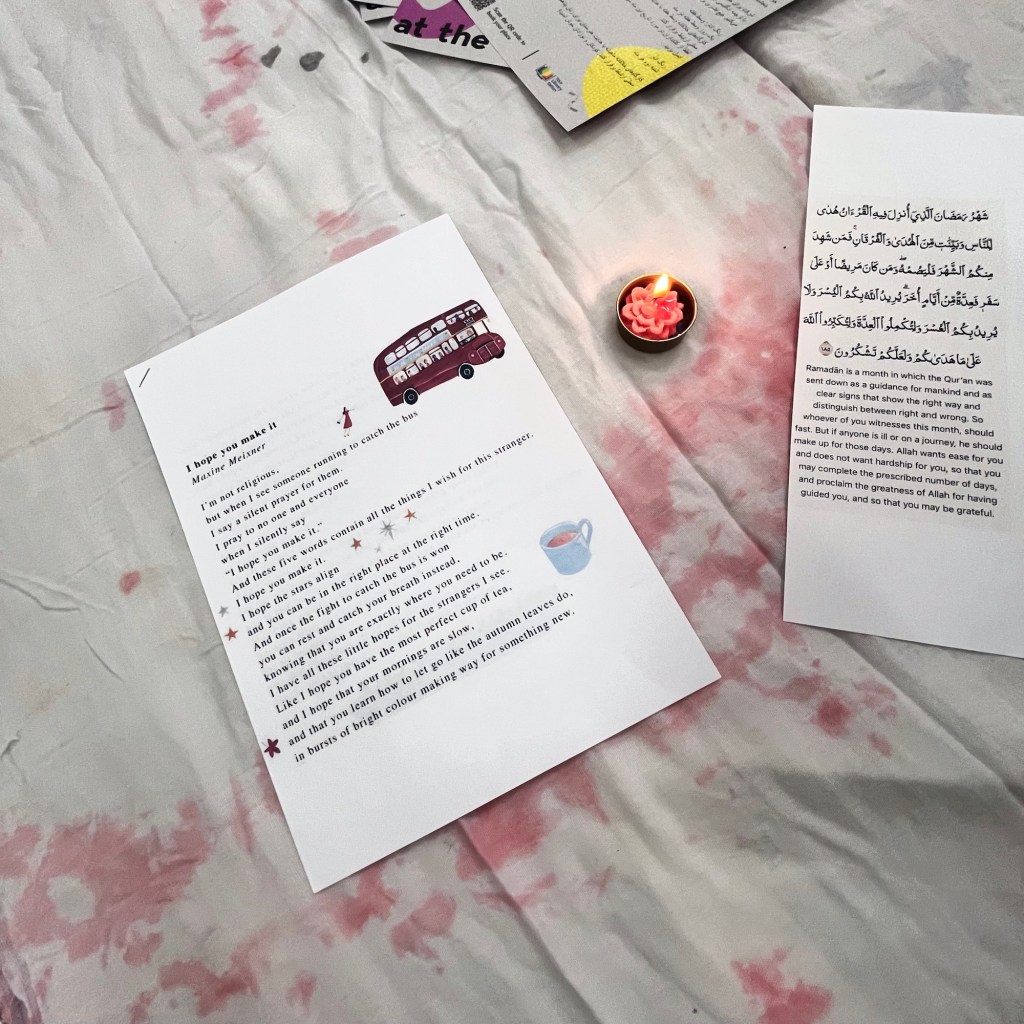
As part of the preparations for our upcoming Iftar gathering, I led a special reading session. It created a space to ask questions and learn more about Ramadan. We read a poem together, spoke about prayer, and people asked many questions about fasting and other related topics. Questions are welcome, they help clarify misunderstandings. When I went home that evening, I kept thinking about our conversation. Later, a volunteer sent a beautiful message in our group chat thanking me for the session.

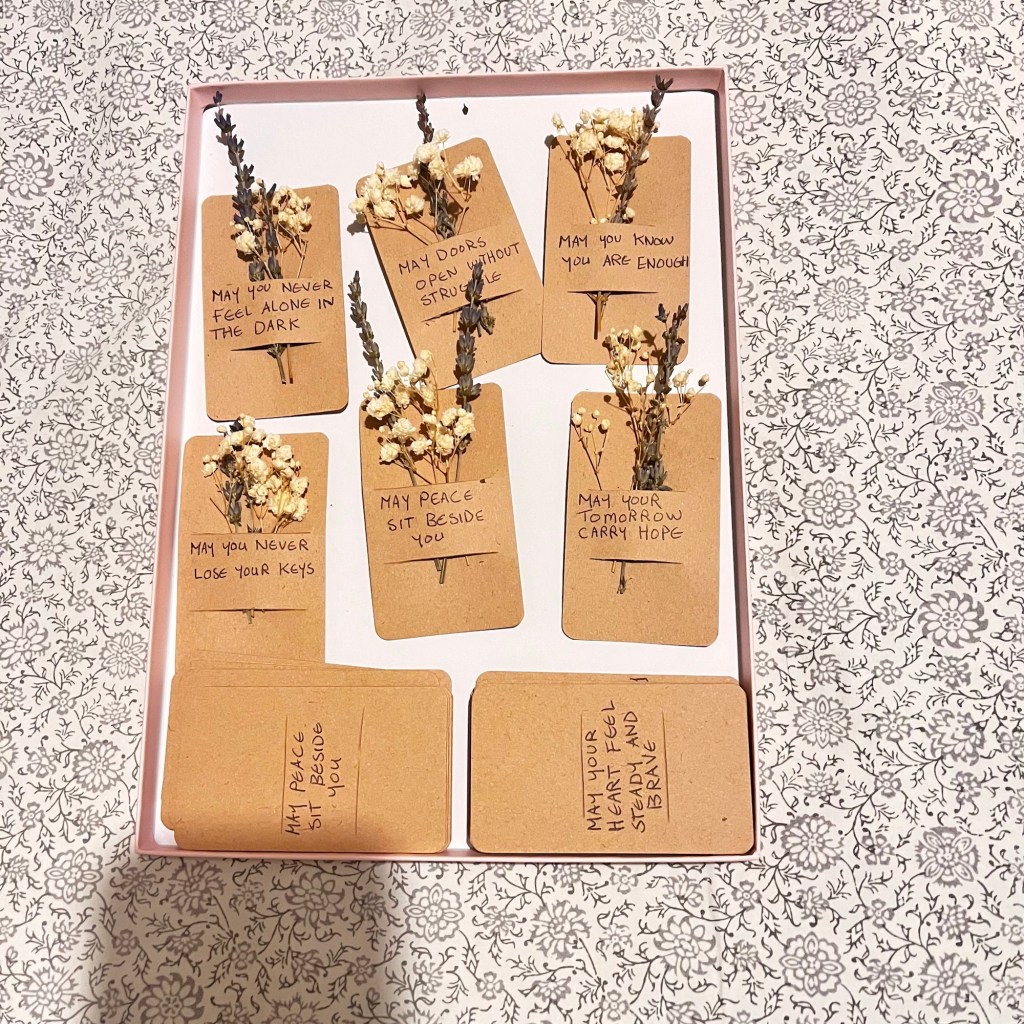
The next day I decided to create small blessing or affirmation cards for our guests, inspired by the poem we read together. I Hope You Make It, a poem by Maxine Meixner, is written in a simple and beautiful way. The words can reach people without challenging them with difficult language. I spent the day writing my simple prayers and preparing the cards so I could finish them at the library the next day.

The cards are simple and decorated with flowers. I chose lavender because it has a gentle, calming scent. In a way, the cards became a small social sculpture, something guests could take with them, carrying the memory of the Iftar after they leave.

Posted in 2025-2026, Books, Reading, Translation, Writing

Wanderer (2009)

Wanderer (2009) by Rory Macbeth is an English translation of Kafka’s The Metamorphosis, produced without knowledge of the German language. To understand the context of this post, it’s helpful to read the previous one.

German capitalises all nouns. When Kafka writes “den Augen” “the eyes”, Macbeth’s translation becomes “towards Augen”, as if Augen were a geographical location. This is not a mistranslation in the traditional sense; rather, it is a relocation of meaning. The work does not simply translate German into English. Instead, it appears to misread or mishear it, treating certain German nouns as destinations and following sound rather than semantic fidelity. In doing so, it produces something that feels both derivative and entirely new.

This method continues throughout. Kafka’s “sein Zimmer, ein richtiges”, translated into English as “his room, a proper human room”, becomes in Macbeth’s version “since summer, the rich man”, an apparent phonetic drift. At several points, Gregor’s sister’s name, Grete, is also translated as “great”. For example, Kafka’s “Komm, Grete” appears in Macbeth’s version as “Commandant! Great!” while the standard English translation reads “Grete, come”. These shifts suggest that Macbeth is not translating through grammar but by ear, treating German as sound material to be sculpted into English.

As the text progresses, one can sense a shift from guessing through sound to asserting narrative intention. At first, the work reads like a linguistic experiment, a kind of phonetic dérive. Gradually, however, something changes. The more one reads, the more an independent narrative begins to solidify; it begins to feel like the writer claiming territory. Wanderer begins to detach itself from The Metamorphosis. Betty starts to echo, but not duplicate, Grete. Threads remain visible, yet they no longer bind the text to its origin. By the end of the story, the authorial voice becomes unmistakable, and Wanderer tests how far transformation can go before it becomes authorship. Macbeth’s restrained conclusion expands into something vast, and the writer steps forward!

This raises the question of where translation ends and authorship begins. In Translation by Sophie J. Williamson (p. 43), a selected passage from Walter Benjamin’s essay The Task of the Translator states that “a translation issues from the original — not so much from its life as from its afterlife”. Benjamin’s idea of translation as a text’s afterlife helps illuminate what is at stake here, yet Macbeth also seems to exceed this model. Benjamin suggests that translation renews the original by revealing the hidden kinship between languages, allowing the text to unfold further in time. Translation, for him, is not reproduction but continuation, a stage in the original’s ongoing life.


Posted in 2025-2026, Books, Reading, Reflection, Social Sculpture, Writing

Gogol, Kafka and Macbeth

This post introduces the next, which will focus on Wanderer (2009) by Rory Macbeth, an English translation of The Metamorphosis produced without knowledge of the German language. Instead of translating through grammar or meaning, Macbeth works by visually and phonetically interpreting the German text and reconstructing it into English. The result is a work that exists somewhere between translation and authorship.

It’s important to briefly touch on The Metamorphosis (1915) by Franz Kafka before writing about Wanderer, and I’ll also use this opportunity to mention The Overcoat (1842) by Nikolai Gogol. I referred to Gogol’s story in our session when we discussed avoiding direct expressions of trauma during Zoe’s presentation. For me, Kafka and Gogol employ absurdity and a kind of quiet defeatism as narrative strategies through which trauma is expressed indirectly.

The Metamorphosis is a small text, yet incredibly heavy in its existential weight. The narrative begins with an unexplained event, Gregor Samsa’s transformation into a giant insect, presented without cause or preamble. Instead of questioning the transformation itself, the narrative quickly shifts to the practical consequences of his condition. His family who once depended entirely on his income, gradually begin to see him less as a son or brother and more as a burden. One gradually senses that the true transformation is not merely physical but human and moral. The story is existential in its questioning, absurd in its world, surreal in its structure, and deeply social in its critique…

Akaky Akakievich, the protagonist of The Overcoat, lives a lonely, repetitive life and struggles to make even minor changes. It takes him a long time to save enough money to buy a new coat, but when he finally does, the simple act of wearing something new gives him confidence and a glimpse of happiness. This joy is short lived… The coat is stolen on his way home! He desperately tries to retrieve it, fails, falls ill, and dies shortly afterwards. In the end, his ghost wanders the city stealing coats from others. The story oscillates between the real and the surreal, it’s sad, absurd, brief, yet emotionally expansive. It’s often seen as an early example of the absurd bureaucratic protagonist and is believed to have influenced many writers. For me, it’s enough to recall Dostoevsky’s saying “We all came out from Gogol’s The Overcoat”.

The Overcoat and The Metamorphosis are both essential reading for lovers of short fiction. They present deliberately ordinary protagonists, characters who almost disappear rather than dominate the plot, humans positioned at a humble level far removed from heroic or supernatural figures. These are stories that sometimes make you want to step inside the page and shake the character awake. In Gogol’s story, the narrator also seems strangely unconcerned with certain details or histories of events. A similar feeling emerges in Kafka.. What happened to Gregor Samsa is, in some sense, not important. Although he lives believing he is essential to his family, they ultimately continue without him, and his perceived importance dissolves.

This becomes significant for me when thinking about Wanderer. I sense something familiar here, perhaps one leading to the other, at least in my perception. Just as the lives of Akaky and Gregor seem strangely insignificant within their own stories, the linguistic accuracy of the text also becomes strangely insignificant in Macbeth’s work. Regardless of the original context or linguistic accuracy, the act of translation itself becomes conceptually aligned with the story. This also resonates with my own interest in communication and miscommunication as a form of social sculpture, where meaning is shaped collectively rather than fixed.. It raises questions about what is essential and what is not. What carries meaning? What survives translation? What do we choose to care about, and who decides this?

Posted in 2025-2026, Reflection, Research, Tutorials 2025-26, Uncategorized

1-1 Tutorial 11th February

I took some time to reflect on this tutorial because I was so busy. I also needed to read more carefully, as these kinds of tutorials do not end when they finish; they tend to open further questions and lead me into deeper reading.

In this tutorial I had with Jonathan, we spoke about learning and what learning really means. We reflected on the assimilation and accommodation post, and on the idea that learning is not for display but for use. It should transform how you live. It needs to be functional, active, and embodied.

We also discussed translation and whether my practice is, in itself, a process of translation. I have been thinking that everything I do is a form of translation. There is a language I carry, a language of thoughts and ideas, constructed from the data my brain collects. This data is my lived experience: encounters with people, spaces, and time. Yet data alone is not enough, it must be translated into meaning, and meaning must then be translated into thought and action.

I can’t think about this without turning to Merleau-Ponty’s phenomenology. What interests me most is his insistence that perception is not a detached mental operation but something embodied, something that happens through our being in the world. Our understanding is not separate from our living, it’s shaped through the body’s continuous engagement with its environment.

Language itself offers a powerful example of this phenomenology. Language is collaborative, it’s formed through shared experiences within a community, shaped by surroundings and histories. Using Arabic as an example, because it’s my mother tongue, Arabic is built on a root and pattern system. Most Arabic words derive from a root of three consonants (rarely four). This structure allows the language to remain generative: new words can emerge as long as they remain faithful to the semantic core of the root.

Here are two examples one scientific and one poetic, the word حاسوب (computer) and حاسبة (calculator) both derive from the root ح س ب, meaning “to calculate”, similar to how “computer” and “calculator” trace back to Latin roots. Second one is حب (love), from the root ح ب ب, associated with seeds. Although I have not encountered this interpretation formally in literature, I’m drawn to the poetic possibility that “I love you” could be understood as “I carry/have a seed for you” a seed that has the potential to grow… For me, this aligns with the lived experience of love not as a finished/ready object, but as something cultivated and sustained. Here the language demonstrates embodied perception. Meaning does not emerge abstractly; it grows from how the body, historically and culturally, encounters the world.

Colour offers another compelling example. We identify colours based on how our brains interpret light wavelengths. Yet colour is not an intrinsic property of objects. A green card is not “green” in itself, it absorbs most wavelengths and reflects the one we perceive as green. What we call colour is the result of an interaction between light, object, and perceiver. From a phenomenological perspective, colour is relational. It exists in the encounter. Different animals perceive different spectra, therefore, the world of colour shifts depending on the perceiving body. In this sense, colour is not a fixed external fact but an event that occurs within perception.

This becomes even more complex when considering visual impairment… A relative has Stargardt disease, and many people assume that eye disease results in darkness or emptiness. But in his case the brain uses surrounding visual information (often background colour) to fill in gaps where central vision is weakened. This is not simply a defect, it’s evidence of the brain’s active participation in constructing perception. Perception is not produced by the eyes alone; it’s a whole body phenomenon. The body is not a passive receiver of data; it’s an intelligent, adaptive system constantly negotiating meaning. What my relative experiences demonstrates that perception is collaborative between eye, brain, memory, environment, and prior experience.

This also raises further questions for me: how does the brain decide which colour to use to fill a gap? Why that tone rather than another? These questions do not weaken the phenomenological argument; rather, they reveal how perception is both structured and creative. The body does not merely record reality, it actively composes it. There is undeniably a relational dynamic shaping human perception. At the same time, there is an astonishing intelligence within the body itself a continuous, largely unconscious orchestration. The heart beats, the lungs breathe, cells regenerate, all without instruction from conscious thought… In recognising this, I feel both philosophical and spiritual awe, and all I can say is: glory to the One who created this body.

Finally, I return to learning. Learning is about becoming informed and being able to decode what was previously inaccessible. Ideally, learning should help solve a problem, generate new questions, or bring you closer to an answer. Yet the information we receive is always filtered through perception, our minds process what they are capable of processing and what feels significant within our lived experience.

Posted in 2025-2026, collaboration, curation, Experiments, Motivations, Research, Social Sculpture, Visit

Free Workshops

Last Sunday, I spent a rewarding day with Ghost Art School and creatives from October Salon (a new collective in Preston led byHannah Browne). My aim was to organise a free workshops day, focused on sharing knowledge and skills without the need for materials or money. I offered an introductory session in British Sign Language (BSL), while Liverpool-based artists Tom Kelly and Tom Doubtfire generously shared aspects of their practices. Hannah provided the space in Preston, making the event possible through collaboration rather than institutional support.

The day had several clear intentions. Firstly, I wanted to gather with peers and begin the year in a meaningful, collaborative way, learning together and exchanging knowledge. Secondly, the event allowed us to engage with October Salon, an emerging creative group, and to demonstrate what can happen through collective artistic practice.

The programme began with Tom Doubtfire leading a discussion on the role of the artist and the relationship between art and activism. His reflections centred on disturbance, sustainability, sacrifice, and focus. The group discussed what it means for art to be disturbing, what sustainable practice might look like, how much we are willing to sacrifice and the importance of setting limits, also how to remain focused on our aims.

This was followed by my one-hour introduction to BSL. My motivation for teaching BSL stems from both personal conviction and historical awareness. The language was banned in the United Kingdom between 1880 and 1970, and despite its cultural and social importance, it still receives limited funding in education. BSL was officially recognised as a language in 2003 and granted legal status in 2022, yet it is still not included in the GCSE curriculum. In this context, teaching BSL freely can be understood as a quiet form of activism! Challenging ableism, questioning unequal access to culture, and sharing knowledge rather than gatekeeping it.

BSL is also highly visual and expressive, connecting strongly with creative disciplines. It can influence performance, filmmaking, choreography, and storytelling, functioning not only as a language but also as an artistic medium. More broadly, offering knowledge without payment can be seen as a response to the increasing commercialisation of the arts. It reminds us that generosity and collective growth still hold value.

The day concluded with a workshop led by Tom Kelly, which provided a joyful ending. His approach to clowning demonstrated that it’s not simply about being silly, but about exploring human emotions through humour and vulnerability. Through simple games and spontaneous interaction, the group communicated naturally, without preparation. There was a strong sense of care, kindness, and mutual respect among participants.

The structure of the day loosely echoed Joseph Beuys’ idea of the Free International University, an artist-led model of education independent from institutions and grounded in dialogue and shared learning. By offering knowledge freely and prioritising exchange over production, the gathering became less about outcomes and more about shaping a temporary community through participation.

For me, the impact of this day was more meaningful than any individual artwork I’ve made recently. It highlighted the importance of shared time, laughter, and informal learning within creative communities. It felt like an encouraging and significant beginning for the group, grounded in connection rather than productivity alone

Posted in 2025-2026, Reading, Reflection, Research

Assimilation and Accommodation

On Tuesday, during a strong presentation session, while listening to the last talk about dérive and virtual spaces as alternatives by Pritish, I found my mind returning to a learning theory I had studied many years ago. I could not immediately recall whether it was Vygotsky or Piaget, and this hesitation made me unsure about sharing the thought at the time. Afterwards, I searched…and yes! It was Piaget’s theory of assimilation and accommodation, the idea that learning happens either by fitting new information into existing schemas or by adjusting those schemas when new information does not fit.

Reflecting on this, I began to think about how virtual spaces function in a similar way. Even when people experience digital or alternative environments, their feelings and reactions are still shaped by accumulated past experiences and knowledge. Any first encounter within a virtual space is built upon pre-existing cognitive and emotional structures. So, virtual spaces act more as a mimic or extension of reality rather than a replacement. This process can apply not only to places, but also to human relationships, attachments, and the way knowledge itself is formed. For artists in particular, engaging with new media or environments becomes less about abandoning reality and more about negotiating between what is already known and what is newly encountered.

Artists can be understood through Piaget’s concepts of assimilation and accommodation, where creative practice becomes a continuous process of negotiating between existing internal frameworks and new experiences. In assimilation, artists adopt new media, theories, or environments while maintaining their established emotional language and conceptual concerns. The tools or platforms may change but the underlying schemas remain consistent.

On the other hand, accommodation occurs when new encounters challenge existing schemas and require deeper transformation. This is often where significant artistic shifts emerge, when identity or the understanding of presence itself is reconsidered. This change is not merely stylistic but structural and art education environments sometimes encourage this level of critical adjustment.

Virtual space also reveals how artistic perception is shaped by memory and embodiment. In digital environments, artists still rely on bodily memory, cultural conditioning and early play patterns, while also borrowing physical metaphors such as walking, entering, meeting, or distancing. Virtual space often mirrors or exaggerates reality rather than escaping it entirely, showing that cognition and imagination remain grounded in lived experience.

Play therefore persists as a fundamental mechanism within artistic practice. What begins as childhood experimentation evolves into adult creative inquiry, where testing rules, breaking structures, and negotiating imagination against reality become methods of continuous learning and re-formation.

Below is a short child observation, with an image and a video, which for me explains the theory mentioned above:

The child is my nephew, my brother’s son. In the first image he was two years old, in August 2024. We were at a farmhouse with cousins and aunties. I introduced him to drawing with charcoal that we found the day after a barbecue. We made a few marks on the ground together, and he didn’t stop playing with it, continuing to draw small circles and lines.

Last summer, in August 2025, in the second video, we returned to the same farmhouse with the same family gathering. The next day my nephew found small pieces of charcoal and began making circles again. When the charcoal finished, he picked up a small stone and continued drawing on the floor. This happened without my involvement or guidance, I was simply nearby watching him play outside. What amazed me, and what I could not resist recording, was the moment he began showing his cousins what to do and teaching them. They were all having fun, and I was quietly enjoying this very human moment at a child’s level.

2025

This observation functions as a small case study of assimilation and accommodation in everyday life. The first encounter with charcoal represents assimilation, where the child integrates a new material into existing playful behaviours such as drawing circles and lines. The second encounter, one year later, demonstrates accommodation, when the charcoal is no longer available, the child searches for an alternative and selects a stone, adjusting both the tool and the physical effort required while maintaining the same intention to draw. The act of later teaching other children reinforces this learning socially, showing how knowledge becomes shared rather than individual.

In an artistic context, this example illustrates how creative practice is not only about materials but about cognitive continuity. The surface, gesture, and intention remain consistent while the medium changes. This mirrors how artists adapt to new technologies or environments without abandoning their internal motivations. The child’s behaviour reveals that creativity operates through repetition, substitution, and social exchange, suggesting that artistic development, much like childhood learning, is a cycle of experimentation rather than a linear progression… which this also can relate to the cyclicality that mentioned in Eleanor’s presentation.