What can I say… this experience has reminded me why I love working collectively and why it is so important not to rely on a single resource or only on self-knowledge.
Giving feedback as a group is such a powerful idea and such a beautiful way to enrich one another’s reflection on our practice. I genuinely loved sharing my thoughts with each of my peers and reading theirs in return. The work is amazing, it expresses human experience in such diverse ways, full of richness, honesty and genuine emotion. I felt truly honoured to be among them and lucky to witness their progress over time.
It was emotional to reflect on how we are growing together, holding each other’s hands virtually on this journey with such care and generosity. It reminded me of Jonathan’s first session in October 2024, when he spoke about kindness and compassion and how these could become the strength of our collective and our cohort. Throughout the course, he has guided us with constant care and kindness, so it is no surprise that he created this opportunity: for each of us to write short feedback for one another on a shared Miro board dedicated to every artist.
My peers’ feedback has genuinely boosted my confidence and trust in my practice. Of course, there are always things missing, intentionally or not, due to circumstances and the challenges of process. But receiving feedback that recognises your efforts is deeply energising, especially as a socially engaged artist, where the social aspect is the heart of the work.
I will definitely return to this Miro board whenever I need to. It has become a beautiful space, full of thoughts floating in this quiet corner of cyberspace.
When I was reading for my research paper, I kept thinking about the unusual and slightly funny relationship between the German artist Joseph Beuys and the British critic David Sylvester! They were both major figures in modern art, but they never managed to build a close or comfortable connection.
Sylvester saw how important Beuys was. He never denied Beuys’s impact or how strongly he shaped his time, just as Duchamp had done for modern art. Even so, their relationship never became warm or collaborative. Sylvester had deep, ongoing conversations with many artists, but with Beuys he stayed distant, almost cautious.
This shows clearly in his writing. Sylvester never wrote a whole book about Beuys, nor explored him in the focused way he did with others. Beuys appears only here and there, usually as one example inside bigger discussions about conceptual art and post Duchamp ideas. Important, yes, but never at the centre.
The moment that captures their dynamic best is a small story Sylvester shared in About Modern Art, 2002 p.514-15. Beuys came to visit him at his flat in South London, bringing his wife, children and another friend. Before they entered, Sylvester asked him to remove his shoes, which he always asked visitors to do to protect his antique Persian carpets. Beuys refused!! His hat and clothes were part of his artistic identity and he would not take them off.. Sylvester refused too!! So they stood outside on the pavement, stuck between two different kinds of pride.
The more I think about it, the more I wonder what felt most important at that moment. For Sylvester, was it the artwork he lived with the antique rugs he treasured and protected or the chance to welcome an artist who was reshaping the art world? And for Beuys, a well established artist known for his big ideas, what mattered more being treated as a significant cultural figure, someone above everyday rules, or simply being a human guest respecting the home he was entering?!
In that moment, neither chose flexibility… And because of that, the visit never really began!
I find this story surprisingly touching…These were people who changed the direction of art, yet a simple request about shoes created a pause they could not overcome. Their relationship was always a mix of respect, misunderstanding, admiration and a bit of irritation.
They never became close, but their awkward meetings reveal something real about personality, ego and the small rituals of daily life. Maybe that is why I keep returning to this story. It shows how the biggest ideas in art can be interrupted by tiny habits and decisions. And sometimes, the most memorable parts of art history are not the grand gestures, but the little ones, like the moment when two strong characters collide at a doorway🙃
I had a tutorial with Jonathan on Monday. As always, it was eye-opening and thoughtful, almost like thinking out loud with someone who asks the questions you don’t necessarily want to confront yourself. We discussed my last two blog posts and reflected on how I feel about my ceramics (as the sugar bowl) which could stand alone in a show, compared with the collective work at the library (as the table-cloth)
Jonathan described the library project as a pure form of social sculpture and I agree with him. I see social sculpture built from “bricks” with each brick made by a volunteer. My ceramics are an interpretation of the world around me, a sculpture that begins with a thought engaged with the world and is then transformed into material. The library work, however, only comes into existence after contributors engage directly with the materials first. That distinction became clearer when I repeated Jonathan’s question to myself..
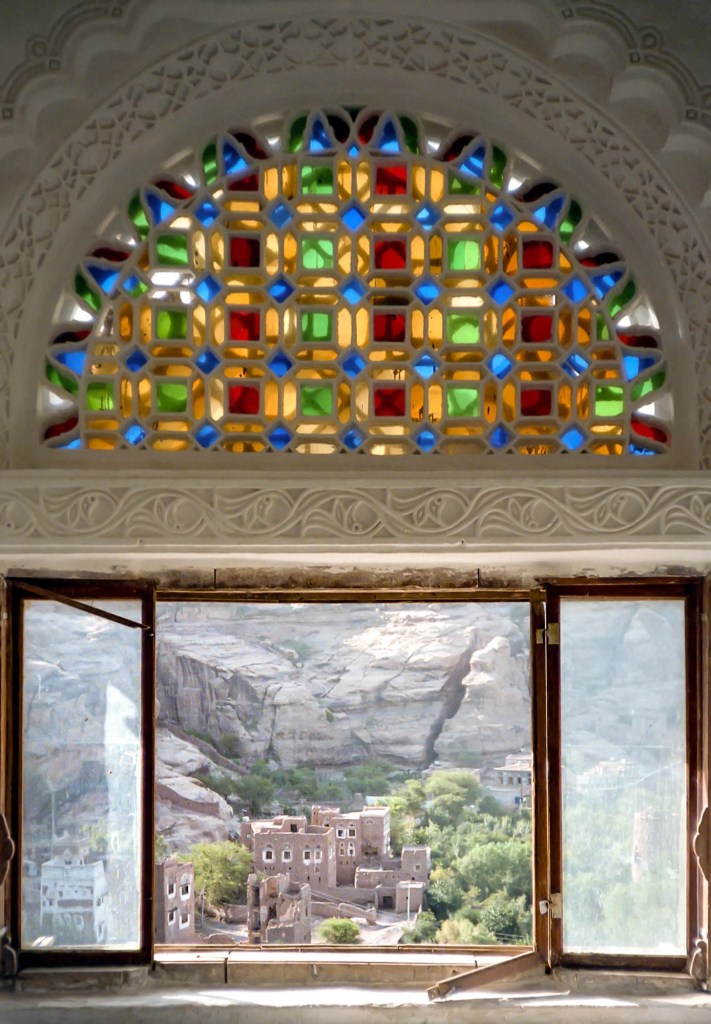
I also shared something that might have sounded a bit silly: an idea to create new work inspired by Yemeni qamariyya (قمرية) the moon windows. Then I discovered a Yemeni artist, Afraa, who is already making them in Egypt. Her beautiful pieces made from plaster and glass. And, I’m genuinely happy that a Yemeni artist is doing this work, but it now feels as though I would simply be repeating what she has already developed.
I still love the idea because it is part of my culture and such a distinctive feature of Yemeni architecture. But at the moment, I don’t feel I have a new angle that differs from Afraa’s. Unfortunately, I have gaps in my identity; much of what I know comes from stories I’ve heard or fragments of childhood memory. This places us in different positions. Afraa’s work feels rooted in presence, while mine often reflects absence something missing, yet shaping the space around it.
Last Friday, I exhibited as part of Ornament–Intent, curated by Emma Rushton at her house in Manchester. The exhibition offered a chance to re-situate my practice within the intimacy of a domestic environment. The curatorial premise, that decoration and political intent flow through the home, aligned closely with my interest in how social and political meaning is transmitted through ordinary gestures, materials and language.
Rushton’s house, transformed into a living exhibition space, blurred the boundaries between art and life. The space carried traces of daily existence, forming a backdrop that resisted the neutrality of the white cube. Within this context, my ceramic works and participatory writing installation became part of an evolving conversation about the home as both refuge and political site.
On a handmade ceramic plate inscribed Sykes–Picot 1916, I presented a red velvet cake. The act of division mirrored the historical partition of the Middle East under the Sykes–Picot Agreement. I used the domestic ritual of cake-cutting, usually symbolic of celebration, generosity and communion, to expose its opposite: consumption, greed and geopolitical appetite.
This gesture was performative in the sense Joseph Beuys might describe as Soziale Plastik (social sculpture), where symbolic action and participation become material. The knife, crumbs and creamy surface formed an ephemeral installation that questioned how colonial histories persist within gestures of hospitality and everyday pleasure.
A second ceramic work consisted of 11 handmade spoons arranged in a circular formation across a white table. Each spoon was inscribed with the name of a country and a range of dates, including Gaza, Bosnia, Yemen, Cambodia, Congo, India, Ireland .. etc marking periods of famine, war and conflict. Together, they formed a kind of geopolitical clock, a cycle of recurring histories and unresolved wounds.
Unlike traditional cartography, this piece used domestic utensils, tools of nourishment and care, to map famines/conflicts. The spoons stood in for mouths, stories and silenced voices, suggesting that global politics is not abstract but deeply entangled with the rhythms of everyday life.
In the setting of Ornament–Intent, this work transformed the dining table into a site of memory. It invited viewers to confront histories of violence not through spectacle but through quiet familiarity. The domestic language of tableware became an entry point into questions of accountability and empathy. The work reflects my ongoing interest in social sculpture as an aesthetic of recontextualisation, where meaning is generated through the repositioning of ordinary materials within spaces of shared attention and care.
Another ceramic piece juxtaposed a sugar bowl labelled Third World with a spoon marked First World. Sugar, a substance historically tied to trade, slavery and colonial wealth, became a material metaphor for extraction and imbalance.
Placed in a domestic setting, the object drew attention to how structural inequalities are embedded in ordinary life. A simple act such as stirring sugar into tea carries invisible histories of power. In this sense, the work functioned as a micro-political sculpture, where meaning emerges not through spectacle but through subtle provocation within the familiar.
A handwritten note, in Arabic and English, listed key dates in Sudan’s history of famine and conflict: 1984, 1993, 2017, 2024, followed by the line (And Sudan’s issues remain words on paper…) with a ceramic spoon read (Money eats first)
Here, I explored the limits of communication and documentation, and how political struggle often becomes archived as text, detached from lived experience. The translation between languages paralleled the translation between activism and representation, between the urgency of lived crisis and the inertia of global indifference. The work questioned the gap between empathy and action, a recurring concern in my social sculpture practice. What is the role of the artist when language itself becomes complicit in the act of forgetting?
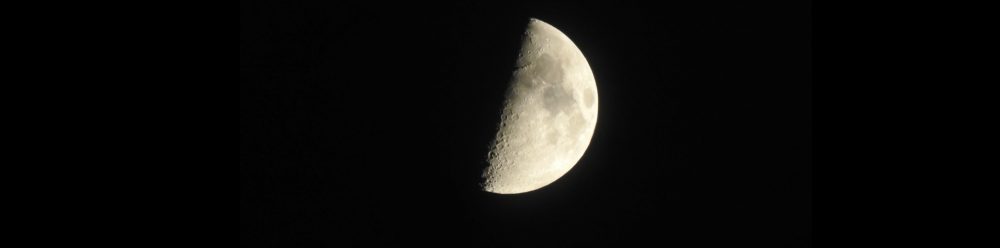
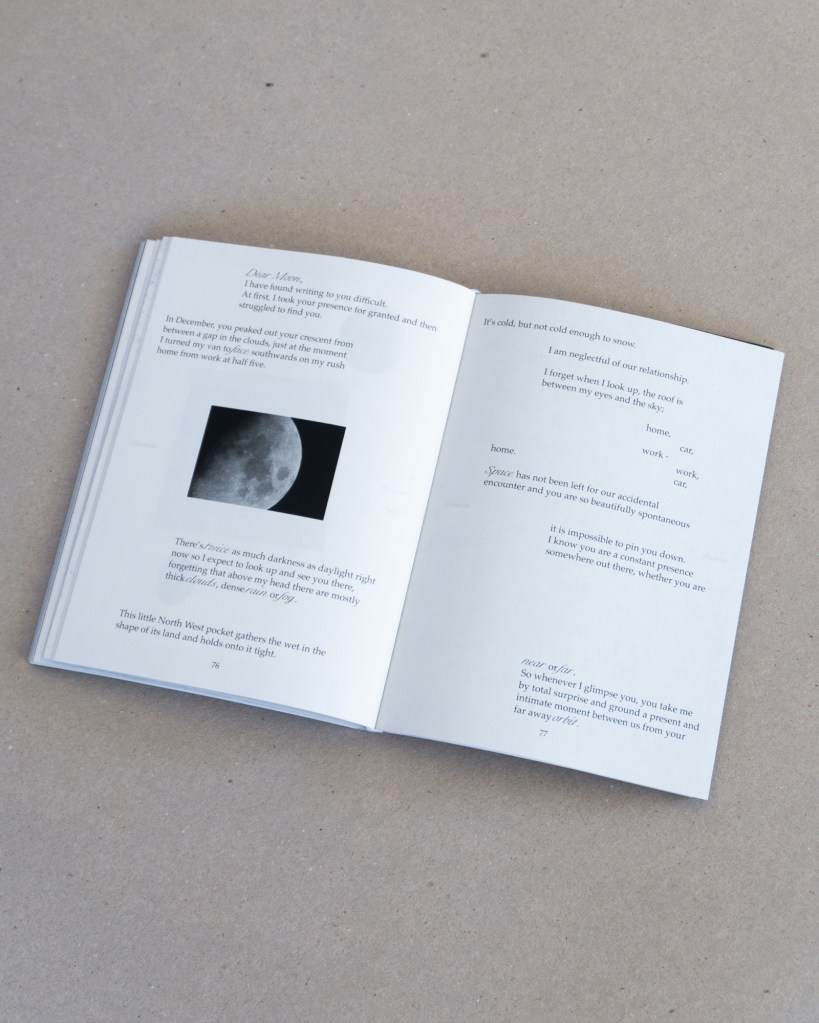
In another part of the house, I presented Dear Moon, a participatory installation inviting visitors to write letters to the moon. A small writing table, paper, envelopes and a black letterbox created a space for reflection and dialogue.
This piece extended my ongoing investigation into correspondence and indirect communication, letters that may never reach their destination yet carry emotional truth. The moon, as an unreachable listener, became a symbol of distance, empathy and collective longing.
Here, the act of writing functioned as a social sculpture, a participatory moment that transformed private thought into shared experience. It also reasserted my belief that art can hold silence as much as speech, offering space for what cannot be articulated in political discourse.
Ornament–Intent revealed how the domestic realm, often coded as private or decorative, is inherently political. Within Emma Rushton’s home, art entered the space of the everyday, resisting the hierarchies that separate aesthetic experience from lived reality.
My contribution sought to hold this tension between care and critique, ornament and intent, intimacy and history. Each ceramic object or written phrase acted as a small social gesture, reanimating the conversation between form, politics and communication.
On Monday, I joined the open 1–1 tutorial with Jonathan. I really needed that conversation, my thoughts were fighting inside my head, and sometimes talking is the best way to organise them.
We discussed many different things. Jonathan has a great way of asking the kind of questions I should be asking myself. I feel that if I had one good question every day, I’d probably write on my blog much more often.
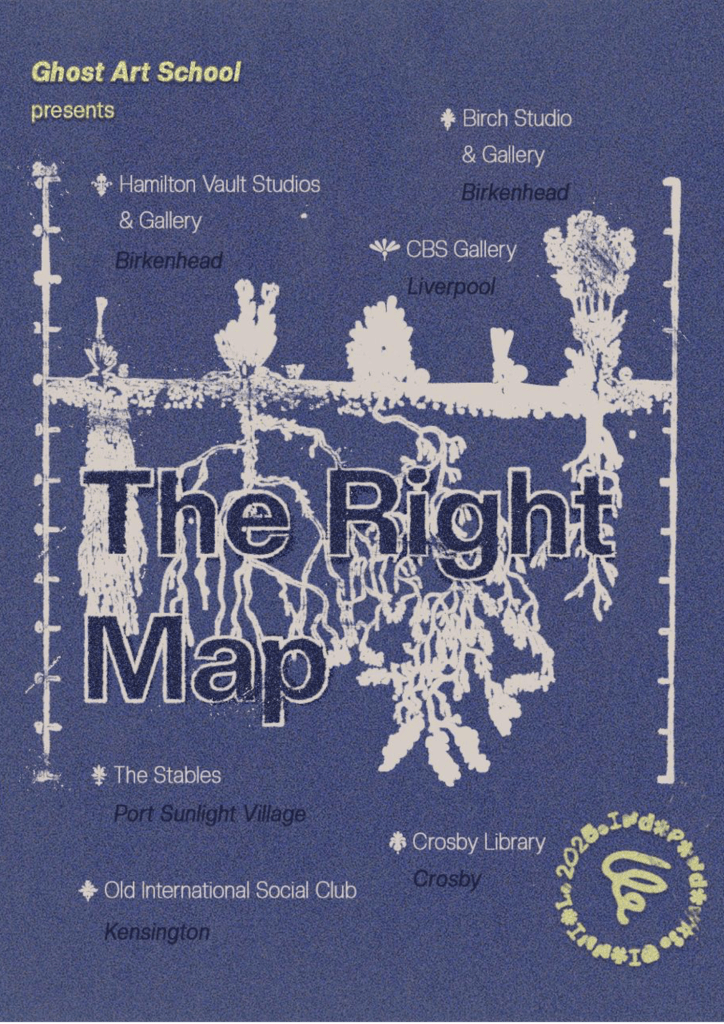
We talked about The Right Map exhibition series and my experiences, how much I learned from working with different people, and how I feel about working with different groups: one more formal and structured, and the other relaxed and informal. Although I’m an organised person who likes to plan ahead, I found that I have the ability to be adaptable and ready to work in fast-paced situations, finding solutions in the moment. It was a challenge, but it also increased my confidence.
I know people have different styles of thinking and working, and as long as we trust each other’s intentions and skills, things go smoothly. We can fill each other’s gaps, and I was definitely learning so much from our team.
For me, the goal of The Right Map was to create a free and welcoming space where everyone could learn and grow together. That’s what makes a social sculpture, and that’s the goal of making this kind of art.
We also talked about the CBS show Sculpture (see my previous post), which reminded me that I should share the short text I wrote for it, along with the 50-word bio I submitted, and the one I received written by artist Cos Ahmet, which my sculpture responded to.
Here are the two secret bios:
Cos Ahmet:
Tropes corporeal fragmented, human, other. Limbs without a host, the skin of things physical, digital. Choreographic. The material’s immaterial states between liminal space on the threshold of self, other. Dust.
Me:
A child took up her pen, signing walls with her name. We’ll play socially… I’ll sculpt the riddle. Language won’t matter; wisdom gathered on page 104–105. Forgive the broken clock!
Another part of our discussion was about Social Publishing, a lecture by Allegra Baggio Corradi that I listened to after the printing meeting with Alex Schady. Jonathan had attended that session too, so it was wonderful to exchange thoughts and notes with someone who was there. We both agreed how inspiring it was. I realised how much it connected with my ongoing project Writing Letters to the Moon.
Learning about Social Publishing, even just understanding its definition, helped me see what I’ve been doing from a new perspective. I’ve always thought of my book as a sculpture, its process far removed from traditional publishing. I don’t see myself as an author but as an artist, still figuring out what that means!!
These days it’s hard not to wonder are artists becoming celebrities, activists, or something in between? Genuine voices, attention-seekers or good actors? There’s definitely more to write about this.. I feel like I’ve gathered so much new information, yet the more I learn, the more I realise how far I am from finding the right answers.. And the higher I try to rise, the lighter I have to become, learning to let go of things and sometimes people along the way..
Earlier this month, a group of us, friends/artists gathered at Birch Studios & Gallery in Wirral, for a one-night experiment we called Crash Test. Half exhibition, half crit, half scratch night. Crash Test was a place to try things out, to test-drive new work and unfinished thoughts in a space where feedback was as valued as the visuals.
The idea was simple: set up something raw, something you’re unsure about, and invite others to respond. The name Crash Test seemed fitting, not just for its visual punch, but because it captured the risk, the speed, and the impact of trying something unpolished in public.
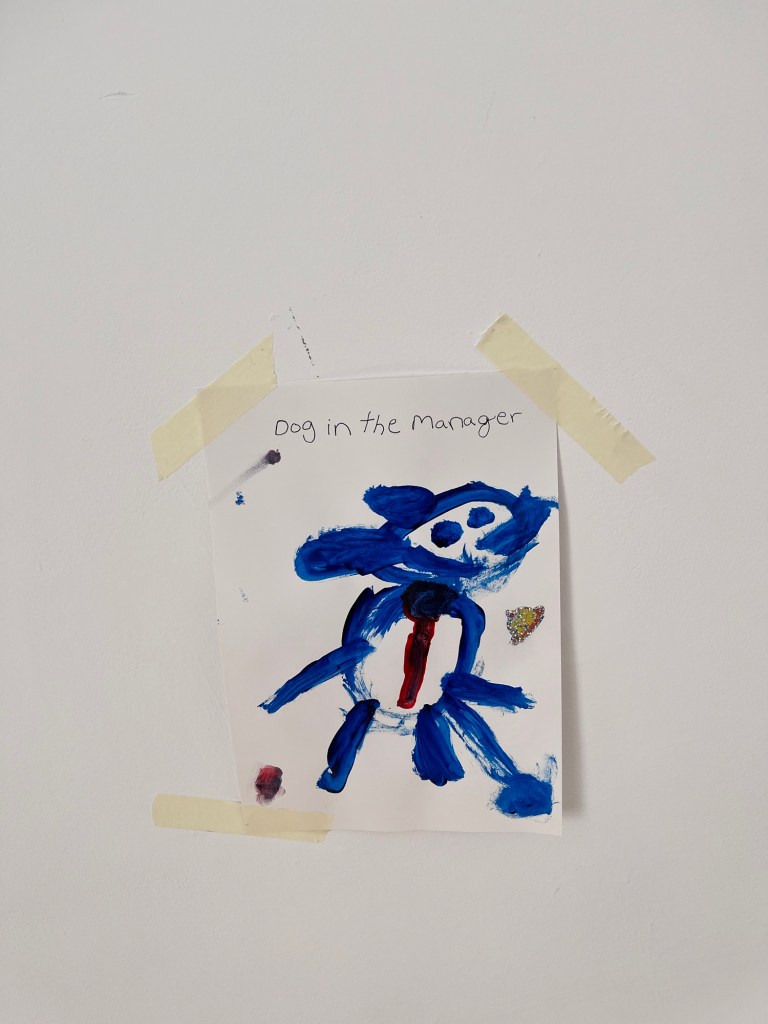
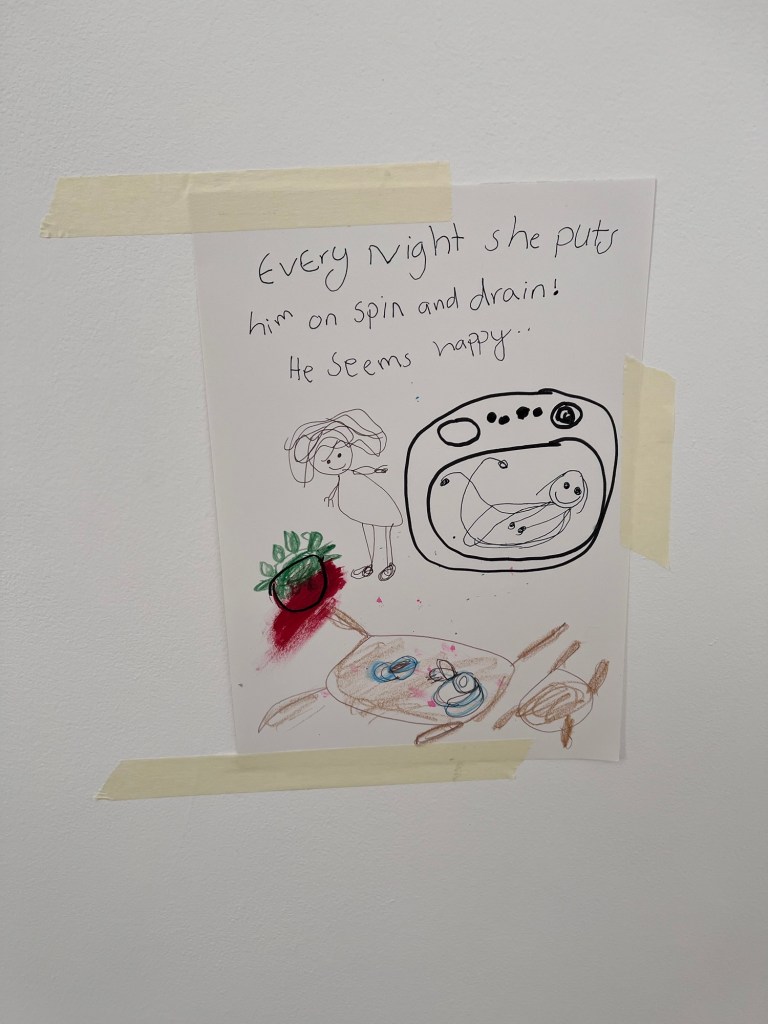
I brought along some child-like drawings, experimenting with simplicity, ambiguity, and humour. The feedback I received was encouraging, people connected with the looseness, the absurdity, and the layered messages behind the bright colours and crayon lines.
That said, for the upcoming Show ‘Unstable’ as part of the Independents Biennial, I want to develop something more dynamic and expansive, something less stable and more open-ended. I’m thinking of revisiting the Moon Litters idea. There’s something about the unpredictability of that work, the way it can shift and change over the exhibition’s duration that feels right for where I’m at now. It allows space for other voices, movements, and moments to enter.
Coordinating The Right Map for the Ghost Art School artists was intended as an act of support for others. But in the process, I found myself unexpectedly charting new ground in my own practice. What began as a curatorial and facilitative role gradually unfolded into a deep personal enquiry, one that significantly shaped my ongoing research in social sculpture.
I began to notice shifts in my own thinking. Supporting artists to articulate their intentions, reflect on their choices, and ground their practice compelled me to ask the same of myself. It was not a passive role; it was active, dynamic, and generative.
Interestingly, throughout The Right Map, I found myself increasingly drawn to the curatorial aspects of my work more than the making itself. It’s not just about presenting artworks, it’s about orchestrating experiences, holding conversations, shaping encounters. I became fascinated with how frameworks are built, how meaning is constructed around and through art. In many ways, the coordination itself became a form of social sculpture.
This shift is not about stepping away from being an artist…it’s about understanding the expanded field in which I operate. Curation, facilitation, research, and community-building have become a core tool kit in my practice. Through coordinating The Right Map, I gained new confidence in embracing this hybridity. I no longer see it as fragmented, but rather as a cohesive and intentional mode of working that reflects my values and voice.
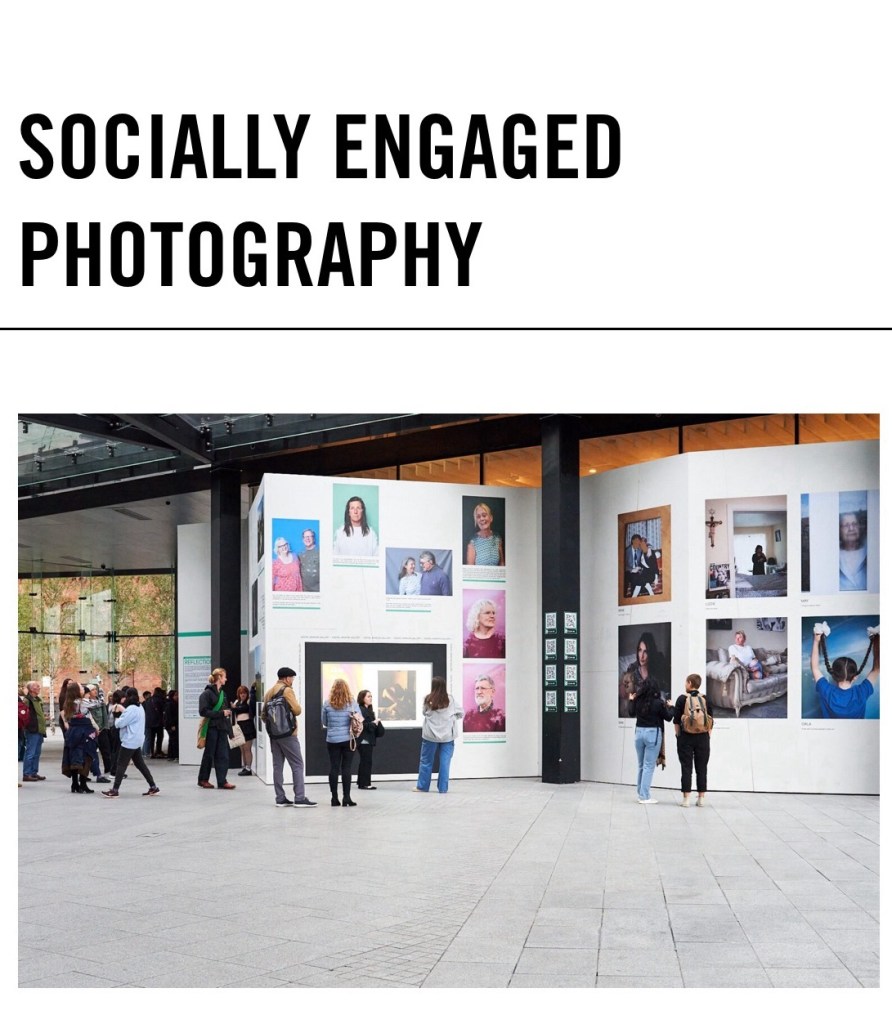
19 artists from across the country and beyond, working across different disciplines, were selected for Open Eye Gallery’s Socially Engaged Photography programme. The session began gently with an icebreaker to help us introduce ourselves and connect, opening into a space full of layered questions and open dialogue.
One phrase stayed with me: “Becoming an audience to your own work.” It’s the idea that the artist creates a framework for others to shape, leading to outcomes unknown even to them. This made me reflect on Dear Moon, a book project I designed. By the end, I felt less like its author and more like its audience. The photographs simply held space—the real substance came from the contributors’ words. Their voices carried the project forward.
In breakout groups, we explored definitions of socially engaged practice. From using art as a collaborative tool for justice (Sholette & Bass) to fostering shared understanding and personal growth (Matarasso), the emphasis was clear: this work is about people, not product. It’s about ethics, active listening, and creating conditions for transformation.
I feel genuinely grateful to have been selected for this course and to be mentored by Elizabeth Wewiora. I look forward to continuing the journey and exploring how it might help shape my research around social sculpture.
Since October, I’ve been immersed in the making of Dear Moon. What began as a simple idea grew into something layered and full of meaning. Over these months, I’ve learnt so much, not just about putting together a book, but about myself. The skills I’ve had to call on managing, organising, communicating, publishing, sharing all came with challenges. I had to practise patience.. I had to listen. And more than anything, I had to trust the process!
There were many moments when I didn’t know exactly where it was heading, but I allowed myself to follow the rhythm of the work, and something beautiful came through. I’m especially grateful that the work is expanding being read, being held and I’ve been watching it with a sort of quiet pride.
Still, I have to be honest. Sharing Dear Moon in public spaces hasn’t felt completely right. I tried presenting it in a vibrant setting, but I could feel the book asking for something else, something slower, more still. It asks the reader to sit, pause, and take time. And that’s hard to find in environments filled with movement.
So, although I didn’t quite succeed in the way I had imagined, I don’t see it as failure. Instead, I see it as another learning. The challenge now is to explore different ways a book like this can live in public space. How do I present it in a way that honours its pace and stillness? How can I guide people toward it gently, instead of expecting it to compete for attention?
I’m still learning, and I’m open. I’m proud of Dear Moon, and I know it will keep finding its way as long as I keep listening.
Working on Dear Moon has been one of the most personal and expansive projects I’ve ever taken on. While the words came slowly, shaped by honesty and quiet reflection, the visual form of the book took a different kind of journey, one that became stronger and more meaningful through collaboration.
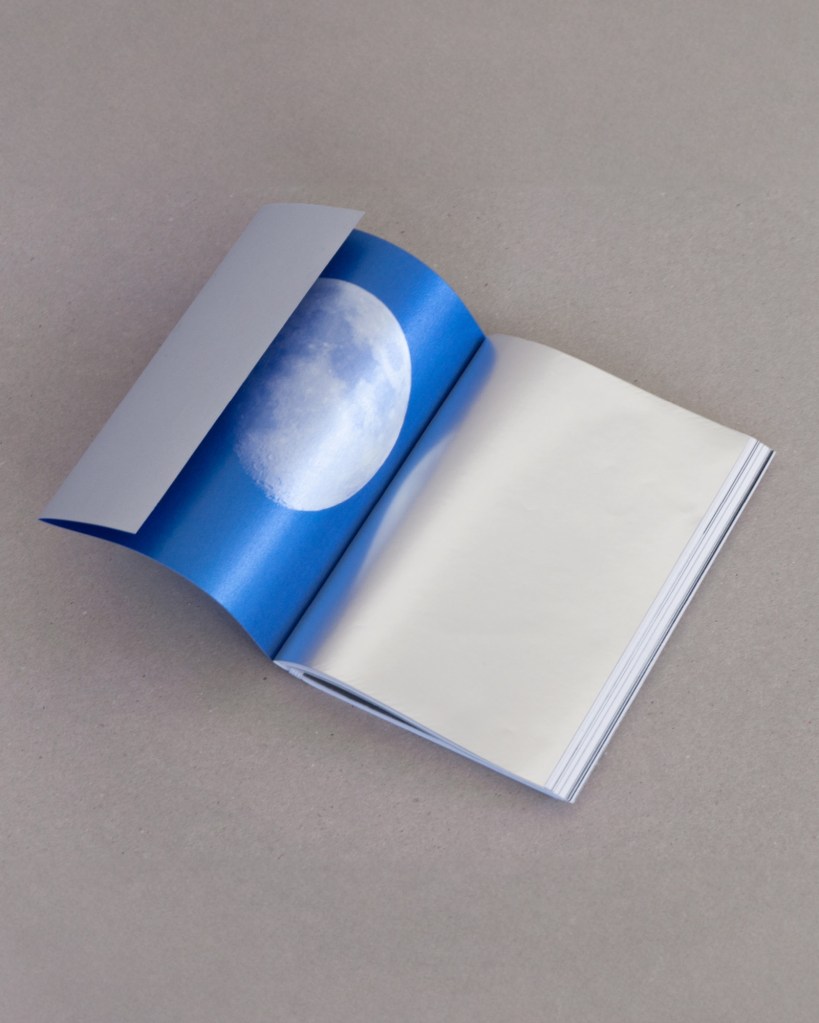
I had the pleasure of working with Jiayi and GG, two recent MA Graphic Design graduates from the university. They took on the challenge of designing Dear Moon and brought their own vision to it. Where I had initially imagined something simple, quiet, and almost invisible in its design letting the words do all the work they brought something else entirely: depth, elegance, and boldness in aesthetic.
Their design sensibility was so different from mine. I approached the book with simplicity, wanting to preserve the gentle rhythm of the letters and photographs without interruption. I didn’t want the visuals to overpower the messages within. But what Jiayi and GG brought was not overpowering it was enhancing. They introduced a poetic visual language: deep blues, moonscapes that speak for themselves, layout choices that echo the movement of tides and emotion. They weren’t just decorating; they were interpreting.
Looking at the final book now, I see a true collaboration. It’s no longer just a collection of letters; it’s a designed experience. A conversation between stillness and form.
Collaborating in this way has taught me the value of letting go. Of sharing creative control. Of trusting others to hold your work with care and transform it with love and intention. I feel Dear Moon is stronger because of this process, and I’m grateful to Jiayi and GG for reminding me how powerful cross-disciplinary work can be.






 Karema