We recently started a new group in my programme called International Shared Reading, with the support of The Reader. Instead of taking the training myself, I recommended two women from my group an assistant from Afghanistan and a volunteer from Portugal to take the paid training and co-lead the sessions alongside my co-producer, while I support them where needed. I believe that our strength comes from building a strong team rather than individual effort.
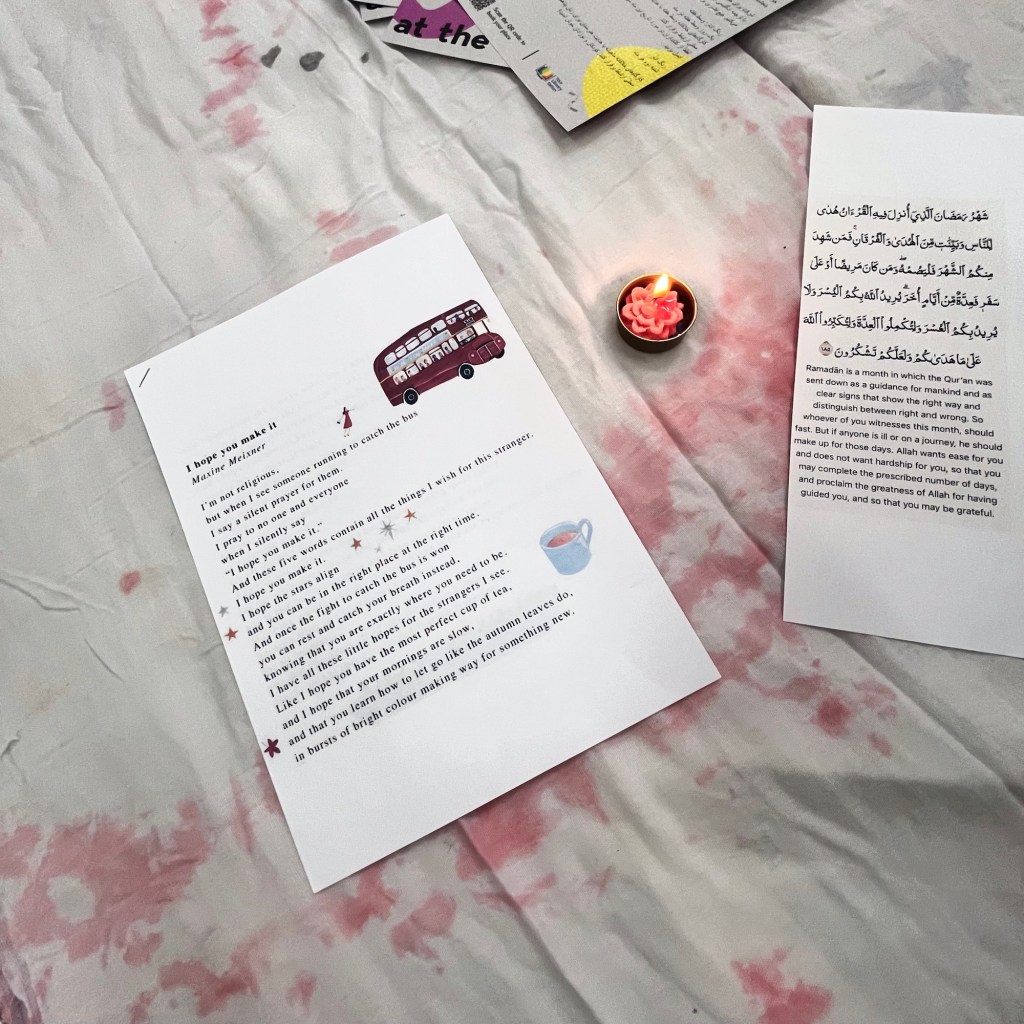
As part of the preparations for our upcoming Iftar gathering, I led a special reading session. It created a space to ask questions and learn more about Ramadan. We read a poem together, spoke about prayer, and people asked many questions about fasting and other related topics. Questions are welcome, they help clarify misunderstandings. When I went home that evening, I kept thinking about our conversation. Later, a volunteer sent a beautiful message in our group chat thanking me for the session.
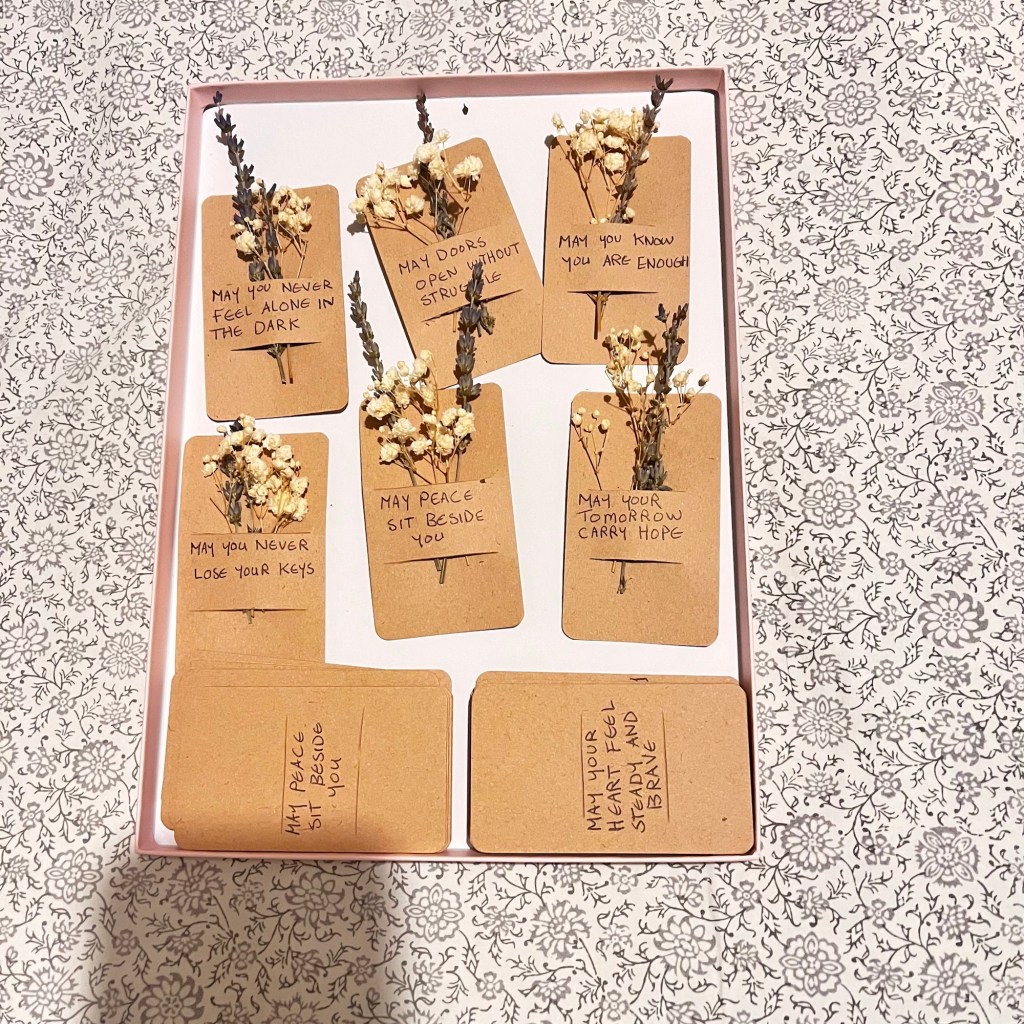
The next day I decided to create small blessing or affirmation cards for our guests, inspired by the poem we read together. I Hope You Make It, a poem by Maxine Meixner, is written in a simple and beautiful way. The words can reach people without challenging them with difficult language. I spent the day writing my simple prayers and preparing the cards so I could finish them at the library the next day.
The cards are simple and decorated with flowers. I chose lavender because it has a gentle, calming scent. In a way, the cards became a small social sculpture, something guests could take with them, carrying the memory of the Iftar after they leave.
Wanderer (2009) by Rory Macbeth is an English translation of Kafka’s The Metamorphosis, produced without knowledge of the German language. To understand the context of this post, it’s helpful to read the previous one.
German capitalises all nouns. When Kafka writes “den Augen” “the eyes”, Macbeth’s translation becomes “towards Augen”, as if Augen were a geographical location. This is not a mistranslation in the traditional sense; rather, it is a relocation of meaning. The work does not simply translate German into English. Instead, it appears to misread or mishear it, treating certain German nouns as destinations and following sound rather than semantic fidelity. In doing so, it produces something that feels both derivative and entirely new.
This method continues throughout. Kafka’s “sein Zimmer, ein richtiges”, translated into English as “his room, a proper human room”, becomes in Macbeth’s version “since summer, the rich man”, an apparent phonetic drift. At several points, Gregor’s sister’s name, Grete, is also translated as “great”. For example, Kafka’s “Komm, Grete” appears in Macbeth’s version as “Commandant! Great!” while the standard English translation reads “Grete, come”. These shifts suggest that Macbeth is not translating through grammar but by ear, treating German as sound material to be sculpted into English.
As the text progresses, one can sense a shift from guessing through sound to asserting narrative intention. At first, the work reads like a linguistic experiment, a kind of phonetic dérive. Gradually, however, something changes. The more one reads, the more an independent narrative begins to solidify; it begins to feel like the writer claiming territory. Wanderer begins to detach itself from The Metamorphosis. Betty starts to echo, but not duplicate, Grete. Threads remain visible, yet they no longer bind the text to its origin. By the end of the story, the authorial voice becomes unmistakable, and Wanderer tests how far transformation can go before it becomes authorship. Macbeth’s restrained conclusion expands into something vast, and the writer steps forward!
This raises the question of where translation ends and authorship begins. In Translation by Sophie J. Williamson (p. 43), a selected passage from Walter Benjamin’s essay The Task of the Translator states that “a translation issues from the original — not so much from its life as from its afterlife”. Benjamin’s idea of translation as a text’s afterlife helps illuminate what is at stake here, yet Macbeth also seems to exceed this model. Benjamin suggests that translation renews the original by revealing the hidden kinship between languages, allowing the text to unfold further in time. Translation, for him, is not reproduction but continuation, a stage in the original’s ongoing life.
This post introduces the next, which will focus on Wanderer (2009) by Rory Macbeth, an English translation of The Metamorphosis produced without knowledge of the German language. Instead of translating through grammar or meaning, Macbeth works by visually and phonetically interpreting the German text and reconstructing it into English. The result is a work that exists somewhere between translation and authorship.
It’s important to briefly touch on The Metamorphosis (1915) by Franz Kafka before writing about Wanderer, and I’ll also use this opportunity to mention The Overcoat (1842) by Nikolai Gogol. I referred to Gogol’s story in our session when we discussed avoiding direct expressions of trauma during Zoe’s presentation. For me, Kafka and Gogol employ absurdity and a kind of quiet defeatism as narrative strategies through which trauma is expressed indirectly.
The Metamorphosis is a small text, yet incredibly heavy in its existential weight. The narrative begins with an unexplained event, Gregor Samsa’s transformation into a giant insect, presented without cause or preamble. Instead of questioning the transformation itself, the narrative quickly shifts to the practical consequences of his condition. His family who once depended entirely on his income, gradually begin to see him less as a son or brother and more as a burden. One gradually senses that the true transformation is not merely physical but human and moral. The story is existential in its questioning, absurd in its world, surreal in its structure, and deeply social in its critique…
Akaky Akakievich, the protagonist of The Overcoat, lives a lonely, repetitive life and struggles to make even minor changes. It takes him a long time to save enough money to buy a new coat, but when he finally does, the simple act of wearing something new gives him confidence and a glimpse of happiness. This joy is short lived… The coat is stolen on his way home! He desperately tries to retrieve it, fails, falls ill, and dies shortly afterwards. In the end, his ghost wanders the city stealing coats from others. The story oscillates between the real and the surreal, it’s sad, absurd, brief, yet emotionally expansive. It’s often seen as an early example of the absurd bureaucratic protagonist and is believed to have influenced many writers. For me, it’s enough to recall Dostoevsky’s saying “We all came out from Gogol’s The Overcoat”.
The Overcoat and The Metamorphosis are both essential reading for lovers of short fiction. They present deliberately ordinary protagonists, characters who almost disappear rather than dominate the plot, humans positioned at a humble level far removed from heroic or supernatural figures. These are stories that sometimes make you want to step inside the page and shake the character awake. In Gogol’s story, the narrator also seems strangely unconcerned with certain details or histories of events. A similar feeling emerges in Kafka.. What happened to Gregor Samsa is, in some sense, not important. Although he lives believing he is essential to his family, they ultimately continue without him, and his perceived importance dissolves.
This becomes significant for me when thinking about Wanderer. I sense something familiar here, perhaps one leading to the other, at least in my perception. Just as the lives of Akaky and Gregor seem strangely insignificant within their own stories, the linguistic accuracy of the text also becomes strangely insignificant in Macbeth’s work. Regardless of the original context or linguistic accuracy, the act of translation itself becomes conceptually aligned with the story. This also resonates with my own interest in communication and miscommunication as a form of social sculpture, where meaning is shaped collectively rather than fixed.. It raises questions about what is essential and what is not. What carries meaning? What survives translation? What do we choose to care about, and who decides this?
I took some time to reflect on this tutorial because I was so busy. I also needed to read more carefully, as these kinds of tutorials do not end when they finish; they tend to open further questions and lead me into deeper reading.
In this tutorial I had with Jonathan, we spoke about learning and what learning really means. We reflected on the assimilation and accommodation post, and on the idea that learning is not for display but for use. It should transform how you live. It needs to be functional, active, and embodied.
We also discussed translation and whether my practice is, in itself, a process of translation. I have been thinking that everything I do is a form of translation. There is a language I carry, a language of thoughts and ideas, constructed from the data my brain collects. This data is my lived experience: encounters with people, spaces, and time. Yet data alone is not enough, it must be translated into meaning, and meaning must then be translated into thought and action.
I can’t think about this without turning to Merleau-Ponty’s phenomenology. What interests me most is his insistence that perception is not a detached mental operation but something embodied, something that happens through our being in the world. Our understanding is not separate from our living, it’s shaped through the body’s continuous engagement with its environment.
Language itself offers a powerful example of this phenomenology. Language is collaborative, it’s formed through shared experiences within a community, shaped by surroundings and histories. Using Arabic as an example, because it’s my mother tongue, Arabic is built on a root and pattern system. Most Arabic words derive from a root of three consonants (rarely four). This structure allows the language to remain generative: new words can emerge as long as they remain faithful to the semantic core of the root.
Here are two examples one scientific and one poetic, the word حاسوب (computer) and حاسبة (calculator) both derive from the root ح س ب, meaning “to calculate”, similar to how “computer” and “calculator” trace back to Latin roots. Second one is حب (love), from the root ح ب ب, associated with seeds. Although I have not encountered this interpretation formally in literature, I’m drawn to the poetic possibility that “I love you” could be understood as “I carry/have a seed for you” a seed that has the potential to grow… For me, this aligns with the lived experience of love not as a finished/ready object, but as something cultivated and sustained. Here the language demonstrates embodied perception. Meaning does not emerge abstractly; it grows from how the body, historically and culturally, encounters the world.
Colour offers another compelling example. We identify colours based on how our brains interpret light wavelengths. Yet colour is not an intrinsic property of objects. A green card is not “green” in itself, it absorbs most wavelengths and reflects the one we perceive as green. What we call colour is the result of an interaction between light, object, and perceiver. From a phenomenological perspective, colour is relational. It exists in the encounter. Different animals perceive different spectra, therefore, the world of colour shifts depending on the perceiving body. In this sense, colour is not a fixed external fact but an event that occurs within perception.
This becomes even more complex when considering visual impairment… A relative has Stargardt disease, and many people assume that eye disease results in darkness or emptiness. But in his case the brain uses surrounding visual information (often background colour) to fill in gaps where central vision is weakened. This is not simply a defect, it’s evidence of the brain’s active participation in constructing perception. Perception is not produced by the eyes alone; it’s a whole body phenomenon. The body is not a passive receiver of data; it’s an intelligent, adaptive system constantly negotiating meaning. What my relative experiences demonstrates that perception is collaborative between eye, brain, memory, environment, and prior experience.
This also raises further questions for me: how does the brain decide which colour to use to fill a gap? Why that tone rather than another? These questions do not weaken the phenomenological argument; rather, they reveal how perception is both structured and creative. The body does not merely record reality, it actively composes it. There is undeniably a relational dynamic shaping human perception. At the same time, there is an astonishing intelligence within the body itself a continuous, largely unconscious orchestration. The heart beats, the lungs breathe, cells regenerate, all without instruction from conscious thought… In recognising this, I feel both philosophical and spiritual awe, and all I can say is: glory to the One who created this body.
Finally, I return to learning. Learning is about becoming informed and being able to decode what was previously inaccessible. Ideally, learning should help solve a problem, generate new questions, or bring you closer to an answer. Yet the information we receive is always filtered through perception, our minds process what they are capable of processing and what feels significant within our lived experience.
Last Sunday, I spent a rewarding day with Ghost Art School and creatives from October Salon (a new collective in Preston led byHannah Browne). My aim was to organise a free workshops day, focused on sharing knowledge and skills without the need for materials or money. I offered an introductory session in British Sign Language (BSL), while Liverpool-based artists Tom Kelly and Tom Doubtfire generously shared aspects of their practices. Hannah provided the space in Preston, making the event possible through collaboration rather than institutional support.
The day had several clear intentions. Firstly, I wanted to gather with peers and begin the year in a meaningful, collaborative way, learning together and exchanging knowledge. Secondly, the event allowed us to engage with October Salon, an emerging creative group, and to demonstrate what can happen through collective artistic practice.
The programme began with Tom Doubtfire leading a discussion on the role of the artist and the relationship between art and activism. His reflections centred on disturbance, sustainability, sacrifice, and focus. The group discussed what it means for art to be disturbing, what sustainable practice might look like, how much we are willing to sacrifice and the importance of setting limits, also how to remain focused on our aims.
This was followed by my one-hour introduction to BSL. My motivation for teaching BSL stems from both personal conviction and historical awareness. The language was banned in the United Kingdom between 1880 and 1970, and despite its cultural and social importance, it still receives limited funding in education. BSL was officially recognised as a language in 2003 and granted legal status in 2022, yet it is still not included in the GCSE curriculum. In this context, teaching BSL freely can be understood as a quiet form of activism! Challenging ableism, questioning unequal access to culture, and sharing knowledge rather than gatekeeping it.
BSL is also highly visual and expressive, connecting strongly with creative disciplines. It can influence performance, filmmaking, choreography, and storytelling, functioning not only as a language but also as an artistic medium. More broadly, offering knowledge without payment can be seen as a response to the increasing commercialisation of the arts. It reminds us that generosity and collective growth still hold value.
The day concluded with a workshop led by Tom Kelly, which provided a joyful ending. His approach to clowning demonstrated that it’s not simply about being silly, but about exploring human emotions through humour and vulnerability. Through simple games and spontaneous interaction, the group communicated naturally, without preparation. There was a strong sense of care, kindness, and mutual respect among participants.
The structure of the day loosely echoed Joseph Beuys’ idea of the Free International University, an artist-led model of education independent from institutions and grounded in dialogue and shared learning. By offering knowledge freely and prioritising exchange over production, the gathering became less about outcomes and more about shaping a temporary community through participation.
For me, the impact of this day was more meaningful than any individual artwork I’ve made recently. It highlighted the importance of shared time, laughter, and informal learning within creative communities. It felt like an encouraging and significant beginning for the group, grounded in connection rather than productivity alone
After reading Translation, I found myself asking what I would add if I were given the chance to contribute more pages to the book. Three came to mind: Omar Bahabri the translator, Arnaud Balard’s Deaf Flag, Adriano Celentano’s Prisencolinensinainciusol, and Wanderer by Rory Macbeth particularly after What Is a Minor Literature?//1986 by Deleuze and Guattari page.
The first story is a Yemeni tale set during the period of British occupation in southern Yemen. Omar Bahabri was a Yemeni tea merchant who spoke English through his work with foreign traders. At a time when the British struggled to communicate with the local population due to the lack of Arabic translators, Omar was called upon to help. The British asked him to translate pamphlets intended to win the trust and loyalty of the Yemeni people. Omar translated their demands into Arabic, and pamphlets were printed and distributed by aircraft across the country.
Some time later, a British general visited Aden to inspect the situation. He was familiar with Arabic, so he picked up a handful of the pamphlets and read them. He asked the officer in charge about their purpose and was told they were meant to encourage public support for British rule. The officer explained that the pamphlets called on people to join the Allies and support them. The general replied that the pamphlets read “Buy the finest tea from Omar Bahabri” . And here only reference I found in English: https://www.jstor.org/stable/48752006
Whether the story is true or not is hardly important here. What matters is how brilliantly it portrays the fate of outsiders who believe they can exploit local language and people for their own ends, only to find those intentions quietly undermined in favour of distinctly Yemeni interests. It also led me to reflect on the fact that the British occupied Aden for 128 years, from 1839 to 1967, yet hardly any of them learned Arabic. From this, it becomes easier to understand why the French aggressively imposed their language in colonised territories, and how English was forced upon Indigenous populations in North America, Australia, and New Zealand. This reinforces my belief that language is essential to the survival of culture and heritage.
Thinking about this story alongside Translation, I realised that what draws me in is not accuracy, but refusal. Translation here is not a neutral act. It becomes a space of misalignment, humour, survival, and agency. Language appears to serve power, while quietly redirecting it elsewhere.
So yes, I already know what my next ceramic piece will be.. A tea set! A familiar site of hospitality, negotiation, and politeness. Cups that sit between people, holding conversation, holding silence or things that are never quite said…
What can I say… this experience has reminded me why I love working collectively and why it is so important not to rely on a single resource or only on self-knowledge.
Giving feedback as a group is such a powerful idea and such a beautiful way to enrich one another’s reflection on our practice. I genuinely loved sharing my thoughts with each of my peers and reading theirs in return. The work is amazing, it expresses human experience in such diverse ways, full of richness, honesty and genuine emotion. I felt truly honoured to be among them and lucky to witness their progress over time.
It was emotional to reflect on how we are growing together, holding each other’s hands virtually on this journey with such care and generosity. It reminded me of Jonathan’s first session in October 2024, when he spoke about kindness and compassion and how these could become the strength of our collective and our cohort. Throughout the course, he has guided us with constant care and kindness, so it is no surprise that he created this opportunity: for each of us to write short feedback for one another on a shared Miro board dedicated to every artist.
My peers’ feedback has genuinely boosted my confidence and trust in my practice. Of course, there are always things missing, intentionally or not, due to circumstances and the challenges of process. But receiving feedback that recognises your efforts is deeply energising, especially as a socially engaged artist, where the social aspect is the heart of the work.
I will definitely return to this Miro board whenever I need to. It has become a beautiful space, full of thoughts floating in this quiet corner of cyberspace.
When I was reading for my research paper, I kept thinking about the unusual and slightly funny relationship between the German artist Joseph Beuys and the British critic David Sylvester! They were both major figures in modern art, but they never managed to build a close or comfortable connection.
Sylvester saw how important Beuys was. He never denied Beuys’s impact or how strongly he shaped his time, just as Duchamp had done for modern art. Even so, their relationship never became warm or collaborative. Sylvester had deep, ongoing conversations with many artists, but with Beuys he stayed distant, almost cautious.
This shows clearly in his writing. Sylvester never wrote a whole book about Beuys, nor explored him in the focused way he did with others. Beuys appears only here and there, usually as one example inside bigger discussions about conceptual art and post Duchamp ideas. Important, yes, but never at the centre.
The moment that captures their dynamic best is a small story Sylvester shared in About Modern Art, 2002 p.514-15. Beuys came to visit him at his flat in South London, bringing his wife, children and another friend. Before they entered, Sylvester asked him to remove his shoes, which he always asked visitors to do to protect his antique Persian carpets. Beuys refused!! His hat and clothes were part of his artistic identity and he would not take them off.. Sylvester refused too!! So they stood outside on the pavement, stuck between two different kinds of pride.
The more I think about it, the more I wonder what felt most important at that moment. For Sylvester, was it the artwork he lived with the antique rugs he treasured and protected or the chance to welcome an artist who was reshaping the art world? And for Beuys, a well established artist known for his big ideas, what mattered more being treated as a significant cultural figure, someone above everyday rules, or simply being a human guest respecting the home he was entering?!
In that moment, neither chose flexibility… And because of that, the visit never really began!
I find this story surprisingly touching…These were people who changed the direction of art, yet a simple request about shoes created a pause they could not overcome. Their relationship was always a mix of respect, misunderstanding, admiration and a bit of irritation.
They never became close, but their awkward meetings reveal something real about personality, ego and the small rituals of daily life. Maybe that is why I keep returning to this story. It shows how the biggest ideas in art can be interrupted by tiny habits and decisions. And sometimes, the most memorable parts of art history are not the grand gestures, but the little ones, like the moment when two strong characters collide at a doorway🙃
I had a tutorial with Jonathan on Monday. As always, it was eye-opening and thoughtful, almost like thinking out loud with someone who asks the questions you don’t necessarily want to confront yourself. We discussed my last two blog posts and reflected on how I feel about my ceramics (as the sugar bowl) which could stand alone in a show, compared with the collective work at the library (as the table-cloth)
Jonathan described the library project as a pure form of social sculpture and I agree with him. I see social sculpture built from “bricks” with each brick made by a volunteer. My ceramics are an interpretation of the world around me, a sculpture that begins with a thought engaged with the world and is then transformed into material. The library work, however, only comes into existence after contributors engage directly with the materials first. That distinction became clearer when I repeated Jonathan’s question to myself..
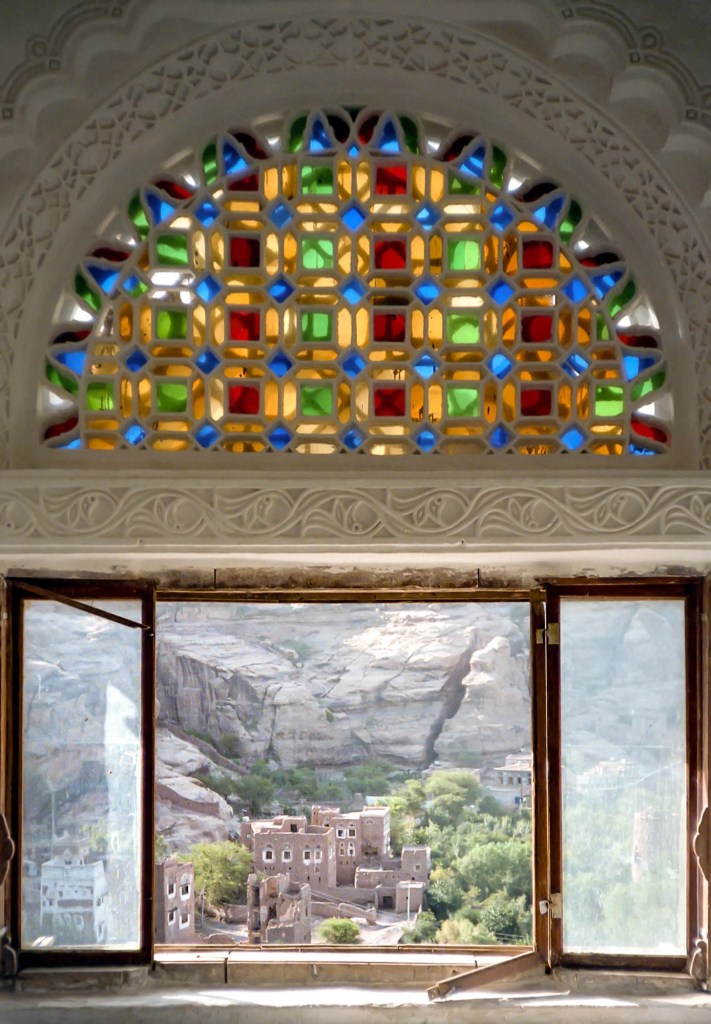
I also shared something that might have sounded a bit silly: an idea to create new work inspired by Yemeni qamariyya (قمرية) the moon windows. Then I discovered a Yemeni artist, Afraa, who is already making them in Egypt. Her beautiful pieces made from plaster and glass. And, I’m genuinely happy that a Yemeni artist is doing this work, but it now feels as though I would simply be repeating what she has already developed.
I still love the idea because it is part of my culture and such a distinctive feature of Yemeni architecture. But at the moment, I don’t feel I have a new angle that differs from Afraa’s. Unfortunately, I have gaps in my identity; much of what I know comes from stories I’ve heard or fragments of childhood memory. This places us in different positions. Afraa’s work feels rooted in presence, while mine often reflects absence something missing, yet shaping the space around it.
Last Friday, I exhibited as part of Ornament–Intent, curated by Emma Rushton at her house in Manchester. The exhibition offered a chance to re-situate my practice within the intimacy of a domestic environment. The curatorial premise, that decoration and political intent flow through the home, aligned closely with my interest in how social and political meaning is transmitted through ordinary gestures, materials and language.
Rushton’s house, transformed into a living exhibition space, blurred the boundaries between art and life. The space carried traces of daily existence, forming a backdrop that resisted the neutrality of the white cube. Within this context, my ceramic works and participatory writing installation became part of an evolving conversation about the home as both refuge and political site.
On a handmade ceramic plate inscribed Sykes–Picot 1916, I presented a red velvet cake. The act of division mirrored the historical partition of the Middle East under the Sykes–Picot Agreement. I used the domestic ritual of cake-cutting, usually symbolic of celebration, generosity and communion, to expose its opposite: consumption, greed and geopolitical appetite.
This gesture was performative in the sense Joseph Beuys might describe as Soziale Plastik (social sculpture), where symbolic action and participation become material. The knife, crumbs and creamy surface formed an ephemeral installation that questioned how colonial histories persist within gestures of hospitality and everyday pleasure.
A second ceramic work consisted of 11 handmade spoons arranged in a circular formation across a white table. Each spoon was inscribed with the name of a country and a range of dates, including Gaza, Bosnia, Yemen, Cambodia, Congo, India, Ireland .. etc marking periods of famine, war and conflict. Together, they formed a kind of geopolitical clock, a cycle of recurring histories and unresolved wounds.
Unlike traditional cartography, this piece used domestic utensils, tools of nourishment and care, to map famines/conflicts. The spoons stood in for mouths, stories and silenced voices, suggesting that global politics is not abstract but deeply entangled with the rhythms of everyday life.
In the setting of Ornament–Intent, this work transformed the dining table into a site of memory. It invited viewers to confront histories of violence not through spectacle but through quiet familiarity. The domestic language of tableware became an entry point into questions of accountability and empathy. The work reflects my ongoing interest in social sculpture as an aesthetic of recontextualisation, where meaning is generated through the repositioning of ordinary materials within spaces of shared attention and care.
Another ceramic piece juxtaposed a sugar bowl labelled Third World with a spoon marked First World. Sugar, a substance historically tied to trade, slavery and colonial wealth, became a material metaphor for extraction and imbalance.
Placed in a domestic setting, the object drew attention to how structural inequalities are embedded in ordinary life. A simple act such as stirring sugar into tea carries invisible histories of power. In this sense, the work functioned as a micro-political sculpture, where meaning emerges not through spectacle but through subtle provocation within the familiar.
A handwritten note, in Arabic and English, listed key dates in Sudan’s history of famine and conflict: 1984, 1993, 2017, 2024, followed by the line (And Sudan’s issues remain words on paper…) with a ceramic spoon read (Money eats first)
Here, I explored the limits of communication and documentation, and how political struggle often becomes archived as text, detached from lived experience. The translation between languages paralleled the translation between activism and representation, between the urgency of lived crisis and the inertia of global indifference. The work questioned the gap between empathy and action, a recurring concern in my social sculpture practice. What is the role of the artist when language itself becomes complicit in the act of forgetting?
In another part of the house, I presented Dear Moon, a participatory installation inviting visitors to write letters to the moon. A small writing table, paper, envelopes and a black letterbox created a space for reflection and dialogue.
This piece extended my ongoing investigation into correspondence and indirect communication, letters that may never reach their destination yet carry emotional truth. The moon, as an unreachable listener, became a symbol of distance, empathy and collective longing.
Here, the act of writing functioned as a social sculpture, a participatory moment that transformed private thought into shared experience. It also reasserted my belief that art can hold silence as much as speech, offering space for what cannot be articulated in political discourse.
Ornament–Intent revealed how the domestic realm, often coded as private or decorative, is inherently political. Within Emma Rushton’s home, art entered the space of the everyday, resisting the hierarchies that separate aesthetic experience from lived reality.
My contribution sought to hold this tension between care and critique, ornament and intent, intimacy and history. Each ceramic object or written phrase acted as a small social gesture, reanimating the conversation between form, politics and communication.







 Karema