Posted in 2025-2026, collaboration, curation, Project, Reflection, Social Sculpture

Tablecloth for a Feast at the Library

In the summer, I coated large pieces of fabric (a single bed sheet) with a light sensitive solution and left them to dry in a dark room. After a few days, I invited participants from a group of women and children to a cyanotype workshop. We used plants and flowers collected during the library’s foraging sessions led by Kitchen Library artists George Herbert and Niamh Riordan, and artist in residence Hannah Fincham, linking our work directly to the local environment.

When the fabric was laid out under the sun, the women and children carefully arranged the plants, holding them down with stones and found objects. Leaves, stems and other gathered items became areas of negative space, and the sunlight painted around them. After rinsing the fabric in water, deep blues emerged, revealing the delicate silhouettes of each plant. For many in the group, particularly those who had recently arrived in the UK, this process offered something simple and grounding. Cyanotype is slow and gentle. It does not require previous artistic training or a shared language… The sun does most of the work!

In a second workshop, we returned to the dried and cured cyanotype cloth, now covered with ghostly plant impressions. The women and volunteers stitched messages into the fabric, simple words that carried enormous emotional weight such as Love, Welcome, Root, We Are Here, along with others that expressed hope and belonging. These stitched messages felt like offerings, small acts of care placed directly into the surface of a communal object that would later host a shared meal. For many of the refugee participants, displacement, uncertainty and cultural disconnection are part of daily life. Embroidery, however, is familiar across so many cultures. Hands know how to hold fabric, how to push a needle through, how to make a mark that lasts.

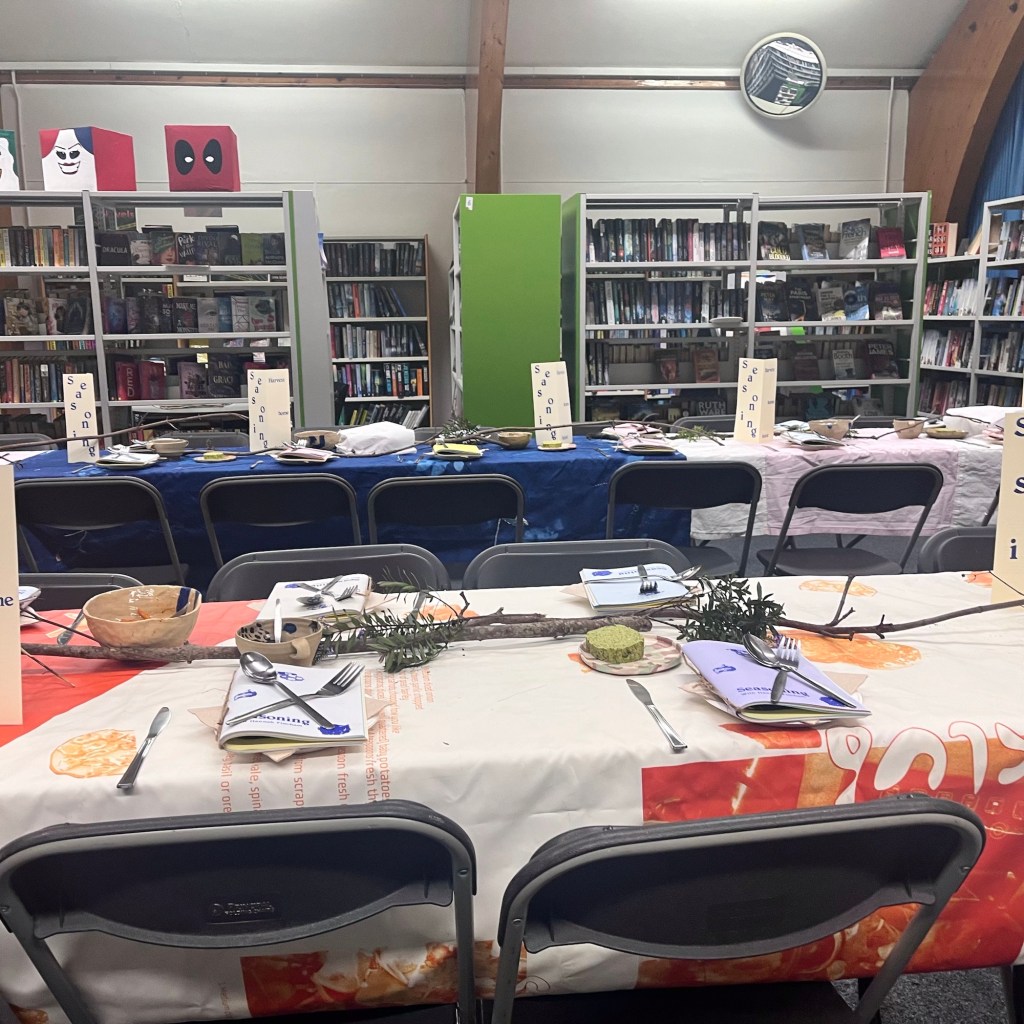
Finally, last week on Friday night we had a feast in Bootle Library. The tablecloth ran along the length of one of the tables reserved for my group. It carried the plants of Sefton, the light of our summer workshops, and the stitched words of women and children who are rebuilding their lives. Seeing it in place, surrounded by food, conversation and the warm buzz of At the Library’s artists and team, was profoundly moving. I wanted to reflect on it because it is so connected to my social sculpture research and my own practice. I felt it reflected much of what we do at the library and echoed what Jonathan taught us last week about Contact Zones. The library is, for me, the clearest physical Contact Zone.

Working alongside colleagues, each contributing their own talent and care, reminded me how these projects are held in harmony by many hands. The feast was not about showcasing artwork, it was about celebrating community, connection and the slow work of building trust through creativity. The feast project by the Kitchen Library feels to me like a multilayered social sculpture. It unfolded across different times, places and relationships. Each layer held a different group of people including colleagues, refugee women, children and artists in residence, and each contributed something unique such as their labour, their stories, their presence and their materials.

The tablecloth project deepened my understanding of social sculpture and care through art. More importantly, in a time when many communities are fractured, the involvement of refugee women and children revealed how creativity can bring us together, even if only for a moment. The tablecloth is only one visible layer. Beneath it lies the invisible sculpture of conversations, gestures, learning, trust building, cultural exchange and the shared act of preparing for a communal feast. All of these intangible elements shaped the social form just as much as the physical cloth.

Posted in 2025-2026, Ceramic, Exhibitions, Moon, Reflection, Social Sculpture, Uncategorized, Writing

Reflections on Ornament–Intent: Home as Political Medium

Last Friday, I exhibited as part of Ornament–Intent, curated by Emma Rushton at her house in Manchester. The exhibition offered a chance to re-situate my practice within the intimacy of a domestic environment. The curatorial premise, that decoration and political intent flow through the home, aligned closely with my interest in how social and political meaning is transmitted through ordinary gestures, materials and language.

Rushton’s house, transformed into a living exhibition space, blurred the boundaries between art and life. The space carried traces of daily existence, forming a backdrop that resisted the neutrality of the white cube. Within this context, my ceramic works and participatory writing installation became part of an evolving conversation about the home as both refuge and political site.

On a handmade ceramic plate inscribed Sykes–Picot 1916, I presented a red velvet cake. The act of division mirrored the historical partition of the Middle East under the Sykes–Picot Agreement. I used the domestic ritual of cake-cutting, usually symbolic of celebration, generosity and communion, to expose its opposite: consumption, greed and geopolitical appetite.

This gesture was performative in the sense Joseph Beuys might describe as Soziale Plastik (social sculpture), where symbolic action and participation become material. The knife, crumbs and creamy surface formed an ephemeral installation that questioned how colonial histories persist within gestures of hospitality and everyday pleasure.

A second ceramic work consisted of 11 handmade spoons arranged in a circular formation across a white table. Each spoon was inscribed with the name of a country and a range of dates, including Gaza, Bosnia, Yemen, Cambodia, Congo, India, Ireland .. etc marking periods of famine, war and conflict. Together, they formed a kind of geopolitical clock, a cycle of recurring histories and unresolved wounds.

Unlike traditional cartography, this piece used domestic utensils, tools of nourishment and care, to map famines/conflicts. The spoons stood in for mouths, stories and silenced voices, suggesting that global politics is not abstract but deeply entangled with the rhythms of everyday life.

In the setting of Ornament–Intent, this work transformed the dining table into a site of memory. It invited viewers to confront histories of violence not through spectacle but through quiet familiarity. The domestic language of tableware became an entry point into questions of accountability and empathy. The work reflects my ongoing interest in social sculpture as an aesthetic of recontextualisation, where meaning is generated through the repositioning of ordinary materials within spaces of shared attention and care.

Another ceramic piece juxtaposed a sugar bowl labelled Third World with a spoon marked First World. Sugar, a substance historically tied to trade, slavery and colonial wealth, became a material metaphor for extraction and imbalance.

Placed in a domestic setting, the object drew attention to how structural inequalities are embedded in ordinary life. A simple act such as stirring sugar into tea carries invisible histories of power. In this sense, the work functioned as a micro-political sculpture, where meaning emerges not through spectacle but through subtle provocation within the familiar.

A handwritten note, in Arabic and English, listed key dates in Sudan’s history of famine and conflict: 1984, 1993, 2017, 2024, followed by the line (And Sudan’s issues remain words on paper…) with a ceramic spoon read (Money eats first)

Here, I explored the limits of communication and documentation, and how political struggle often becomes archived as text, detached from lived experience. The translation between languages paralleled the translation between activism and representation, between the urgency of lived crisis and the inertia of global indifference. The work questioned the gap between empathy and action, a recurring concern in my social sculpture practice. What is the role of the artist when language itself becomes complicit in the act of forgetting?

In another part of the house, I presented Dear Moon, a participatory installation inviting visitors to write letters to the moon. A small writing table, paper, envelopes and a black letterbox created a space for reflection and dialogue.

This piece extended my ongoing investigation into correspondence and indirect communication, letters that may never reach their destination yet carry emotional truth. The moon, as an unreachable listener, became a symbol of distance, empathy and collective longing.

Here, the act of writing functioned as a social sculpture, a participatory moment that transformed private thought into shared experience. It also reasserted my belief that art can hold silence as much as speech, offering space for what cannot be articulated in political discourse.

Ornament–Intent revealed how the domestic realm, often coded as private or decorative, is inherently political. Within Emma Rushton’s home, art entered the space of the everyday, resisting the hierarchies that separate aesthetic experience from lived reality.

My contribution sought to hold this tension between care and critique, ornament and intent, intimacy and history. Each ceramic object or written phrase acted as a small social gesture, reanimating the conversation between form, politics and communication.

Posted in 2025-2026, collaboration, curation, Exhibitions, Project, Reflection, Research, Social Sculpture

Account Not Recognised- Reflection of The Right Map

Account Not Recognised at Birch in June was part of The Right Map programme by Ghost Art School. The exhibition took place in the Hamilton building, which was once a bank. This setting shaped my thinking about the title and the idea of value, exchange and belonging. The phrase Account Not Recognised came from my digital text piece and reflected both a technical error and a human condition. It suggested exclusion, misunderstanding and the unstable ways in which identities and actions are acknowledged or denied.

Co- curating this show was a process of collaboration and care. We wanted to create a space that could hold protest and rest, activism and absurdity, humour and exhaustion. The title Account Not Recognised came from the familiar digital message, but in this context it became about being unseen or misread, and about the tensions between visibility and erasure.

My own contributions included a pillow, a fragment of wall text and a digital LED display. The pillow was printed with an image found online showing a crowded boat of migrants at sea, overlaid with a pixelated speech bubble saying “HELLO”. It appeared soft and domestic, yet the image beneath disrupted that comfort. The LED panel displayed inverted scrolling red text Account Not Recognised and the wall text read “Dear Moon, The war has sto…” and referred to my Dear Moon project. It was a sentence left unfinished, a letter that could not be completed…

In the centre of the gallery stood a large boat containing soil and growing sunflowers. The boat came from the Kensington community garden project by Tom D and functioned as a living sculpture. It was both landlocked and adrift, a fragile symbol of movement, care and survival.

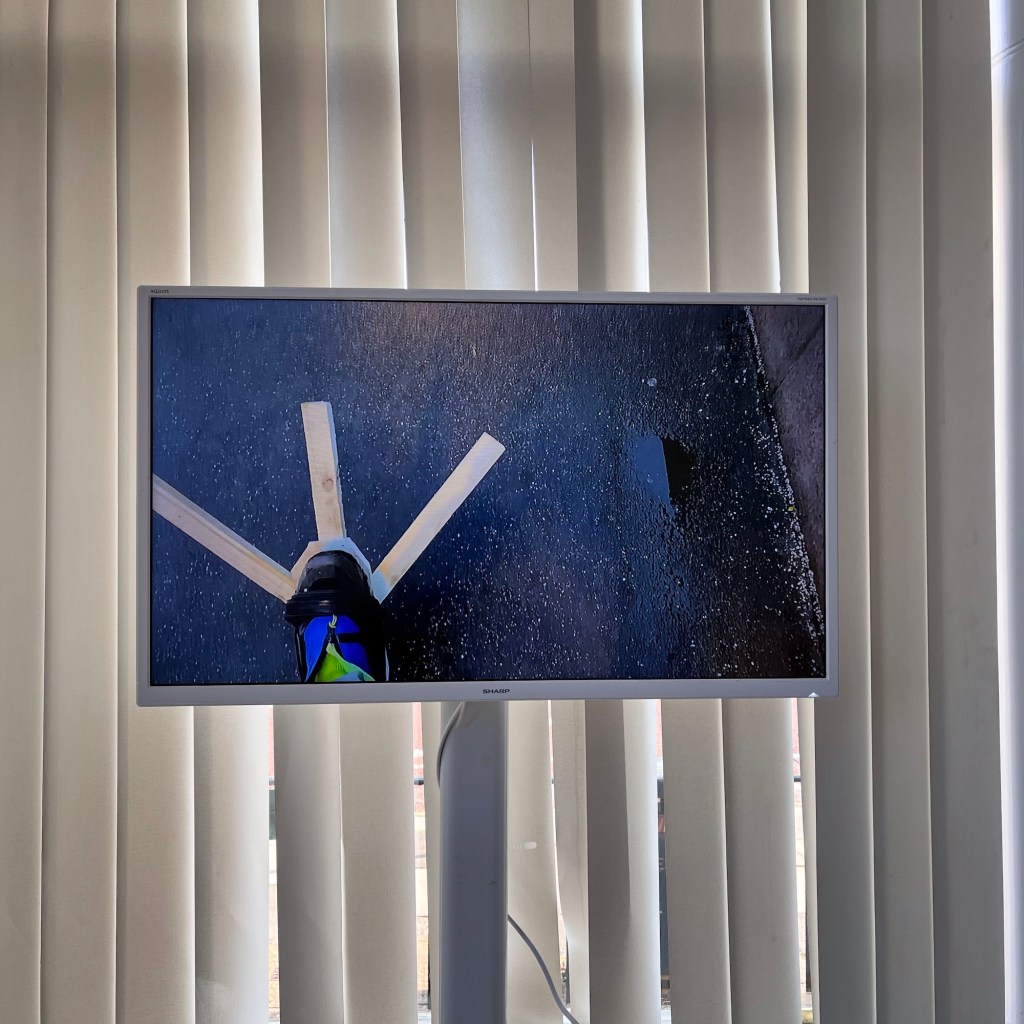
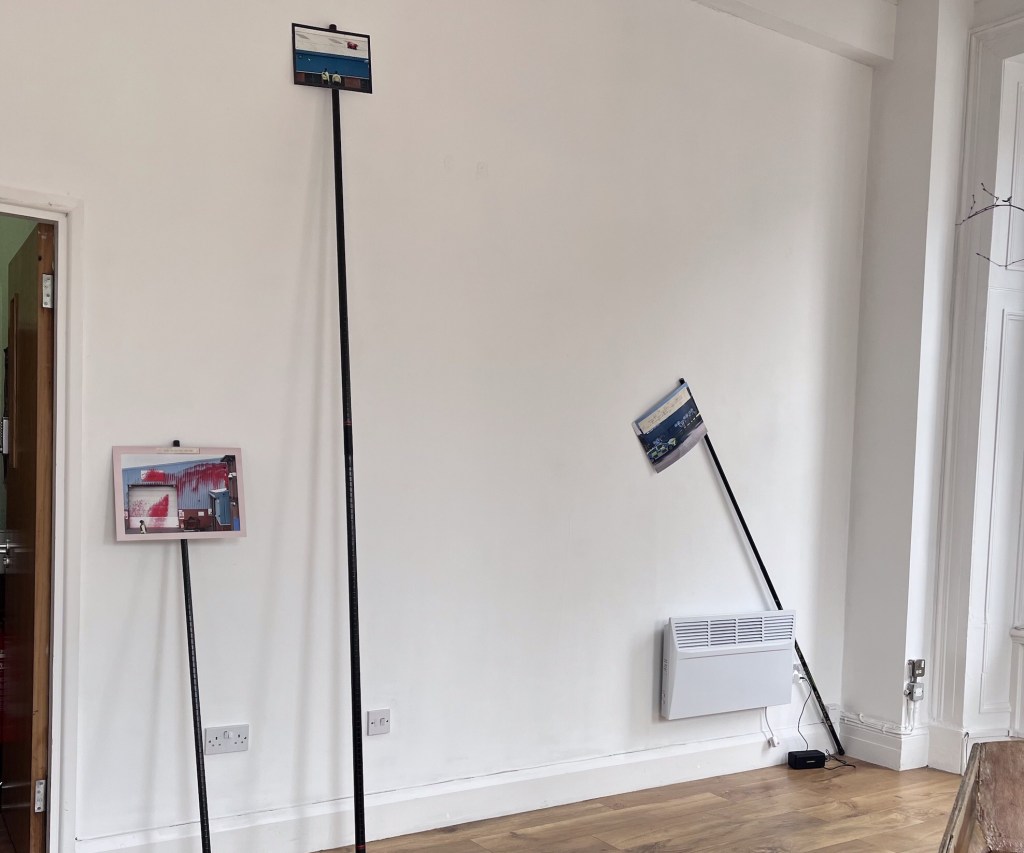
Other artists’ works brought further layers to the exhibition. Rory’s video showed a chicken foot strapped to his shoe, filmed during a protest in Russia on the second anniversary of the invasion of Ukraine. It was a quiet but powerful gesture that turned absurdity into endurance. Tom D’s photographs documented a Palestine Action protest at the Elbit Systems site in Oldham, where activists succeeded in stopping the production of weapons for the Israeli military. The red-stained facade of the building became both a wound and a mark of resistance.

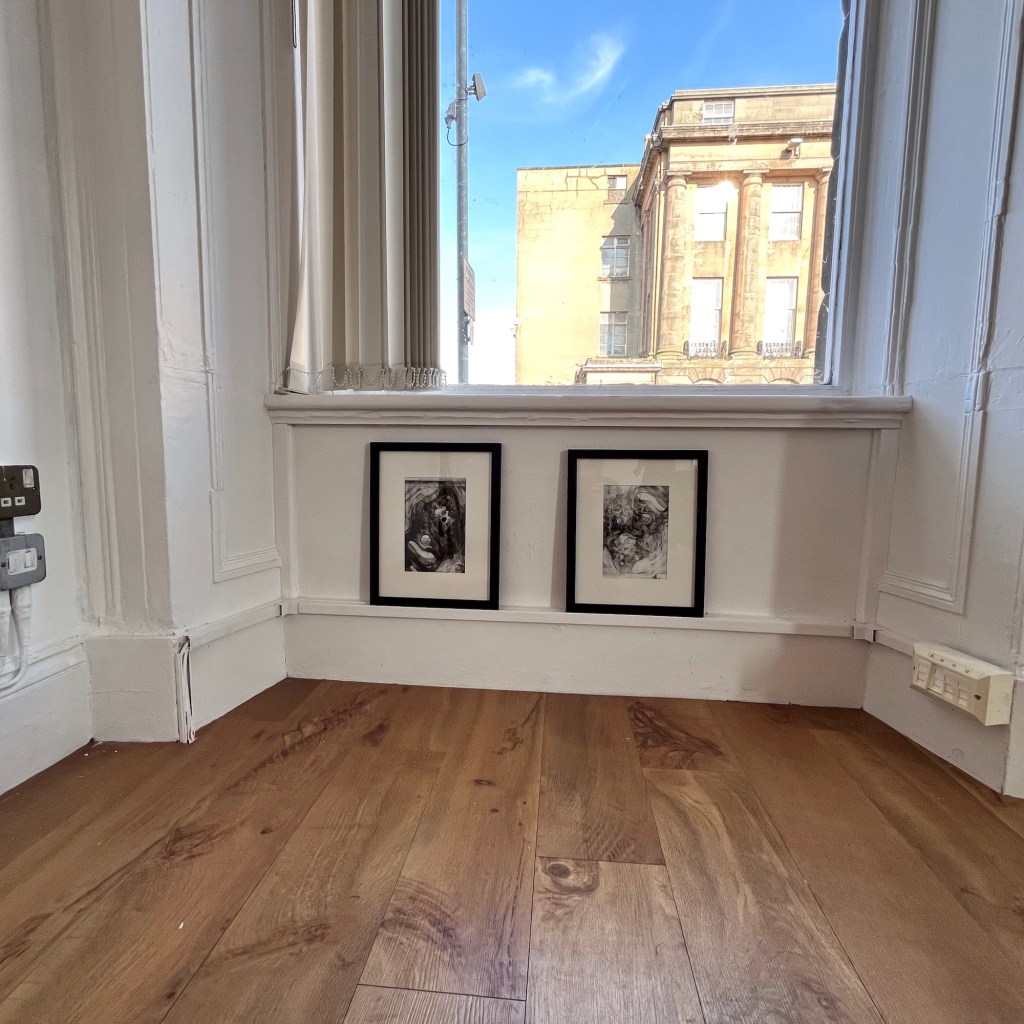
Molly’s black and white drawings added a more abstract presence.. Lily’s film, projected inside a small metal alcove, appeared to be caught mid-edit, reflecting on itself as it played.

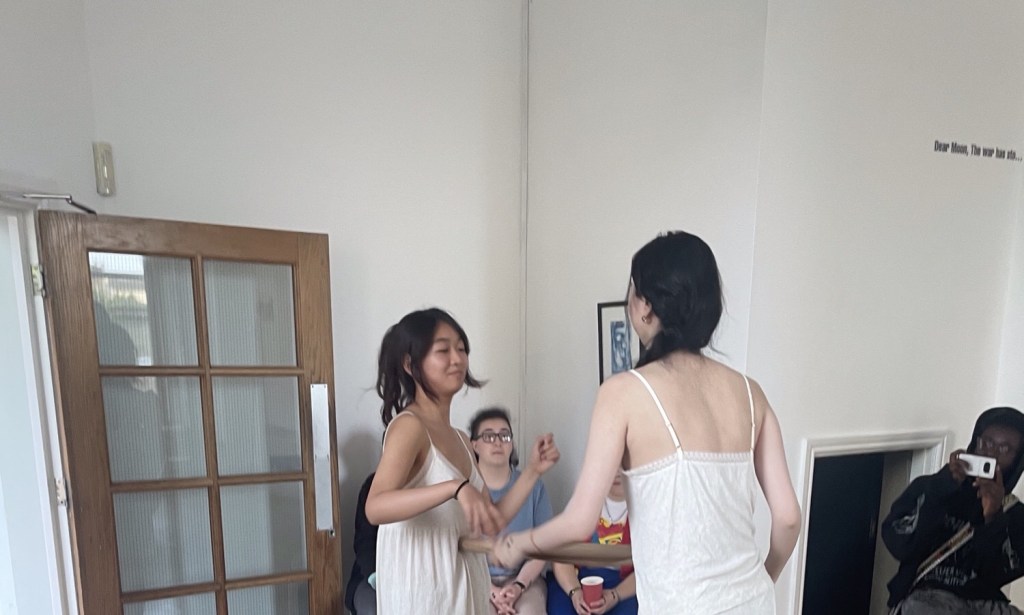
Two live performances took place on the opening night. Soop, by Hannah, Marie and Tom K, involved the audience in making a communal soup. It was messy, generous and unpredictable, reminding me of how collaboration relies on trust as well as misunderstanding. Xueying Zhang’s performance with her collaborator involved holding a cardboard pole between their bodies while slapping each other. It expressed the tension between cooperation and conflict, both intimate and absurd.

The work here whether documentary, performative or digital, asked what it means to be recognised and what is lost or gained in that process. It confirmed my interest in social sculpture and the politics of communication.

Finally, recognition is never simple or complete, yet within its uncertainty there is always room for empathy..