Posted in 2025-2026, collaboration, curation, Exhibitions, Project, Reflection, Research, Social Sculpture

Account Not Recognised- Reflection of The Right Map

Account Not Recognised at Birch in June was part of The Right Map programme by Ghost Art School. The exhibition took place in the Hamilton building, which was once a bank. This setting shaped my thinking about the title and the idea of value, exchange and belonging. The phrase Account Not Recognised came from my digital text piece and reflected both a technical error and a human condition. It suggested exclusion, misunderstanding and the unstable ways in which identities and actions are acknowledged or denied.

Co- curating this show was a process of collaboration and care. We wanted to create a space that could hold protest and rest, activism and absurdity, humour and exhaustion. The title Account Not Recognised came from the familiar digital message, but in this context it became about being unseen or misread, and about the tensions between visibility and erasure.

My own contributions included a pillow, a fragment of wall text and a digital LED display. The pillow was printed with an image found online showing a crowded boat of migrants at sea, overlaid with a pixelated speech bubble saying “HELLO”. It appeared soft and domestic, yet the image beneath disrupted that comfort. The LED panel displayed inverted scrolling red text Account Not Recognised and the wall text read “Dear Moon, The war has sto…” and referred to my Dear Moon project. It was a sentence left unfinished, a letter that could not be completed…

In the centre of the gallery stood a large boat containing soil and growing sunflowers. The boat came from the Kensington community garden project by Tom D and functioned as a living sculpture. It was both landlocked and adrift, a fragile symbol of movement, care and survival.

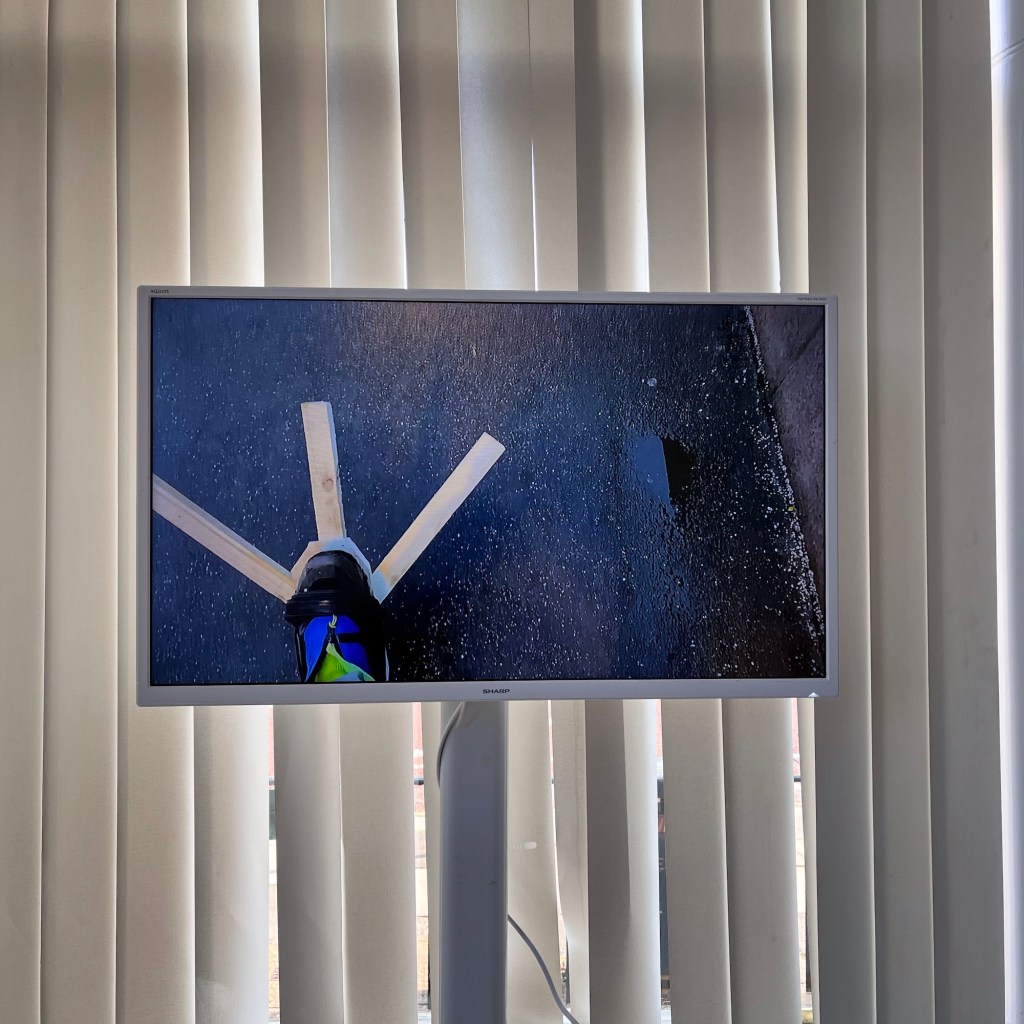
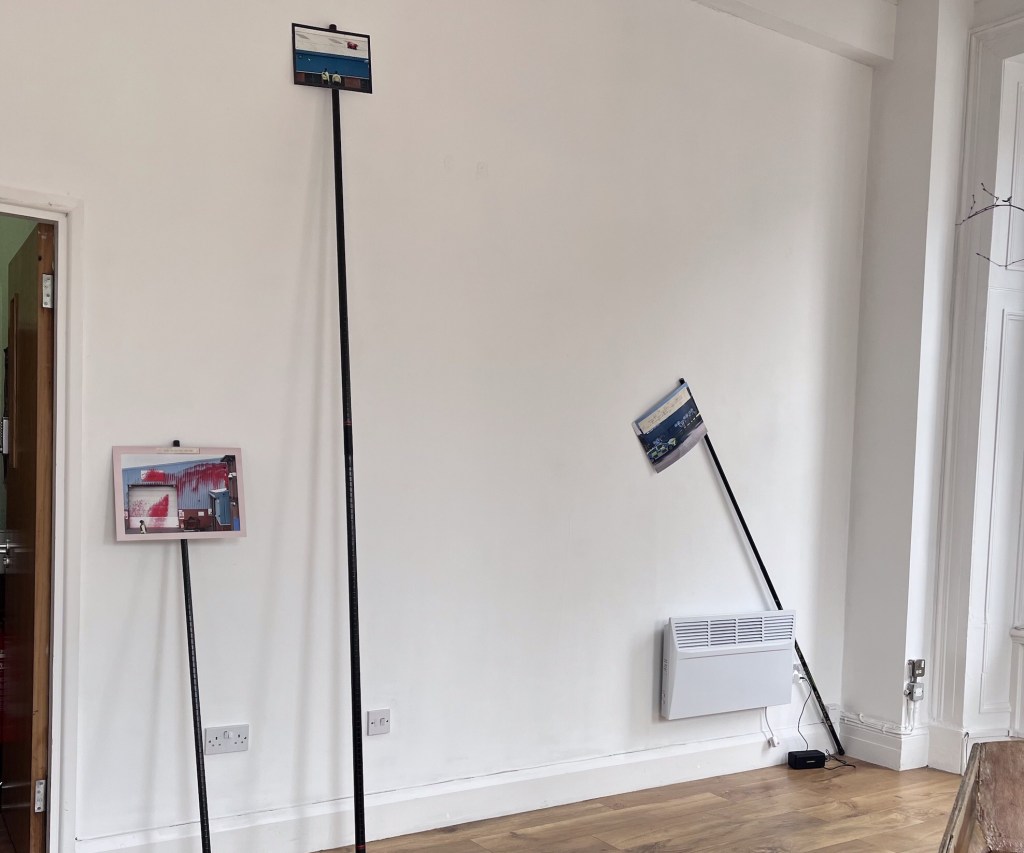
Other artists’ works brought further layers to the exhibition. Rory’s video showed a chicken foot strapped to his shoe, filmed during a protest in Russia on the second anniversary of the invasion of Ukraine. It was a quiet but powerful gesture that turned absurdity into endurance. Tom D’s photographs documented a Palestine Action protest at the Elbit Systems site in Oldham, where activists succeeded in stopping the production of weapons for the Israeli military. The red-stained facade of the building became both a wound and a mark of resistance.

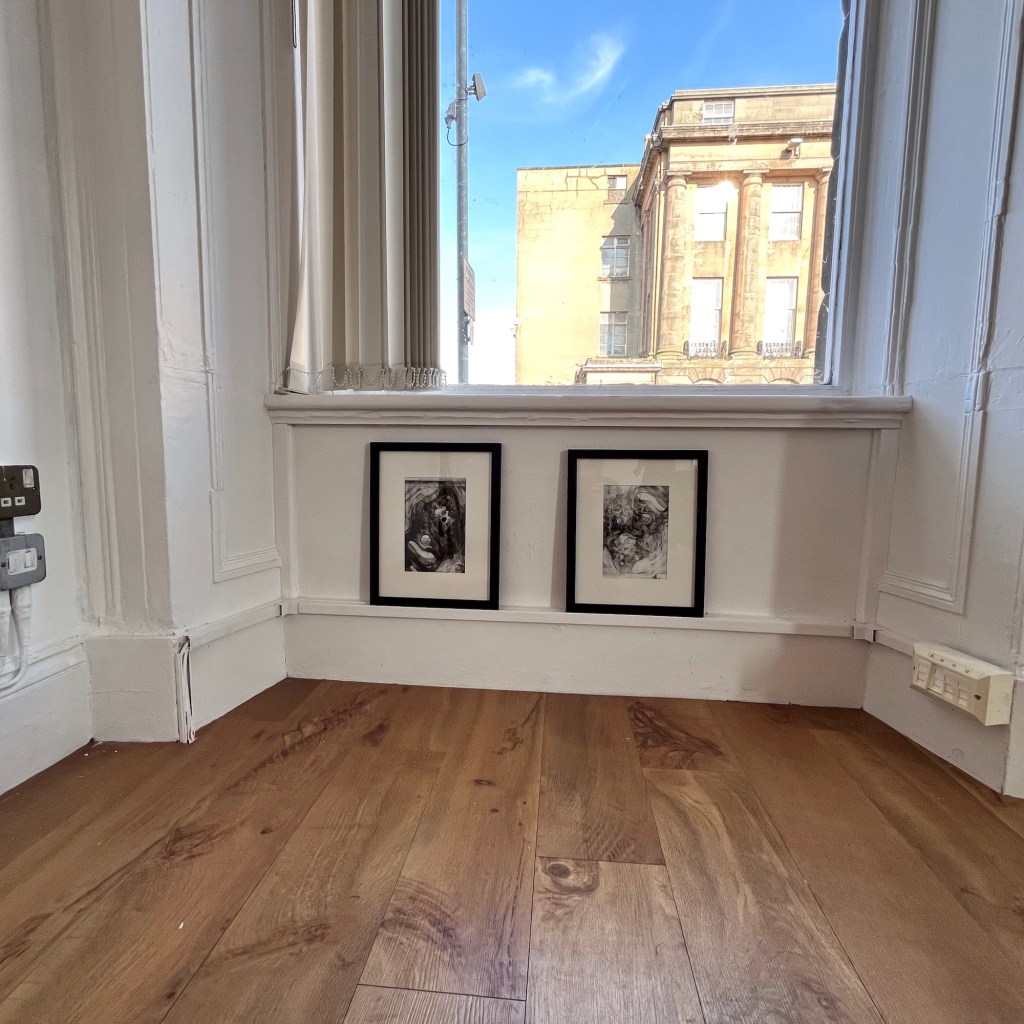
Molly’s black and white drawings added a more abstract presence.. Lily’s film, projected inside a small metal alcove, appeared to be caught mid-edit, reflecting on itself as it played.

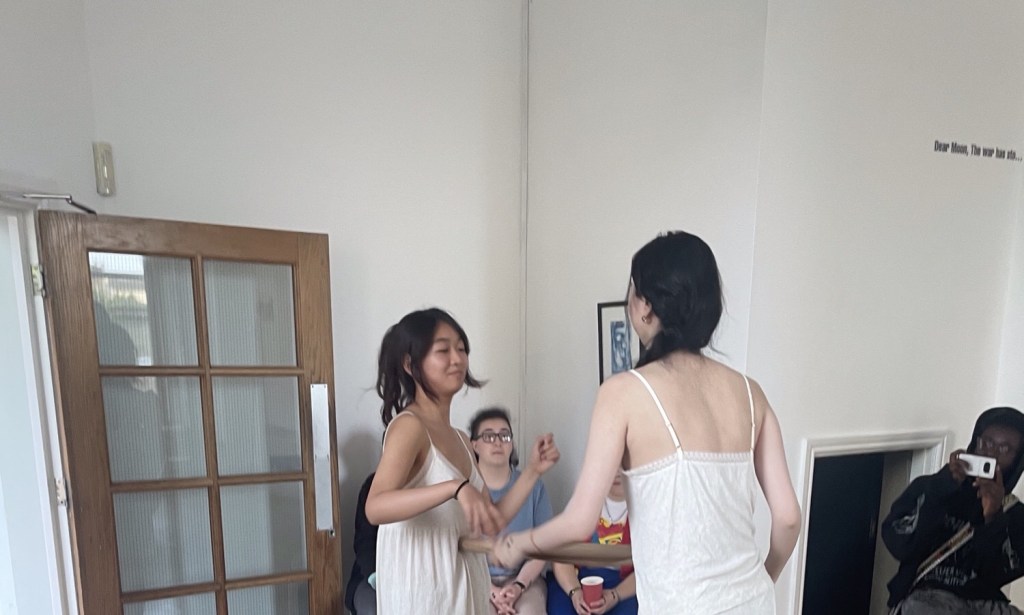
Two live performances took place on the opening night. Soop, by Hannah, Marie and Tom K, involved the audience in making a communal soup. It was messy, generous and unpredictable, reminding me of how collaboration relies on trust as well as misunderstanding. Xueying Zhang’s performance with her collaborator involved holding a cardboard pole between their bodies while slapping each other. It expressed the tension between cooperation and conflict, both intimate and absurd.

The work here whether documentary, performative or digital, asked what it means to be recognised and what is lost or gained in that process. It confirmed my interest in social sculpture and the politics of communication.

Finally, recognition is never simple or complete, yet within its uncertainty there is always room for empathy..

Posted in 2025-2026, collaboration, curation, Exhibitions, Reflection, Writing

The Right Map-reflection: Writing on CBS Hands’ Box

I wrote this piece after meeting a stranger at the garden, young woman and her friend. I was with my friends at an abandoned garden space, helping a friend artist Tom Doubtfire who was turning it into a community garden. We planted flowers and vegetables, cleaned the area many times, and removed piles of rubbish, even though people kept throwing more and using the space at night for drug dealing.

It is sad to see that, but also inspiring to witness how a group of artists continues to work with hope and determination to make a tangible difference. This is what I believe social sculpture truly means, making change through collective effort and care.

The piece was first written in Arabic and then translated into English as a note to myself. Later, I decided to include it in my Hands Box sculpture, inviting others to add their own words if they feel moved to do so.

I will share more about the community garden and the legend Tom Doubtfire in another post.

Kate ..

في تلك اللحظة شعرت بعجزٍ تام عن التعبير. كانت العيون وحدها تتحدث بلا انقطاع، وكأنها تفرّ من الكلام عن ذلك الذي يخيم بيننا، كأنه شبح خفي. كانت عيناها تخفيان أسرارًا كثيرة، وكنت أتجنب التحديق فيهما، إذ كلما التقت نظراتنا، راودتني رغبة ملحّة في أن أقول ما هو جوهري: “أنا قلقة عليكِ… أنتِ بحاجة إلى المساعدة، ويبدو أنك لست بخير.”

لكن عينيها كانتا تقولان بصمت: “ليس الآن”، بينما لسانها انشغل بسرد قصص عن بطولات إنقاذ الحيوانات وحب النباتات. كنت أودّ أن أخبرها بأنني أرى نقاء قلبها، لكن الكلام بدا بلا جدوى، فقد بدت شبه غائبة عن الوعي. ما كان مهمًّا آنذاك هو أن تواصل الحديث ونحن نصغي، إذ كانت تحتاج لمن يسمعها في تلك اللحظة تحديدًا.

راحت مشاعر الحزن تطوّقني، وبدأت أتحرّك مضطربة بين اليمين واليسار، بينما هي تُصرّ على ألا تُبعد عينيها عني. اجتاحني ارتباك، فابتسمت وضحكت، دون أن أدري كيف أسيطر على كل ما كان يعتمل بداخلي.

كان الحرف الأول من اسمها هو ذاته الحرف الأول من اسمي، وكانت آثار الجروح واضحة على جسدها النحيل. كانت برفقة صديق بدا هو الآخر بحاجة إلى العون…

عانقت الجميع قبل أن ترحل، ووعدت بأنها ستعود في الغد حاملةً معها بعض الأزهار.

لم أكن وحدي في ذلك المكان، بل كنت بين أناس أعزّهم كثيرًا؛ أناسٍ كلما اقتربت منهم، رغبت لو أختبئ خلفهم ولا أبالي بشيء…

In that moment, I felt utterly incapable of expressing myself. Only our eyes kept speaking incessantly, as though fleeing from acknowledging what loomed between us, a hidden ghost. Her eyes concealed many secrets, and I avoided staring into them, for each time our gazes met, I was seized by an urgent desire to say what truly mattered: “I’m worried about you… You need help, and it seems you’re not okay.”

But her eyes silently replied, “Not now,” while her tongue busied itself with tales of heroic rescues of animals and a love for plants. I longed to tell her that I saw the goodness in her heart, but words felt futile, as she seemed almost absent, barely conscious. What truly mattered then was for her to keep speaking, while we simply listened, she needed someone to hear her in that very moment.

A wave of sorrow surrounded me, and I began pacing back and forth, while she insisted on keeping her eyes fixed on mine. I felt overwhelmed, smiling and laughing without knowing how to contain the turmoil raging inside me.

The first letter of her name was the same as the first letter of mine, and marks of wounds were visible on her frail body. She was accompanied by a friend who also seemed in need of help… She hugged everyone before leaving, promising she would return the next day, bringing some flowers with her.

I was not alone in that place, I was surrounded by people I hold very dear, people whose closeness makes me wish I could hide behind them and care about nothing else…

Posted in 2025-2026, Lectures 2025-2026, Reflection, Research, Writing

1–1 Tutorial 6th October 2025

On Monday, I joined the open 1–1 tutorial with Jonathan. I really needed that conversation, my thoughts were fighting inside my head, and sometimes talking is the best way to organise them.

We discussed many different things. Jonathan has a great way of asking the kind of questions I should be asking myself. I feel that if I had one good question every day, I’d probably write on my blog much more often.

We talked about The Right Map exhibition series and my experiences, how much I learned from working with different people, and how I feel about working with different groups: one more formal and structured, and the other relaxed and informal. Although I’m an organised person who likes to plan ahead, I found that I have the ability to be adaptable and ready to work in fast-paced situations, finding solutions in the moment. It was a challenge, but it also increased my confidence.

I know people have different styles of thinking and working, and as long as we trust each other’s intentions and skills, things go smoothly. We can fill each other’s gaps, and I was definitely learning so much from our team.

For me, the goal of The Right Map was to create a free and welcoming space where everyone could learn and grow together. That’s what makes a social sculpture, and that’s the goal of making this kind of art.

We also talked about the CBS show Sculpture (see my previous post), which reminded me that I should share the short text I wrote for it, along with the 50-word bio I submitted, and the one I received written by artist Cos Ahmet, which my sculpture responded to.

Here are the two secret bios:

Cos Ahmet:

Tropes corporeal fragmented, human, other. Limbs without a host, the skin of things physical, digital. Choreographic. The material’s immaterial states between liminal space on the threshold of self, other. Dust.

Me:

A child took up her pen, signing walls with her name. We’ll play socially… I’ll sculpt the riddle. Language won’t matter; wisdom gathered on page 104–105. Forgive the broken clock!

Another part of our discussion was about Social Publishing, a lecture by Allegra Baggio Corradi that I listened to after the printing meeting with Alex Schady. Jonathan had attended that session too, so it was wonderful to exchange thoughts and notes with someone who was there. We both agreed how inspiring it was. I realised how much it connected with my ongoing project Writing Letters to the Moon.

Learning about Social Publishing, even just understanding its definition, helped me see what I’ve been doing from a new perspective. I’ve always thought of my book as a sculpture, its process far removed from traditional publishing. I don’t see myself as an author but as an artist, still figuring out what that means!!

These days it’s hard not to wonder are artists becoming celebrities, activists, or something in between? Genuine voices, attention-seekers or good actors? There’s definitely more to write about this.. I feel like I’ve gathered so much new information, yet the more I learn, the more I realise how far I am from finding the right answers.. And the higher I try to rise, the lighter I have to become, learning to let go of things and sometimes people along the way.. 

Posted in Drawings, Exhibitions, Experiments, Project, Reflection, Writing

Crash Test

Earlier this month, a group of us, friends/artists gathered at Birch Studios & Gallery in Wirral, for a one-night experiment we called Crash Test. Half exhibition, half crit, half scratch night. Crash Test was a place to try things out, to test-drive new work and unfinished thoughts in a space where feedback was as valued as the visuals.

The idea was simple: set up something raw, something you’re unsure about, and invite others to respond. The name Crash Test seemed fitting, not just for its visual punch, but because it captured the risk, the speed, and the impact of trying something unpolished in public.

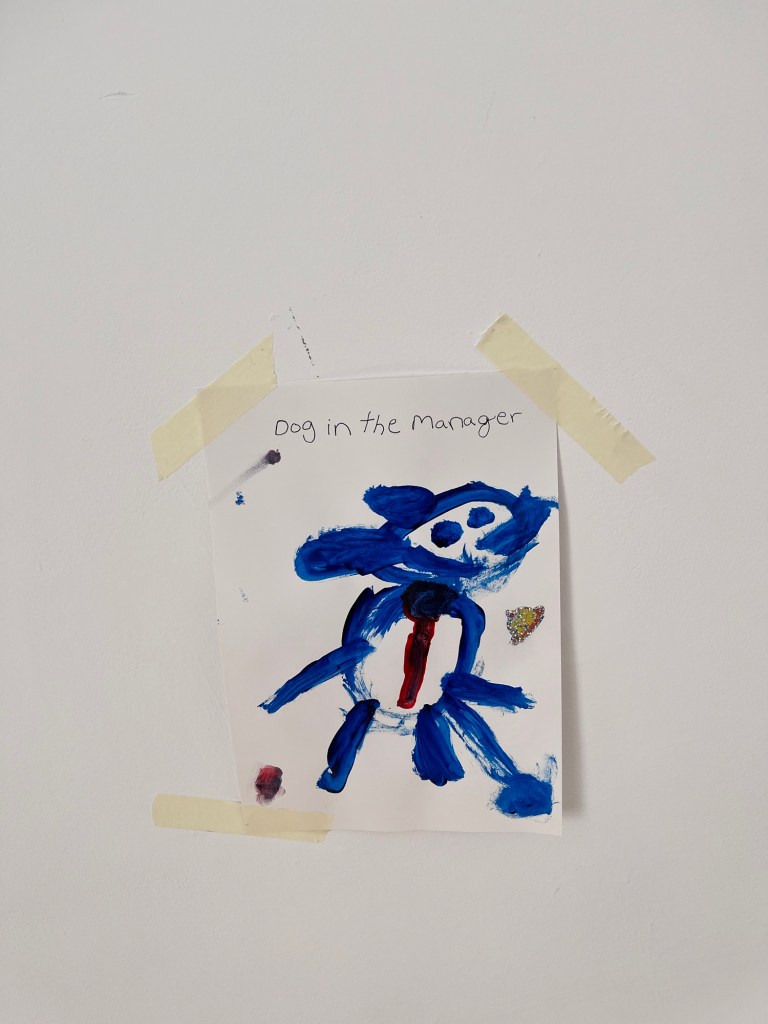
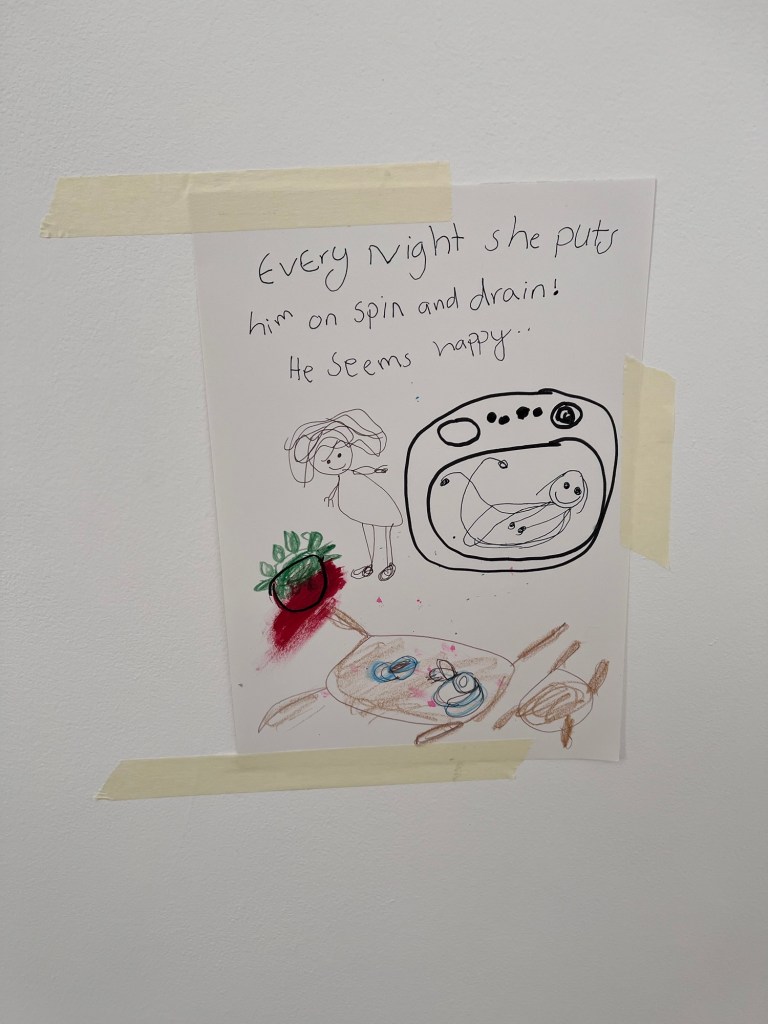
I brought along some child-like drawings, experimenting with simplicity, ambiguity, and humour. The feedback I received was encouraging, people connected with the looseness, the absurdity, and the layered messages behind the bright colours and crayon lines.

That said, for the upcoming Show ‘Unstable’ as part of the Independents Biennial, I want to develop something more dynamic and expansive, something less stable and more open-ended. I’m thinking of revisiting the Moon Litters idea. There’s something about the unpredictability of that work, the way it can shift and change over the exhibition’s duration that feels right for where I’m at now. It allows space for other voices, movements, and moments to enter.

My work 😬
Posted in Exhibitions, Experiments, Moon, Reflection, Research, Visit, Writing

Trusting the Process.. Interim Show 2025

Since October, I’ve been immersed in the making of Dear Moon. What began as a simple idea grew into something layered and full of meaning. Over these months, I’ve learnt so much, not just about putting together a book, but about myself. The skills I’ve had to call on managing, organising, communicating, publishing, sharing all came with challenges. I had to practise patience.. I had to listen. And more than anything, I had to trust the process!

There were many moments when I didn’t know exactly where it was heading, but I allowed myself to follow the rhythm of the work, and something beautiful came through. I’m especially grateful that the work is expanding being read, being held and I’ve been watching it with a sort of quiet pride.

Still, I have to be honest. Sharing Dear Moon in public spaces hasn’t felt completely right. I tried presenting it in a vibrant setting, but I could feel the book asking for something else, something slower, more still. It asks the reader to sit, pause, and take time. And that’s hard to find in environments filled with movement.

So, although I didn’t quite succeed in the way I had imagined, I don’t see it as failure. Instead, I see it as another learning. The challenge now is to explore different ways a book like this can live in public space. How do I present it in a way that honours its pace and stillness? How can I guide people toward it gently, instead of expecting it to compete for attention?

I’m still learning, and I’m open. I’m proud of Dear Moon, and I know it will keep finding its way as long as I keep listening.

Posted in collaboration, Moon, Project, Reflection, Research, Writing

A Collaboration on Dear Moon (Service Point JNG)

Working on Dear Moon has been one of the most personal and expansive projects I’ve ever taken on. While the words came slowly, shaped by honesty and quiet reflection, the visual form of the book took a different kind of journey, one that became stronger and more meaningful through collaboration.

I had the pleasure of working with Jiayi and GG, two recent MA Graphic Design graduates from the university. They took on the challenge of designing Dear Moon and brought their own vision to it. Where I had initially imagined something simple, quiet, and almost invisible in its design letting the words do all the work they brought something else entirely: depth, elegance, and boldness in aesthetic.

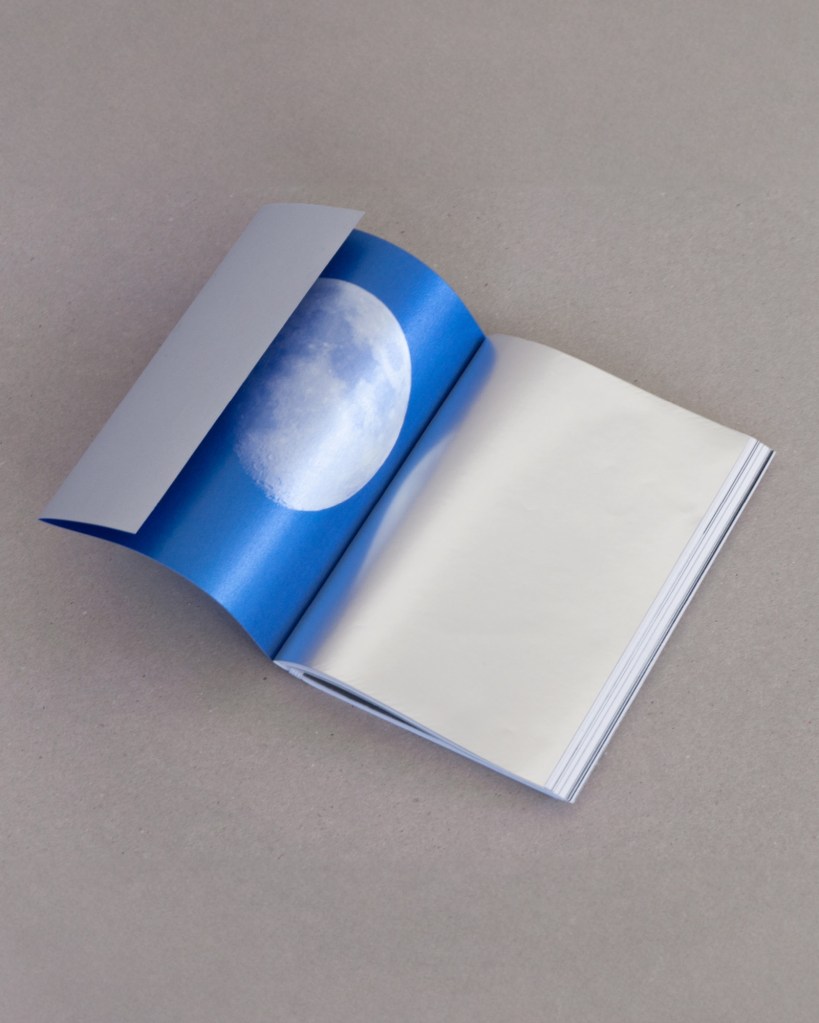
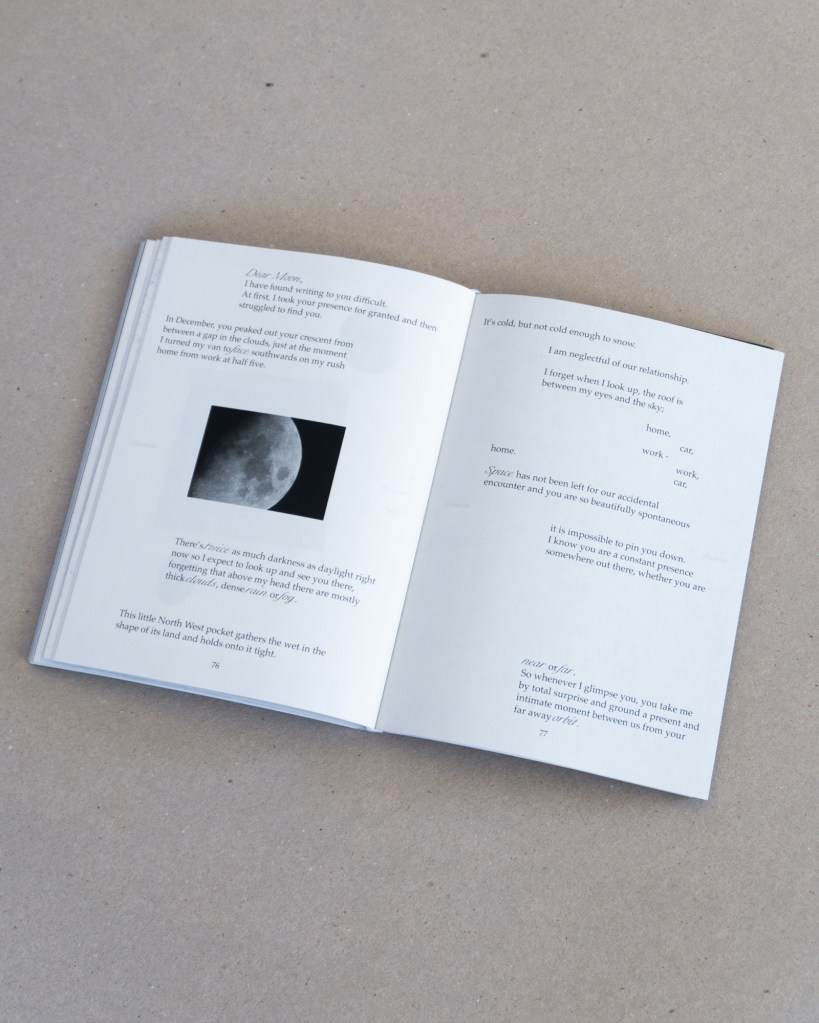
Their design sensibility was so different from mine. I approached the book with simplicity, wanting to preserve the gentle rhythm of the letters and photographs without interruption. I didn’t want the visuals to overpower the messages within. But what Jiayi and GG brought was not overpowering it was enhancing. They introduced a poetic visual language: deep blues, moonscapes that speak for themselves, layout choices that echo the movement of tides and emotion. They weren’t just decorating; they were interpreting.

Looking at the final book now, I see a true collaboration. It’s no longer just a collection of letters; it’s a designed experience. A conversation between stillness and form.

Collaborating in this way has taught me the value of letting go. Of sharing creative control. Of trusting others to hold your work with care and transform it with love and intention. I feel Dear Moon is stronger because of this process, and I’m grateful to Jiayi and GG for reminding me how powerful cross-disciplinary work can be.

https://www.instagram.com/p/DHa-GsDKStV/?igsh=MWVza3g4eGFrZ2g0bw==

Posted in 2024/2025, Exhibitions, Motivations, Reflection, Writing

First Review in Art in Liverpool

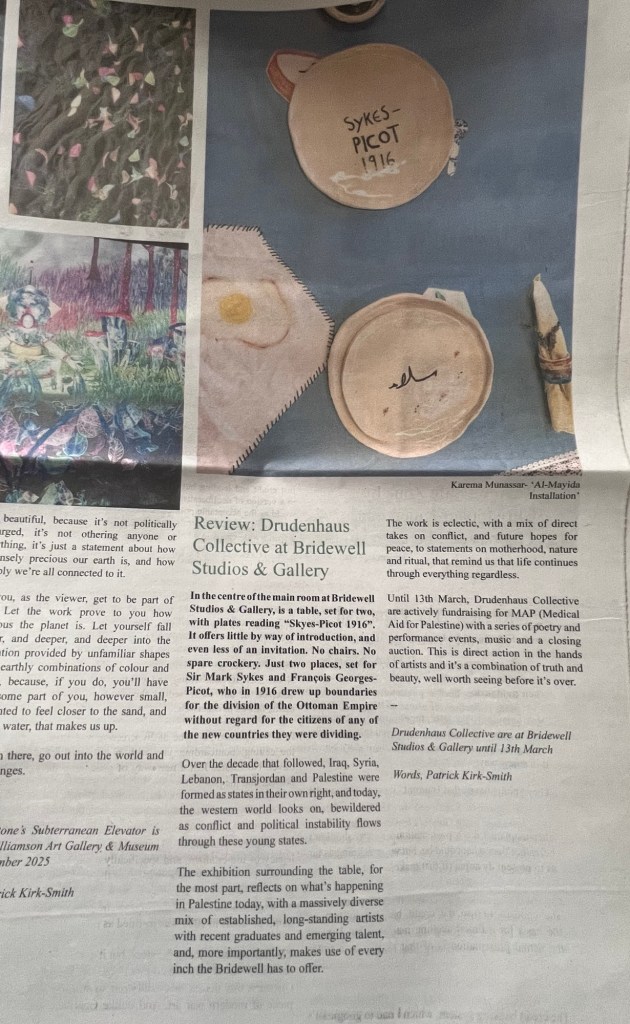
I recently received my first review (which I see as feedback) in Art in Liverpool, written by Patrick Kirk-Smith, about my Al-Mayida installation as part of the Drudenhaus Collective at Bridewell Studios & Gallery. Seeing my work in print, positioned within a broader reflection on history, conflict, and artistic response—has given me space to consider how this moment connects with my ongoing practice.

He writes:

“In the centre of the main room at Bridewell Studios & Gallery is a table, set for two, with plates reading ‘Sykes-Picot 1916’. It offers little by way of introduction, and even less of an invitation. No chairs. No spare crockery. Just two places, set for Sir Mark Sykes and François Georges-Picot, who in 1916 drew up boundaries for the division of the Ottoman Empire without regard for the citizens of any of the new countries they were dividing…”

This review captures the essence of Al-Mayida, how history’s decisions linger in the present, shaping lives and political realities.

As I navigate my MA, this review serves as both encouragement and reflection. It affirms that my work is engaging with complex socio-political themes in a way that resonates beyond the gallery. It also challenges me to refine my approach, how can I sharpen these conversations while maintaining the poetic, unsettling subtlety that Al-Mayida holds?

The Drudenhaus Collective’s fundraising for Medical Aid for Palestine (MAP) adds another layer to this. Art, for me, has always been a site of action as much as expression. This project reinforces my belief that creative practice can exist in solidarity, bringing history into the present not just for reflection, but for tangible impact.

Posted in 2024/2025, Assignments, Reflection

Unit 1 Assessment

Learning Outcome 1:
Formulate, describe and implement a challenging and self-directed programme of study, relating to your Study Statement. (Assessment Criteria: Enquiry):

My work explores topics of communication, connection, and collective experience through projects such as Al-Mayida, Letters to the Moon, asemic writing, and childlike drawings. Each project looks at how art fosters debate, narrative, and inclusivity. Interviews with Pedro Reyes about social sculpture, White Pube’s new book, and Axis’ Artists That Write have all inspired me. Furthermore, the Art for the Earth’s Sake initiative stressed the importance of adopting an ecocentric perspective to social practice. All of these influences have shaped my self-directed method, in which I investigate and learn from literature and artists, as well as my own artworks.

Learning Outcome 2:
Implement appropriate working methods for building an independent and effective self-organisation that enables the critical engagement with practice-based research.
(Assessment Criteria: Process):

In projects such as Al-Mayida, I experiment with diverse curatorial approaches, but in Letters to the Moon, I prioritise participant interaction. My process-driven approach accepts ambiguity and improvisation, which is consistent with Jonathan’s reflection in action research. The final session of Art for Earth’s Sake was especially powerful, as we discussed how artists can practise sustainability, set a good example, and utilise art as a tool for social and environmental change. 

Learning Outcome 3:
Communicate a critical understanding of your developing practice.
(Assessment Criteria: Knowledge, Communication):

My work is a type of social sculpture, an ever-changing discussion that connects personal and collective experiences. Projects such as Al-Mayida focus on unity and history, whereas Letters to the Moon promotes communication and community involvement. My efforts with asemic writing and childlike drawing disrupt art’s traditional hierarchies, emphasising authenticity and accessibility.

At last, I want to utilise art to promote social interactions and spark meaningful discourse about sociopolitical and environmental challenges. Through documentation, reflections, short courses, and visits, I hope to create work that promotes connection, dialogue, and communal action.

Feedback requests:

I would appreciate feedback on two experiments I’m currently working on: Asemic writing with translation and childlike drawings. Both approaches are new and quite different from one another.

Posted in 2024/2025, Exhibitions, Experiments, Visit, Writing

Childlike Drawing

Book cover

As part of my ongoing exploration of communication, I recently created a series of childlike drawings for an upcoming exhibition in Glasgow, documenting my journey to Auchingarrich Park for the Pitch 2024 Ghost Art School exhibition.

Childlike drawings carry a unique authenticity and emotional impact. They are often raw, unfiltered, and filled with a sense of honesty. By using this approach, I aim to challenge traditional notions of what serious art should look like. 

My practice has always focused on breaking down barriers and fostering meaningful connections, and this childlike style is a way to make art more accessible to a wider audience. 

One of the key aspects of my practice is questioning hierarchies within the art world. By choosing a childlike style, I’m challenging the idea that only refined, technically skilled works are valuable. Instead, I’m highlighting that artistic value lies in the ideas, emotions, and dialogue that the work generates.

The simplicity and playful nature of these drawings highlight themes of innocence and exploration. In the context of my journey to Auchingarrich Park, this approach allowed me to convey a sense of wonder and curiosity, encouraging viewers to reflect on their own memories of childhood and play.

As I continue to explore this style, I look forward to seeing the book in the exhibition and observing how people will interact with it next week.

Posted in Experiments, Research, Writing

Hehehe!! A Scanner, Asemic Writing, and an Unexpected Translation

I had fun playing with a new scanner I bought to help me upload the physical Moon Letters to my computer. The quality is great, and I immediately thought—this would be perfect for digitising my Asemic writing.

I decided to experiment: I uploaded a piece of Asemic writing, then tried a translation tool to read the text from the image. I wasn’t expecting much, Asemic writing is by definition without a fixed meaning, existing in a space between language and pure form. But to my surprise, I got three translated lines.

This unexpected outcome was a moment of algorithmic improvisation, a piece of text I never wrote was suddenly part of the work. The machine involved itself in the process, introducing an element beyond my control, much like the way audiences reinterpret asemic writing in unpredictable ways.

Two questions immediately came to mind:

• What does it mean for an asemic text to be “translated”?

• Does this process create a new kind of auto-generated asemic language, where machine logic meets human mark-making?

This might just be the beginning of a new asemic project. And, I’m excited to experiment more, to invite the machine into the asemic process, and to see where this unexpected collaboration between human intention and machine misinterpretation leads me.