Posted in 2025-2026, collaboration, curation, Exhibitions, Reflection, Writing

The Right Map-reflection: Writing on CBS Hands’ Box

I wrote this piece after meeting a stranger at the garden, young woman and her friend. I was with my friends at an abandoned garden space, helping a friend artist Tom Doubtfire who was turning it into a community garden. We planted flowers and vegetables, cleaned the area many times, and removed piles of rubbish, even though people kept throwing more and using the space at night for drug dealing.

It is sad to see that, but also inspiring to witness how a group of artists continues to work with hope and determination to make a tangible difference. This is what I believe social sculpture truly means, making change through collective effort and care.

The piece was first written in Arabic and then translated into English as a note to myself. Later, I decided to include it in my Hands Box sculpture, inviting others to add their own words if they feel moved to do so.

I will share more about the community garden and the legend Tom Doubtfire in another post.

Kate ..

في تلك اللحظة شعرت بعجزٍ تام عن التعبير. كانت العيون وحدها تتحدث بلا انقطاع، وكأنها تفرّ من الكلام عن ذلك الذي يخيم بيننا، كأنه شبح خفي. كانت عيناها تخفيان أسرارًا كثيرة، وكنت أتجنب التحديق فيهما، إذ كلما التقت نظراتنا، راودتني رغبة ملحّة في أن أقول ما هو جوهري: “أنا قلقة عليكِ… أنتِ بحاجة إلى المساعدة، ويبدو أنك لست بخير.”

لكن عينيها كانتا تقولان بصمت: “ليس الآن”، بينما لسانها انشغل بسرد قصص عن بطولات إنقاذ الحيوانات وحب النباتات. كنت أودّ أن أخبرها بأنني أرى نقاء قلبها، لكن الكلام بدا بلا جدوى، فقد بدت شبه غائبة عن الوعي. ما كان مهمًّا آنذاك هو أن تواصل الحديث ونحن نصغي، إذ كانت تحتاج لمن يسمعها في تلك اللحظة تحديدًا.

راحت مشاعر الحزن تطوّقني، وبدأت أتحرّك مضطربة بين اليمين واليسار، بينما هي تُصرّ على ألا تُبعد عينيها عني. اجتاحني ارتباك، فابتسمت وضحكت، دون أن أدري كيف أسيطر على كل ما كان يعتمل بداخلي.

كان الحرف الأول من اسمها هو ذاته الحرف الأول من اسمي، وكانت آثار الجروح واضحة على جسدها النحيل. كانت برفقة صديق بدا هو الآخر بحاجة إلى العون…

عانقت الجميع قبل أن ترحل، ووعدت بأنها ستعود في الغد حاملةً معها بعض الأزهار.

لم أكن وحدي في ذلك المكان، بل كنت بين أناس أعزّهم كثيرًا؛ أناسٍ كلما اقتربت منهم، رغبت لو أختبئ خلفهم ولا أبالي بشيء…

In that moment, I felt utterly incapable of expressing myself. Only our eyes kept speaking incessantly, as though fleeing from acknowledging what loomed between us, a hidden ghost. Her eyes concealed many secrets, and I avoided staring into them, for each time our gazes met, I was seized by an urgent desire to say what truly mattered: “I’m worried about you… You need help, and it seems you’re not okay.”

But her eyes silently replied, “Not now,” while her tongue busied itself with tales of heroic rescues of animals and a love for plants. I longed to tell her that I saw the goodness in her heart, but words felt futile, as she seemed almost absent, barely conscious. What truly mattered then was for her to keep speaking, while we simply listened, she needed someone to hear her in that very moment.

A wave of sorrow surrounded me, and I began pacing back and forth, while she insisted on keeping her eyes fixed on mine. I felt overwhelmed, smiling and laughing without knowing how to contain the turmoil raging inside me.

The first letter of her name was the same as the first letter of mine, and marks of wounds were visible on her frail body. She was accompanied by a friend who also seemed in need of help… She hugged everyone before leaving, promising she would return the next day, bringing some flowers with her.

I was not alone in that place, I was surrounded by people I hold very dear, people whose closeness makes me wish I could hide behind them and care about nothing else…

Posted in 2025-2026, collaboration, Exhibitions, Project, Reflection

The Right Map Reflection: Communication Through Hands

I showed a new work in the group exhibition Slip Stream at CBS Gallery 1st July , curated by Phoebe Thomas. The curatorial framework set us an unusual challenge: each artist was given a 50-word anonymous biography of another contributor. Without names, without identities, we had to respond to these fragments and create a work that became, in some way, a conversation.

My response was a sculpture that invited people to communicate through their hands. The idea began with a conversation I had with my tutor, Jonathan, about how deafblind people often use touch as their primary language. That image stayed with me, of words transformed into hand movements, of dialogue carried through the skin.

I worked with a carpenter to build a wooden structure, box-like and slightly absurd. In fact, he thought it was a lab project at first, not an artwork. It has two circular holes on each side, just large enough for a hand to slip through. Inside, participants could meet in the middle, fingertips searching for another human presence.

What unfolded was fascinating. Some people laughed, finding the whole set-up comical. Others hesitated, uncertain about the strangeness of touching an unseen hand. A few lingered, holding on quietly as though the box had suspended time and language. I loved how the responses varied, awkwardness, tenderness, curiosity, even vulnerability.

For me, the sculpture is about the fragility of communication. We take for granted the ease of speaking or looking, but when those channels are removed, what remains? What does it mean to reach out when you cannot see or hear the other person? In the gallery, the box became a stage for these encounters: funny, intimate, and unsettling all at once.

This work revealed something important about my practice. I often circle back to questions of language, misunderstanding, and how people find ways to connect across barriers. I came to see how even the simplest gestures can be at once symbolic and deeply tangible. In its awkwardness, the sculpture echoed the curatorial task we had taken on blindly, while also reflecting my interest in co-production: an exploration of indirect connection, partial knowledge, and the fragile space between concealment and encounter.

Posted in 2025-2026, collaboration, curation, Exhibitions, Reflection

Invigilator X Artist

Someone: Should artists invigilate their own exhibition?

Me: Absolutely not!

We finally opened our first exhibition Unstable #1 on the festival’s opening day 7th of June . The works were powerful, the team was wonderful, and I learned so much from them. I remain deeply grateful to everyone who came, especially my tutor Jonathan. The exhibition brought together artists from Liverpool, London, Glasgow, Germany, and even as far as Australia.

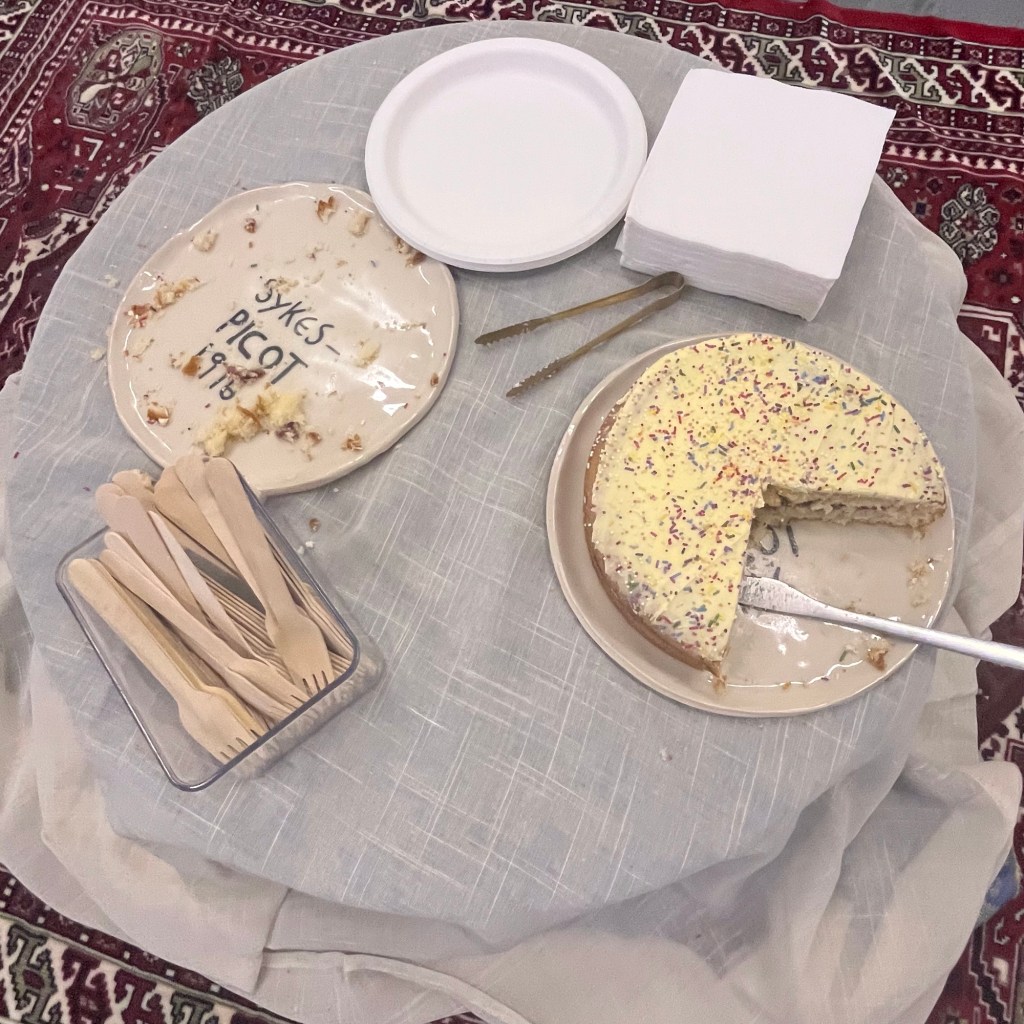
But despite the excitement, I had a difficult experience when I volunteered to invigilate for a day. The Biennial was short of volunteers, and I wanted to help. Yet what I found most challenging was being present in front of my own work: the Sykes–Picot plates, left exactly as they had been on opening night, still holding the crumbs of cake.

When visitors arrived, I would usually begin by introducing the other artists’ works, one by one. I avoided starting with my own. I didn’t present myself as “the artist” but as someone available to guide, to answer questions. I wanted to hear honest responses without the filter of politeness.

Two moments unsettled this:

– First, a group of visitors stopped at my work, were deeply moved, and immediately linked it to what is happening in Gaza. They asked questions, spoke at length, and even wanted a photo of me with the piece.

– Then, two other visitors became emotional as we discussed the history of Sykes–Picot. They spoke of the weariness of violence, of how exhausting it is to keep watching the news. One woman broke down in tears. I felt her exhaustion echo within me, though I tried to remain composed and gently encouraged her to look at the other works.

In those moments, I realised how much people need space to voice their rejection of violence and injustice. We all long for ways to speak out, to push against the weight of helplessness or guilt.. yet, after those encounters, I knew I couldn’t invigilate again. The conclusion was clear: invigilating is not for me.

Posted in 2025-2026, collaboration, curation, Exhibitions, Project, Reflection, Research

The Right Map – My wild Summer 

For more than three months this year, my life was consumed by The Right Map. Coordinating and organising eight shows ( Unstable 1,2,3,4, Account, Account Not Recognised, Slip Stream and In Search of Swallow and Amazon show/fundraising event) across Liverpool was a huge undertaking logistically, emotionally, and artistically. It was intense work: curating, communicating with artists and collaborators, solving problems on the spot, and carrying the responsibility of holding so many different voices together in one programme.

During the summer, I couldn’t write about it.. The pace was too fast, the demands too many, and on top of that, family responsibilities and personal challenges were pulling me in different directions. I was tired, grateful, overwhelmed, and very often carrying mixed feelings that left little room for reflection.

Looking back, I see the full image: what worked, what I loved, what was difficult, and where I grew. Writing from this distance feels possible, even necessary. I realise that part of my practice is not only in the making or the showing but also in reflecting.

The Right Map reminded me of this: the gaps, the tensions and the silences were as important as the works themselves. The experience was more than making artworks. It was about what happens when we work together, recognising where we succeeded so we can carry that forward, and where things did not work so we can avoid them in the future.

In the next posts, I want to unpack some of the moments that stayed with me: the artworks that resonated deeply, the tensions that tested me, the negotiations and miscommunications that revealed the realities of working collectively, and the unexpected joys that reminded me why I do this work.

I needed time to arrive here. To allow the intensity to pass, and to feel ready to write. Now, I can see The Right Map not only as a demanding project but as a turning point in how I think about curation, collaboration, and care in my practice..

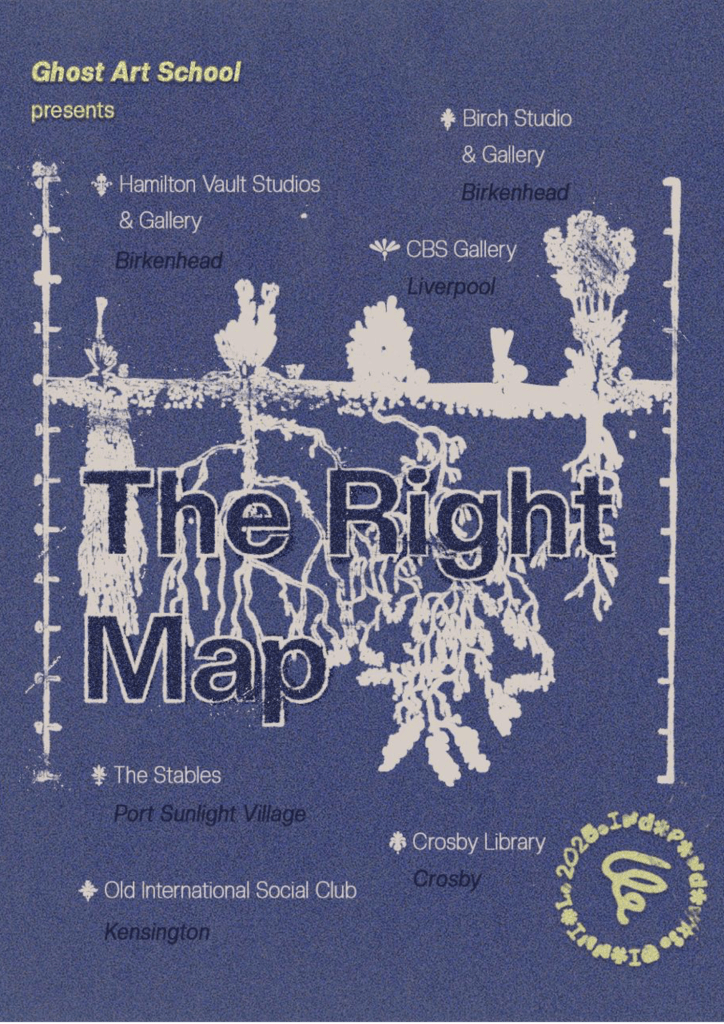
The Right Map was a series of exhibitions presented by Ghost Art School as part of the Independents Biennial. Emerging from the spirit of Ghost Art School, it celebrated artists who move between margins, who learn in the cracks, who map their own routes when none are given.

Here, the map was never fixed, drawn in gestures, erased by time, redrawn in conversation, in defiance, in care. The Right Map asked not where we are going, but how we move… and who gets to move with us.

The Right Map 36 artists: Alison Reid, Alma Stritt, Charli Kleeman, Chelsea Johnson, Chris Roberts, Colm Moore, Conner Browne, Cos Ahmet, Danielle Freakley, David W Hicks, Eleanor Capstick, Finn Roberts, Gary Finnegan, Gwendolin Kircali, Halyna Maystrenko-Grant, Hannah Browne, Harriet Morley, Igor Prato Luna, Jasmir Creed, Jessica Crowe, Karema Munassar, Lily Patricija, Mai Sanchez, Marie-Sofie Braune, Molly Lindsay, Molly Mousdell, Phoebe Thomas, Priya Foster, Ritu Arya, Rory Macbeth, Sonic Relics, Theodora Koumbouzis, Tom Doubtfire, Tom Kelly, Valentina Passerini, and Xueying Zhang 

Posted in Drawings, Exhibitions, Experiments, Project, Reflection, Writing

Crash Test

Earlier this month, a group of us, friends/artists gathered at Birch Studios & Gallery in Wirral, for a one-night experiment we called Crash Test. Half exhibition, half crit, half scratch night. Crash Test was a place to try things out, to test-drive new work and unfinished thoughts in a space where feedback was as valued as the visuals.

The idea was simple: set up something raw, something you’re unsure about, and invite others to respond. The name Crash Test seemed fitting, not just for its visual punch, but because it captured the risk, the speed, and the impact of trying something unpolished in public.

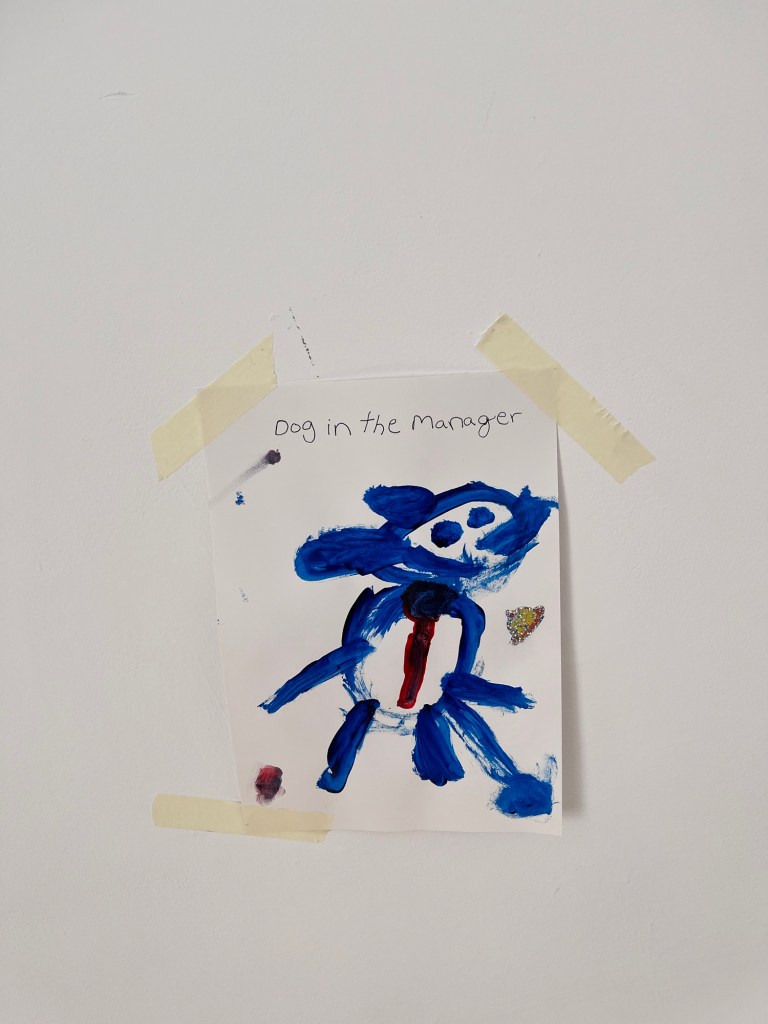
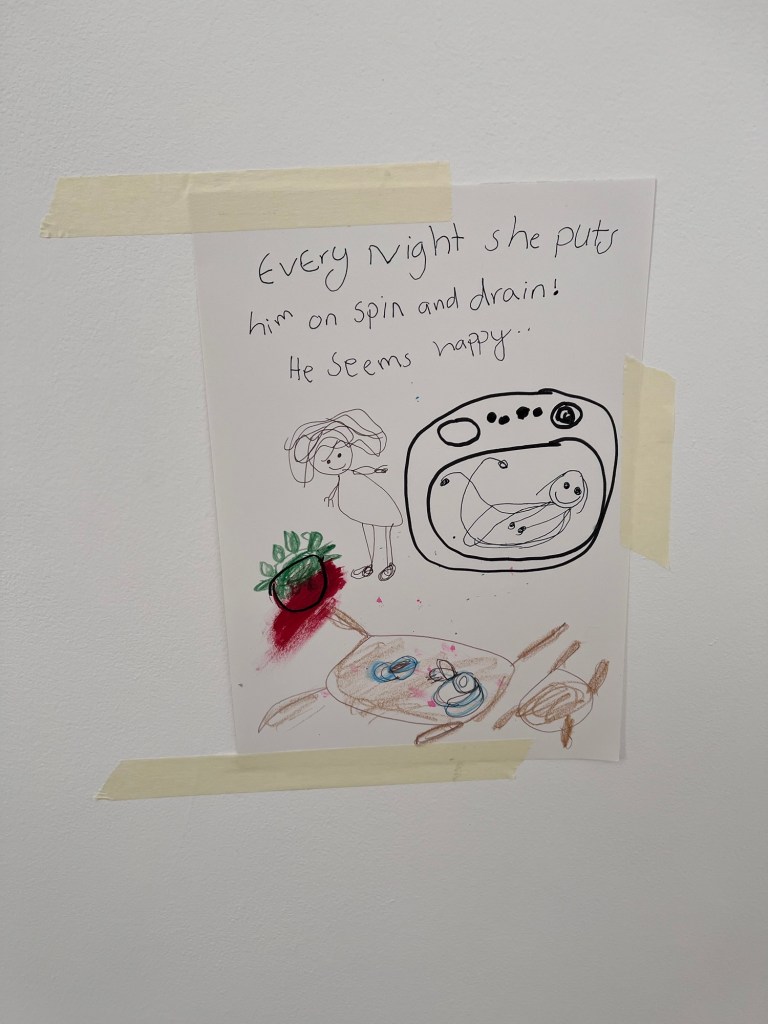
I brought along some child-like drawings, experimenting with simplicity, ambiguity, and humour. The feedback I received was encouraging, people connected with the looseness, the absurdity, and the layered messages behind the bright colours and crayon lines.

That said, for the upcoming Show ‘Unstable’ as part of the Independents Biennial, I want to develop something more dynamic and expansive, something less stable and more open-ended. I’m thinking of revisiting the Moon Litters idea. There’s something about the unpredictability of that work, the way it can shift and change over the exhibition’s duration that feels right for where I’m at now. It allows space for other voices, movements, and moments to enter.

My work 😬
Posted in collaboration, Exhibitions, Experiments, Research

The Right Map

Poster credit: Phoebe Thomas

Coordinating The Right Map for the Ghost Art School artists was intended as an act of support for others. But in the process, I found myself unexpectedly charting new ground in my own practice. What began as a curatorial and facilitative role gradually unfolded into a deep personal enquiry, one that significantly shaped my ongoing research in social sculpture.

I began to notice shifts in my own thinking. Supporting artists to articulate their intentions, reflect on their choices, and ground their practice compelled me to ask the same of myself. It was not a passive role; it was active, dynamic, and generative.

Interestingly, throughout The Right Map, I found myself increasingly drawn to the curatorial aspects of my work more than the making itself. It’s not just about presenting artworks, it’s about orchestrating experiences, holding conversations, shaping encounters. I became fascinated with how frameworks are built, how meaning is constructed around and through art. In many ways, the coordination itself became a form of social sculpture.

This shift is not about stepping away from being an artist…it’s about understanding the expanded field in which I operate. Curation, facilitation, research, and community-building have become a core tool kit in my practice. Through coordinating The Right Map, I gained new confidence in embracing this hybridity. I no longer see it as fragmented, but rather as a cohesive and intentional mode of working that reflects my values and voice.

https://www.instagram.com/p/DJov3YBo9Yg/?igsh=Mnd6MWh3MXRuaDQy

Posted in Exhibitions, Experiments, Moon, Reflection, Research, Visit, Writing

Trusting the Process.. Interim Show 2025

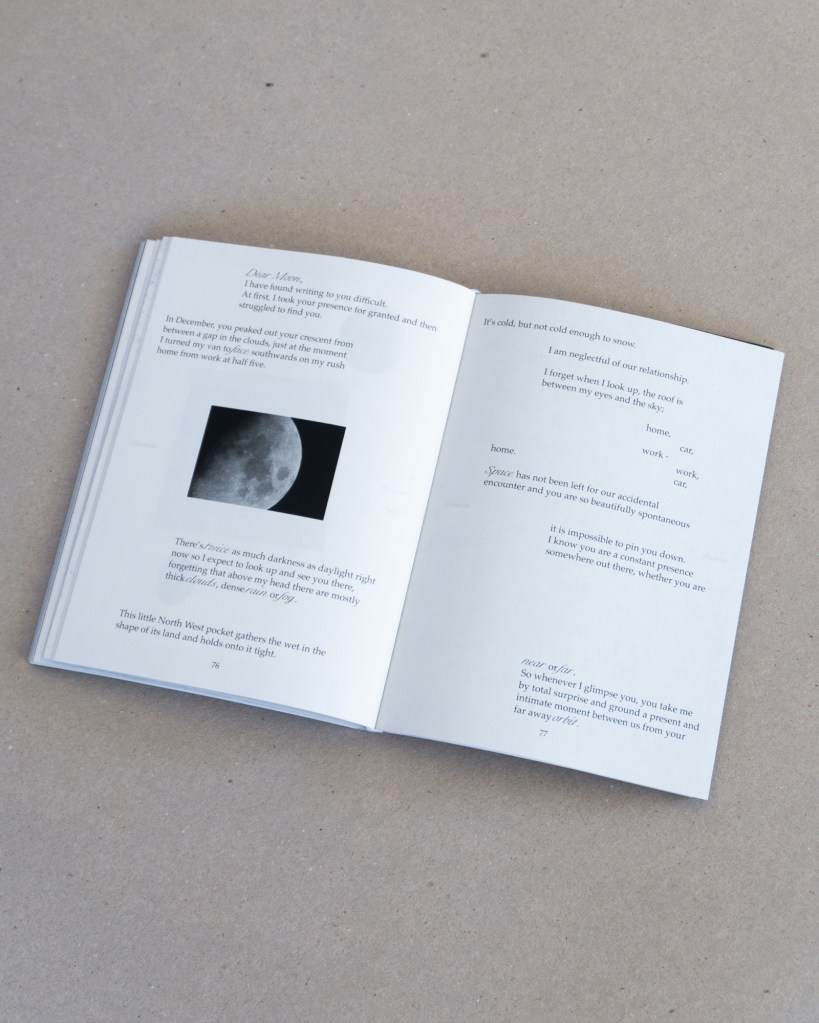
Since October, I’ve been immersed in the making of Dear Moon. What began as a simple idea grew into something layered and full of meaning. Over these months, I’ve learnt so much, not just about putting together a book, but about myself. The skills I’ve had to call on managing, organising, communicating, publishing, sharing all came with challenges. I had to practise patience.. I had to listen. And more than anything, I had to trust the process!

There were many moments when I didn’t know exactly where it was heading, but I allowed myself to follow the rhythm of the work, and something beautiful came through. I’m especially grateful that the work is expanding being read, being held and I’ve been watching it with a sort of quiet pride.

Still, I have to be honest. Sharing Dear Moon in public spaces hasn’t felt completely right. I tried presenting it in a vibrant setting, but I could feel the book asking for something else, something slower, more still. It asks the reader to sit, pause, and take time. And that’s hard to find in environments filled with movement.

So, although I didn’t quite succeed in the way I had imagined, I don’t see it as failure. Instead, I see it as another learning. The challenge now is to explore different ways a book like this can live in public space. How do I present it in a way that honours its pace and stillness? How can I guide people toward it gently, instead of expecting it to compete for attention?

I’m still learning, and I’m open. I’m proud of Dear Moon, and I know it will keep finding its way as long as I keep listening.

Posted in collaboration, Moon, Project, Reflection, Research, Writing

A Collaboration on Dear Moon (Service Point JNG)

Working on Dear Moon has been one of the most personal and expansive projects I’ve ever taken on. While the words came slowly, shaped by honesty and quiet reflection, the visual form of the book took a different kind of journey, one that became stronger and more meaningful through collaboration.

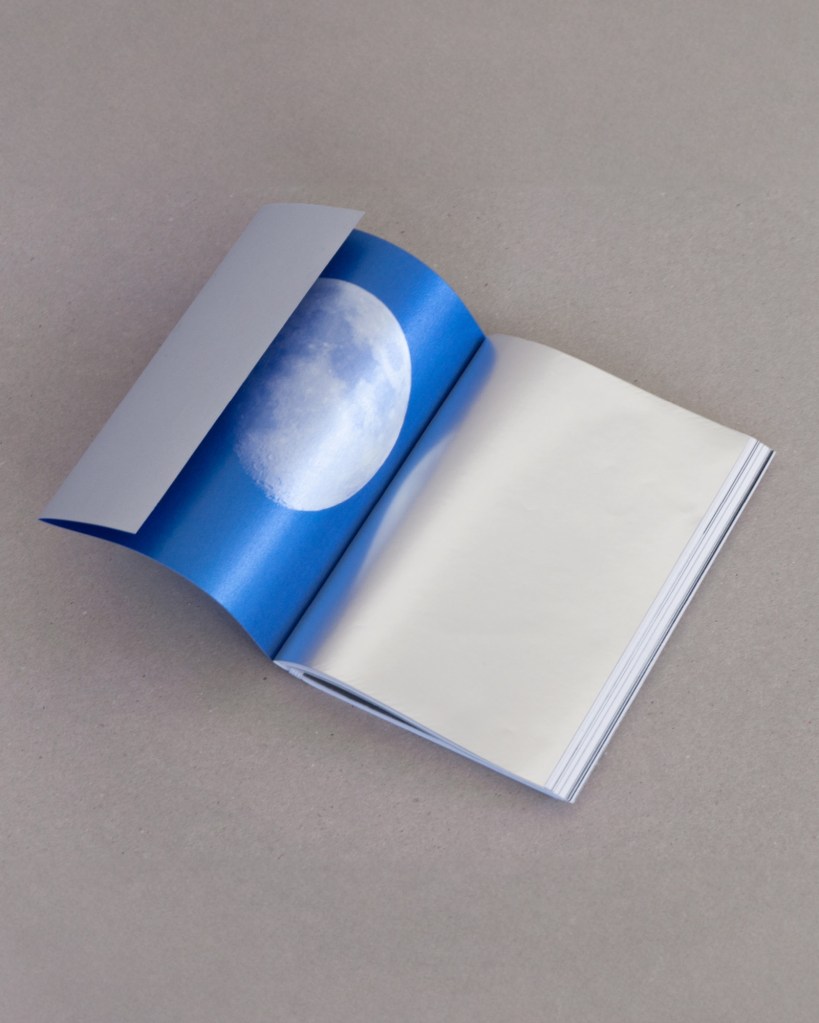
I had the pleasure of working with Jiayi and GG, two recent MA Graphic Design graduates from the university. They took on the challenge of designing Dear Moon and brought their own vision to it. Where I had initially imagined something simple, quiet, and almost invisible in its design letting the words do all the work they brought something else entirely: depth, elegance, and boldness in aesthetic.

Their design sensibility was so different from mine. I approached the book with simplicity, wanting to preserve the gentle rhythm of the letters and photographs without interruption. I didn’t want the visuals to overpower the messages within. But what Jiayi and GG brought was not overpowering it was enhancing. They introduced a poetic visual language: deep blues, moonscapes that speak for themselves, layout choices that echo the movement of tides and emotion. They weren’t just decorating; they were interpreting.

Looking at the final book now, I see a true collaboration. It’s no longer just a collection of letters; it’s a designed experience. A conversation between stillness and form.

Collaborating in this way has taught me the value of letting go. Of sharing creative control. Of trusting others to hold your work with care and transform it with love and intention. I feel Dear Moon is stronger because of this process, and I’m grateful to Jiayi and GG for reminding me how powerful cross-disciplinary work can be.

https://www.instagram.com/p/DHa-GsDKStV/?igsh=MWVza3g4eGFrZ2g0bw==

Posted in 2024/2025, Exhibitions, Experiments

Al-Mayida at Bridewell Gallery & Studios

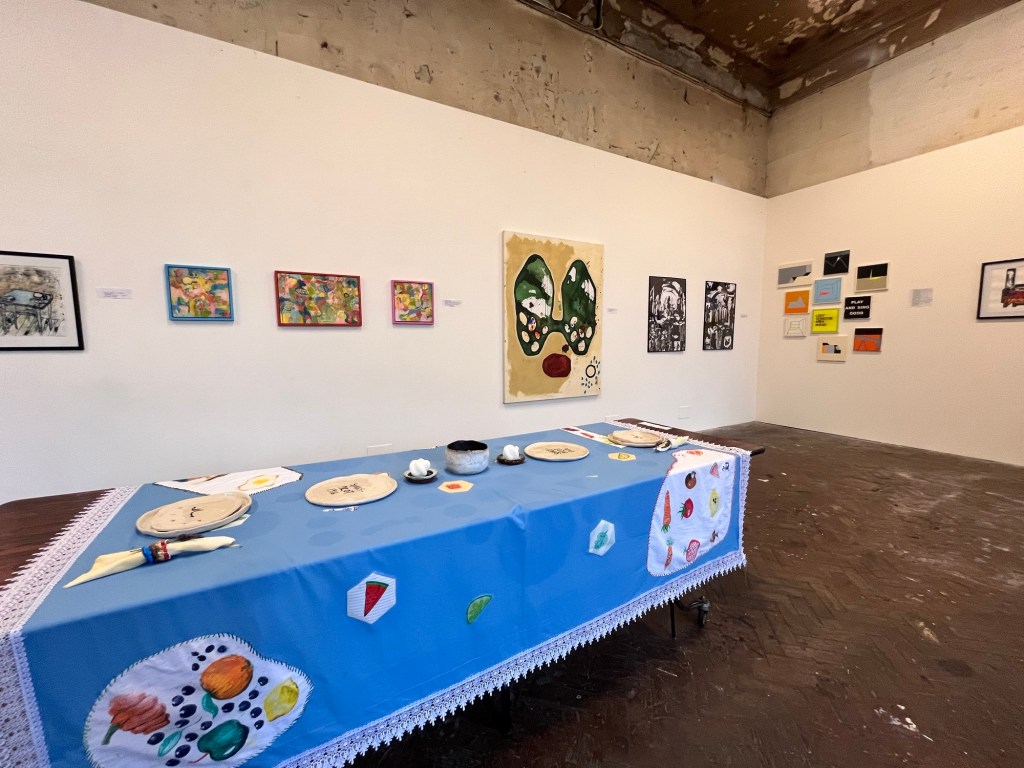
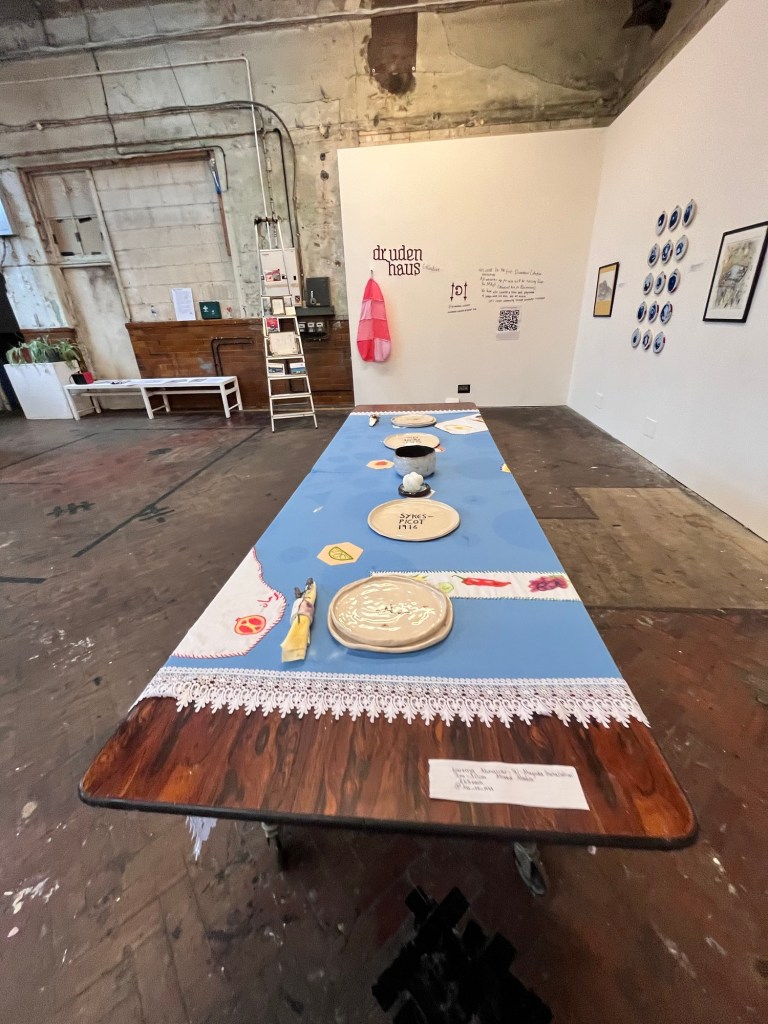
Again, Al-Mayida! The dining table is part of the DRUDENHAUS collective’s exhibition at Bridewell Gallery and Studios, Liverpool. This event includes a fundraiser for Medical Aid for Palestinians, adding a meaningful purpose to the show.

For this iteration, the work was set on a larger table than planned, shifting its dynamic. Though designed for two people, with fewer plates, and the tablecloth still bears marks left behind from previous exhibitions. The exhibition features both new and familiar artists, creating an interesting mix of perspectives.

Every curator brings a unique vision. The DRUDENHAUS collective’s decision to give the table more room to breathe was a contrast to previous presentations of Al-Mayida. This shift made me realise how flexible the work is, how it can adapt to different environments and be shaped by different interpretations.

One of the most meaningful aspects of this exhibition is its purpose as a fundraiser for Medical Aid for Palestinians. This adds weight and significance to the show. The dinner table, a place traditionally associated with hospitality, care, and conversation, becomes a symbol of solidarity. It reminds me that art doesn’t exist in isolation, it has the power to engage with real-world issues and bring people together in support of urgent causes.

Posted in Reflection, Tutorials 2024/2025, Writing

A Tutorial Reflection

Yesterday, I had a 1-1 tutorial with Jonathan, and it was a great opportunity to think aloud about my practice and research. It helped me reflect on where I’m, what comes next, and how I want to present my work in the interim show. More importantly, it allowed me to articulate the intentions behind my work—what I’m truly trying to communicate through it.

At the moment, I’m working on collecting all the moon letters people have submitted into a book, which I see as a sculpture—not just because of the process involved, but also due to the layers I’ve applied throughout its creation. Here, I wanted to make a book—not just a representation of one, but a real, physical book as a sculptural form. I wasn’t trying to turn a book into a sculpture; rather, I wanted to sculpt a book itself. This distinction has been crucial for me, and I feel I’ve achieved a lot through this approach.

The process remains ongoing—collecting letters, designing the book, and considering communication in both content and form. The creative process has pushed me in new ways and opening many doors.

Jonathan shared some useful links to researchers and artists, including Donna Haraway, Claire Bishop and Lucy & Jorge Orta. He also gave valuable advice on selecting the right paper type for the book, its cover, and how different inks could react on specific papers.

We also discussed different ways the book could be displayed, which made me think more deeply about its presence in a space and how the audience will engage with it—what I could add or take away. This reaffirmed that my work is not just about making an object; it’s about layering meaning, process, and interaction.