Posted in 2025-2026, Reading, Reflection, Research, Writing

Beuys and Sylvester

When I was reading for my research paper, I kept thinking about the unusual and slightly funny relationship between the German artist Joseph Beuys and the British critic David Sylvester! They were both major figures in modern art, but they never managed to build a close or comfortable connection.

Sylvester saw how important Beuys was. He never denied Beuys’s impact or how strongly he shaped his time, just as Duchamp had done for modern art. Even so, their relationship never became warm or collaborative. Sylvester had deep, ongoing conversations with many artists, but with Beuys he stayed distant, almost cautious.

This shows clearly in his writing. Sylvester never wrote a whole book about Beuys, nor explored him in the focused way he did with others. Beuys appears only here and there, usually as one example inside bigger discussions about conceptual art and post Duchamp ideas. Important, yes, but never at the centre.

The moment that captures their dynamic best is a small story Sylvester shared in About Modern Art, 2002 p.514-15. Beuys came to visit him at his flat in South London, bringing his wife, children and another friend. Before they entered, Sylvester asked him to remove his shoes, which he always asked visitors to do to protect his antique Persian carpets. Beuys refused!! His hat and clothes were part of his artistic identity and he would not take them off.. Sylvester refused too!! So they stood outside on the pavement, stuck between two different kinds of pride.

The more I think about it, the more I wonder what felt most important at that moment. For Sylvester, was it the artwork he lived with the antique rugs he treasured and protected or the chance to welcome an artist who was reshaping the art world? And for Beuys, a well established artist known for his big ideas, what mattered more being treated as a significant cultural figure, someone above everyday rules, or simply being a human guest respecting the home he was entering?!

In that moment, neither chose flexibility… And because of that, the visit never really began!

I find this story surprisingly touching…These were people who changed the direction of art, yet a simple request about shoes created a pause they could not overcome. Their relationship was always a mix of respect, misunderstanding, admiration and a bit of irritation.

They never became close, but their awkward meetings reveal something real about personality, ego and the small rituals of daily life. Maybe that is why I keep returning to this story. It shows how the biggest ideas in art can be interrupted by tiny habits and decisions. And sometimes, the most memorable parts of art history are not the grand gestures, but the little ones, like the moment when two strong characters collide at a doorway🙃

Posted in Exhibitions, Experiments, Moon, Reflection, Research, Visit, Writing

Trusting the Process.. Interim Show 2025

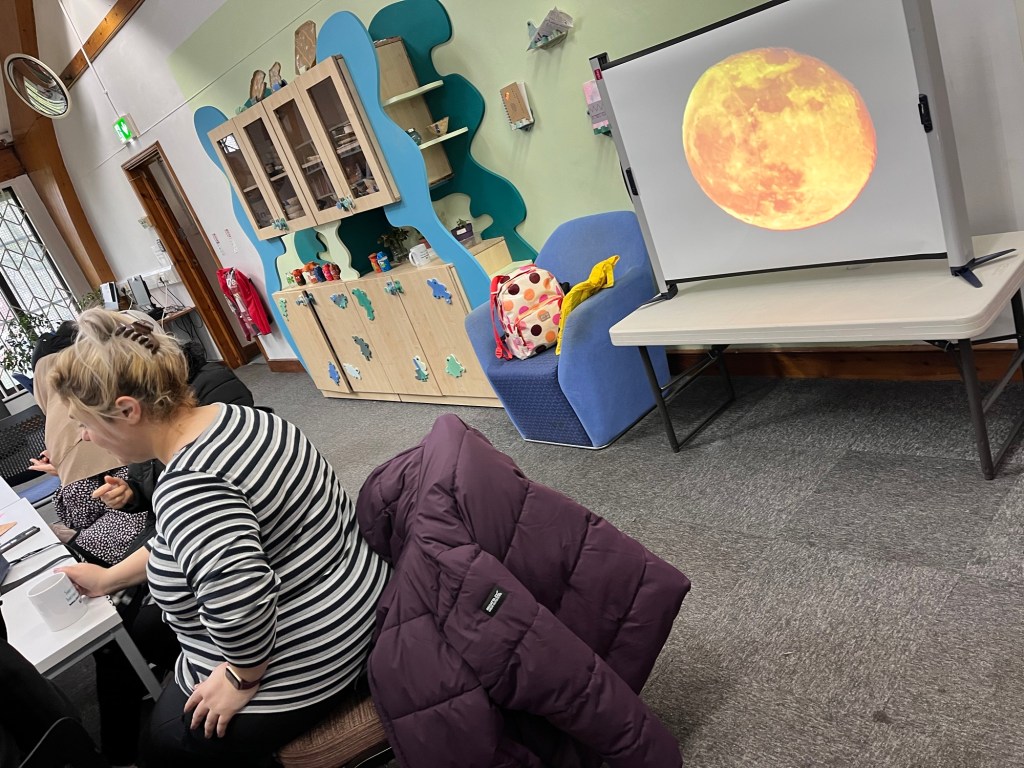
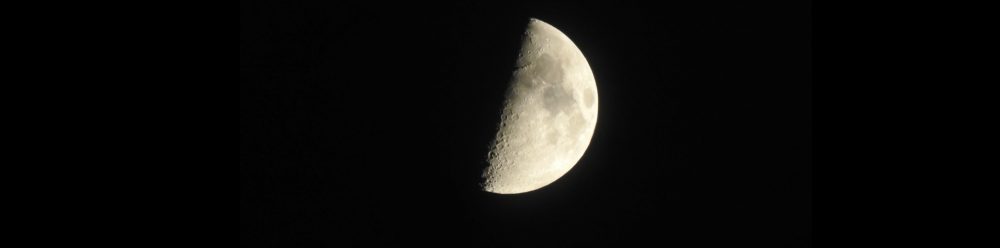
Since October, I’ve been immersed in the making of Dear Moon. What began as a simple idea grew into something layered and full of meaning. Over these months, I’ve learnt so much, not just about putting together a book, but about myself. The skills I’ve had to call on managing, organising, communicating, publishing, sharing all came with challenges. I had to practise patience.. I had to listen. And more than anything, I had to trust the process!

There were many moments when I didn’t know exactly where it was heading, but I allowed myself to follow the rhythm of the work, and something beautiful came through. I’m especially grateful that the work is expanding being read, being held and I’ve been watching it with a sort of quiet pride.

Still, I have to be honest. Sharing Dear Moon in public spaces hasn’t felt completely right. I tried presenting it in a vibrant setting, but I could feel the book asking for something else, something slower, more still. It asks the reader to sit, pause, and take time. And that’s hard to find in environments filled with movement.

So, although I didn’t quite succeed in the way I had imagined, I don’t see it as failure. Instead, I see it as another learning. The challenge now is to explore different ways a book like this can live in public space. How do I present it in a way that honours its pace and stillness? How can I guide people toward it gently, instead of expecting it to compete for attention?

I’m still learning, and I’m open. I’m proud of Dear Moon, and I know it will keep finding its way as long as I keep listening.

Posted in 2024/2025, Exhibitions, Experiments, Visit, Writing

Childlike Drawing

Book cover

As part of my ongoing exploration of communication, I recently created a series of childlike drawings for an upcoming exhibition in Glasgow, documenting my journey to Auchingarrich Park for the Pitch 2024 Ghost Art School exhibition.

Childlike drawings carry a unique authenticity and emotional impact. They are often raw, unfiltered, and filled with a sense of honesty. By using this approach, I aim to challenge traditional notions of what serious art should look like. 

My practice has always focused on breaking down barriers and fostering meaningful connections, and this childlike style is a way to make art more accessible to a wider audience. 

One of the key aspects of my practice is questioning hierarchies within the art world. By choosing a childlike style, I’m challenging the idea that only refined, technically skilled works are valuable. Instead, I’m highlighting that artistic value lies in the ideas, emotions, and dialogue that the work generates.

The simplicity and playful nature of these drawings highlight themes of innocence and exploration. In the context of my journey to Auchingarrich Park, this approach allowed me to convey a sense of wonder and curiosity, encouraging viewers to reflect on their own memories of childhood and play.

As I continue to explore this style, I look forward to seeing the book in the exhibition and observing how people will interact with it next week.

Posted in Experiments, Research, Writing

Hehehe!! A Scanner, Asemic Writing, and an Unexpected Translation

I had fun playing with a new scanner I bought to help me upload the physical Moon Letters to my computer. The quality is great, and I immediately thought—this would be perfect for digitising my Asemic writing.

I decided to experiment: I uploaded a piece of Asemic writing, then tried a translation tool to read the text from the image. I wasn’t expecting much, Asemic writing is by definition without a fixed meaning, existing in a space between language and pure form. But to my surprise, I got three translated lines.

This unexpected outcome was a moment of algorithmic improvisation, a piece of text I never wrote was suddenly part of the work. The machine involved itself in the process, introducing an element beyond my control, much like the way audiences reinterpret asemic writing in unpredictable ways.

Two questions immediately came to mind:

• What does it mean for an asemic text to be “translated”?

• Does this process create a new kind of auto-generated asemic language, where machine logic meets human mark-making?

This might just be the beginning of a new asemic project. And, I’m excited to experiment more, to invite the machine into the asemic process, and to see where this unexpected collaboration between human intention and machine misinterpretation leads me. 


Posted in Reflection, Tutorials 2024/2025, Writing

A Tutorial Reflection

Yesterday, I had a 1-1 tutorial with Jonathan, and it was a great opportunity to think aloud about my practice and research. It helped me reflect on where I’m, what comes next, and how I want to present my work in the interim show. More importantly, it allowed me to articulate the intentions behind my work—what I’m truly trying to communicate through it.

At the moment, I’m working on collecting all the moon letters people have submitted into a book, which I see as a sculpture—not just because of the process involved, but also due to the layers I’ve applied throughout its creation. Here, I wanted to make a book—not just a representation of one, but a real, physical book as a sculptural form. I wasn’t trying to turn a book into a sculpture; rather, I wanted to sculpt a book itself. This distinction has been crucial for me, and I feel I’ve achieved a lot through this approach.

The process remains ongoing—collecting letters, designing the book, and considering communication in both content and form. The creative process has pushed me in new ways and opening many doors.

Jonathan shared some useful links to researchers and artists, including Donna Haraway, Claire Bishop and Lucy & Jorge Orta. He also gave valuable advice on selecting the right paper type for the book, its cover, and how different inks could react on specific papers.

We also discussed different ways the book could be displayed, which made me think more deeply about its presence in a space and how the audience will engage with it—what I could add or take away. This reaffirmed that my work is not just about making an object; it’s about layering meaning, process, and interaction.

Posted in 2024/2025, Project, Research, Writing

Moon Letters and Shared Stories at Bootle Library

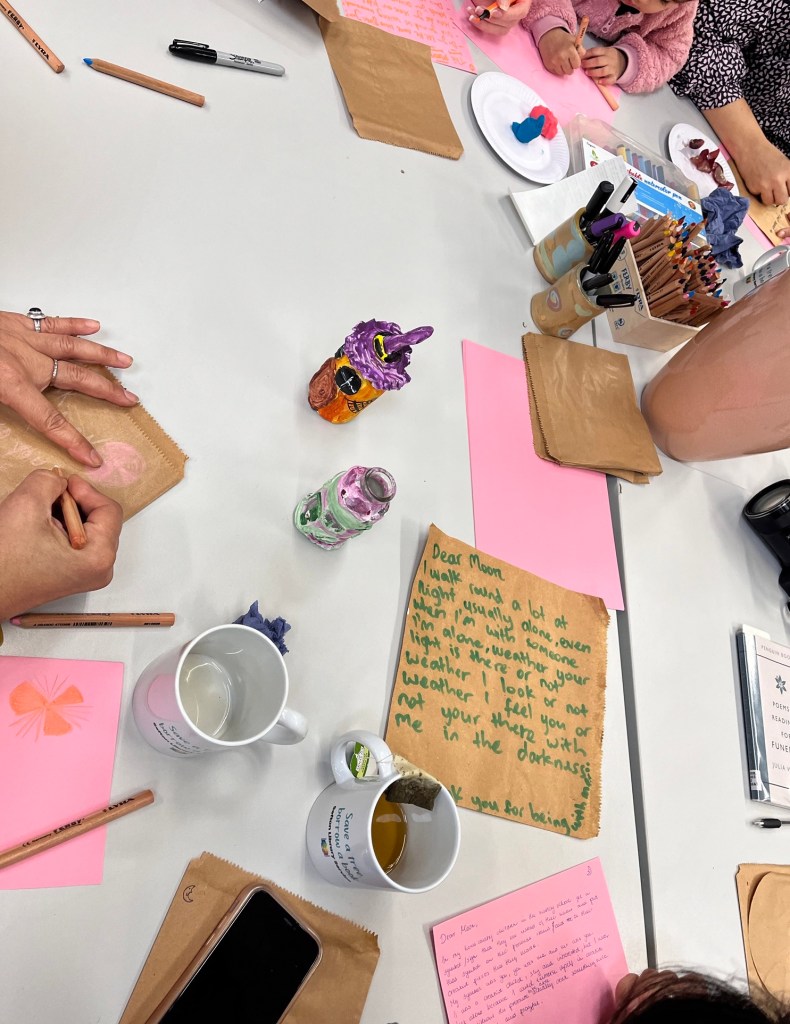
Today, I led a session at Bootle Library with my usual cultural group of ladies, joined by my colleagues from Rule of Threes, a representative from Liverpool Biennial, and artists from Darch Collective. It was a special gathering, as we’ll be contributing to their work for Liverpool Biennial: Bedrock 2025.

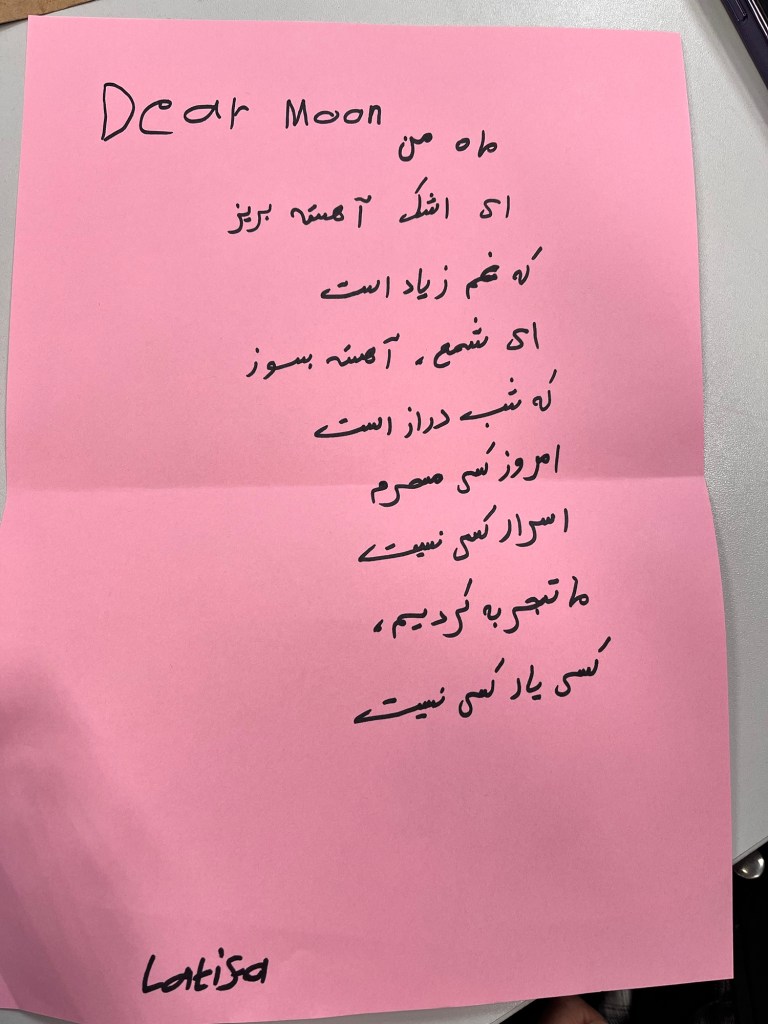
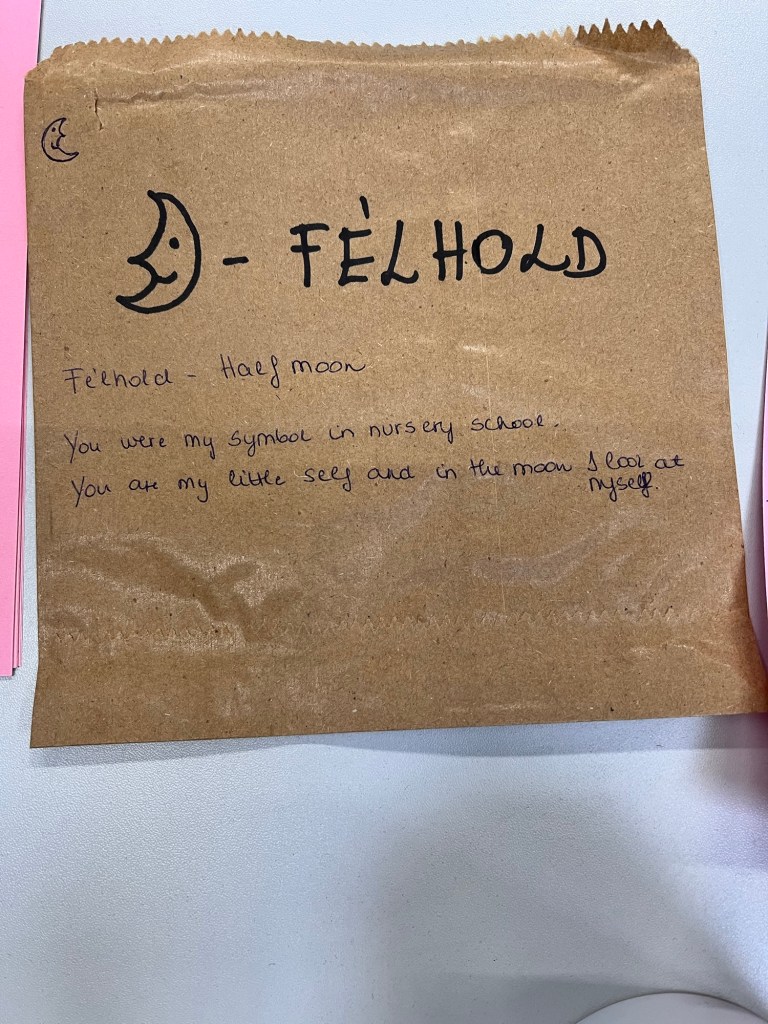
The session had a wonderful turnout, and I received 15 more letters for The Moon Letters project. I’m so grateful to everyone who has taken the time to contribute, and I can’t wait for the moment when I finally hold the book in my hands.

There’s something deeply personal about letters. I find myself attached to each one, treating them as precious objects. They arrive in different ways: through messages, emails, and in person. Each carrying unique thoughts, emotions, and perspectives. People respond in their own way, and I appreciate every word, every feeling that has been shared.

This project is becoming more than just a collection of letters, and  I’m excited to see where it leads and to share these stories with a wider audience.

https://atthelibrary.co.uk/projects/the-colour-of-pomegranates/

Posted in Lectures 2024/2025, Reflection, Writing

The White Pube Lecture

This week, I attended a truly inspiring lecture by The White Pube, a collective I’ve admired for their influence in the art world, especially in championing new and emerging artists. Gabrielle de la Puente and Zarina Muhammad, who started their journey as students at Central Saint Martins, have since grown into influential voices in the contemporary art scene. Their candid and relatable approach resonates deeply, and it was fascinating to learn more about their evolution.

The collective has recently released a book titled Poor Artist, and I was intrigued by their process and approach to publishing. As someone planning to create a book for our upcoming exhibition in March 2025, their journey felt particularly relevant. Gabrielle and Zarina shared how they ventured into publishing without prior experience in creative writing or the publishing industry, relying instead on the foundation of their studio practice. This reminded me of Roy Claire Potter’s words about how creative work stems from lived experience, a sentiment that deeply connects with my own artistic practice.

A highlight for me was when Gabrielle reflected on a conversation with her tutor. She had asked, “How do I become an artist?” to which her tutor replied, “Don’t stop making art.” That phrase stayed with me—not just for its simplicity but for its broader implications. Making art isn’t confined to producing physical pieces; it extends to engaging with the art world in multiple ways: reading, writing, reflecting, and staying informed about what’s happening around us.

The lecture also highlighted how The White Pube began writing for themselves, creating a voice that spoke to two audiences at once: the critical, often inaccessible world of theory, and the everyday experience of artists. They carved out a niche by addressing what they felt was missing—a relatable, conversational space in art writing that didn’t conform to traditional academic or journalistic norms.

This approach inspires me to reflect on my own work and how I can make my practice and writing more accessible, honest, and personal. Gabrielle and Zarina’s story is a reminder that starting small, writing for yourself, and embracing your voice can lead to impactful outcomes.

As I think about the book we’ll be creating for our exhibition, their journey offers a template for how to take risks and embrace the unknown. It’s not about perfection but about authenticity and a willingness to keep going.

This lecture was not only insightful but also a reminder of the power of persistence and self-expression in art. I’m grateful for their honesty and look forward to delving into Poor Artist for more inspiration.

Posted in Research

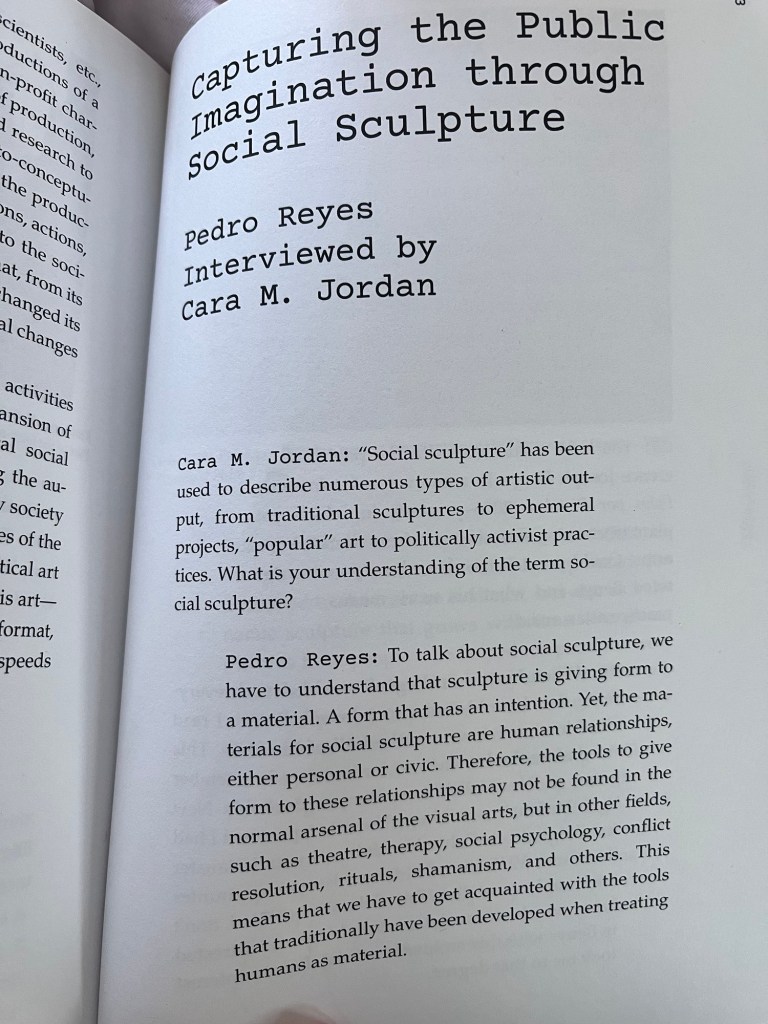
Inspiring Text: Pedro Reyes on Social Sculpture

The interview between Pedro Reyes and Cara M. Jordan is a fascinating exploration of social sculpture and its potential for societal impact. Reyes presents a compelling perspective on social sculpture as a medium where human relationships become the material, transcending traditional artistic boundaries and incorporating tools from diverse fields such as theatre, therapy, and rituals.

Reyes’ reflection on Joseph Beuys as a foundational influence further enriches the discussion, particularly through his project Palas por Pistolas, which transforms weapons into tools for reforestation—a direct homage to Beuys’ 7,000 Oaks. This project exemplifies dynamic, living art that evolves over time, reflecting the transformative power of human collaboration. His appreciation for Beuys’ humour and dedication to socialism underscores an optimistic yet critical vision of art’s role in addressing complex social issues.

Reyes’ commitment to accessibility is especially notable, as he advocates for art that transcends traditional audiences and creates transformative experiences regardless of participants’ familiarity with the art world. Collaborative projects like Sanatorium and People’s United Nations (pUN) highlight his dedication to co-creation and role-play, fostering a sense of ownership and shared authorship among participants.

His belief in the transformative power of materials is equally inspiring. The act of turning rifles into flutes, for example, embodies his philosophy of relational objects—artifacts that catalyse social encounters and spark psychological shifts. This approach strongly resonates with my interest in social sculpture and the symbolic potential of everyday materials.

This interview has deeply influenced my practice, offering inspiration for integrating participatory frameworks, addressing sociopolitical themes, and ensuring inclusivity. Reyes’ approach aligns with my focus on creating art that bridges communication gaps and meaningfully engages audiences, providing valuable strategies to advance my work.

Posted in Motivations, Reflection, Writing

Artist or Writer?

Recently, I tuned into Artists That Write, a fascinating session hosted by We Are Axis, featuring Roy Claire Potter, Roo Dhissou, and Madinah Farhannah. Listening to them discuss their practices and read their work was both inspiring and thought-provoking. It’s always exciting to hear how other artists navigate the overlap between visual art and writing—a space I feel I occupy but have never fully claimed.

I’ve always loved writing, but I hesitate to call myself a “proper writer.” Writing feels more like another medium to me, something I play with and manipulate, much like clay or paint. I resist the constraints of inherited rules about “how” one should write, preferring instead to follow my intuition. As an artist, I’m not aiming for polished prose or perfect grammar; I’m exploring, experimenting, and communicating without borders.

Roy Claire Potter’s reflections particularly resonated with me. They spoke about being more interested in methods and how you make things rather than what you make, which aligns so closely with my own approach. Roy shared insights into a piece they created ten years ago, Mental Furniture, which involved a broken manual typewriter. I’m intrigued to read the book tied to that work and to delve deeper into their methods.

Another standout moment was when Roy talked about The Wastes—how they felt they contained a book within themselves, not one born of studying creative writing but one emerging directly from studio practice. This struck a chord with me. It affirmed the idea that writing, for some artists, is an extension of making rather than an entirely separate discipline.

Roy said something I’ll carry with me: “Text is a cultural thing. Films are text. Fashion is text. Images are text.” It reframed my understanding of writing and language, validating the idea that words are just one form of communication among many. As someone who constantly plays with meaning and form, this was a liberating thought.

For me, writing will always be a tool of exploration—an extension of my practice, unbound by conventions. I’m not a writer who writes like a writer. I’m an artist who writes like an artist.

Posted in Reflection, Visit, Writing

Finding Focus: The Wastes

Last week, I attended the book launch for The Wastes, a novella by Roy Claire Potter. Potter was joined by guest artists David Jacques, Roo Dhissou, and Harriet Morley at Dead Ink Books in Liverpool. It was a wonderful evening celebrating the work of an artist and writer whose practice profoundly influenced my own during my BA studies. I liked Roy Claire’s ability to weave humour and insight into their reflections on everyday working-class life. In The Wastes, this approach shines through as memories ripple across the narrative, creating a vivid and relatable journey for the reader.

Experiencing the book and the discussions around it gave me a renewed sense of direction for my MA in Fine Art. I’ve realised that writing and participatory art are central to my practice, and I want to explore these areas with greater intention. Roy Claire’s work reminded me how powerful text can be—not just as a medium for communication but as a way to build connections.

Moving forward, I’m determined to channel more energy into developing my writing alongside my participatory projects. This means refining my approach to storytelling and reflection while exploring ways to integrate these elements into interactive art-making. I want to experiment, learn by doing, and create a structured plan to support my growth in both areas.

Attending the book launch wasn’t just about celebrating a great piece of writing—it was a reminder of my purpose and aspirations. Writing and participatory art are more than tools in my practice; they are at the core of how I want to connect with others and create art that resonates.