Posted in 2025-2026, collaboration, Exhibitions, Project, Reflection

The Right Map Reflection: Communication Through Hands

I showed a new work in the group exhibition Slip Stream at CBS Gallery 1st July , curated by Phoebe Thomas. The curatorial framework set us an unusual challenge: each artist was given a 50-word anonymous biography of another contributor. Without names, without identities, we had to respond to these fragments and create a work that became, in some way, a conversation.

My response was a sculpture that invited people to communicate through their hands. The idea began with a conversation I had with my tutor, Jonathan, about how deafblind people often use touch as their primary language. That image stayed with me, of words transformed into hand movements, of dialogue carried through the skin.

I worked with a carpenter to build a wooden structure, box-like and slightly absurd. In fact, he thought it was a lab project at first, not an artwork. It has two circular holes on each side, just large enough for a hand to slip through. Inside, participants could meet in the middle, fingertips searching for another human presence.

What unfolded was fascinating. Some people laughed, finding the whole set-up comical. Others hesitated, uncertain about the strangeness of touching an unseen hand. A few lingered, holding on quietly as though the box had suspended time and language. I loved how the responses varied, awkwardness, tenderness, curiosity, even vulnerability.

For me, the sculpture is about the fragility of communication. We take for granted the ease of speaking or looking, but when those channels are removed, what remains? What does it mean to reach out when you cannot see or hear the other person? In the gallery, the box became a stage for these encounters: funny, intimate, and unsettling all at once.

This work revealed something important about my practice. I often circle back to questions of language, misunderstanding, and how people find ways to connect across barriers. I came to see how even the simplest gestures can be at once symbolic and deeply tangible. In its awkwardness, the sculpture echoed the curatorial task we had taken on blindly, while also reflecting my interest in co-production: an exploration of indirect connection, partial knowledge, and the fragile space between concealment and encounter.

Posted in 2025-2026, collaboration, curation, Exhibitions, Reflection

Invigilator X Artist

Someone: Should artists invigilate their own exhibition?

Me: Absolutely not!

We finally opened our first exhibition Unstable #1 on the festival’s opening day 7th of June . The works were powerful, the team was wonderful, and I learned so much from them. I remain deeply grateful to everyone who came, especially my tutor Jonathan. The exhibition brought together artists from Liverpool, London, Glasgow, Germany, and even as far as Australia.

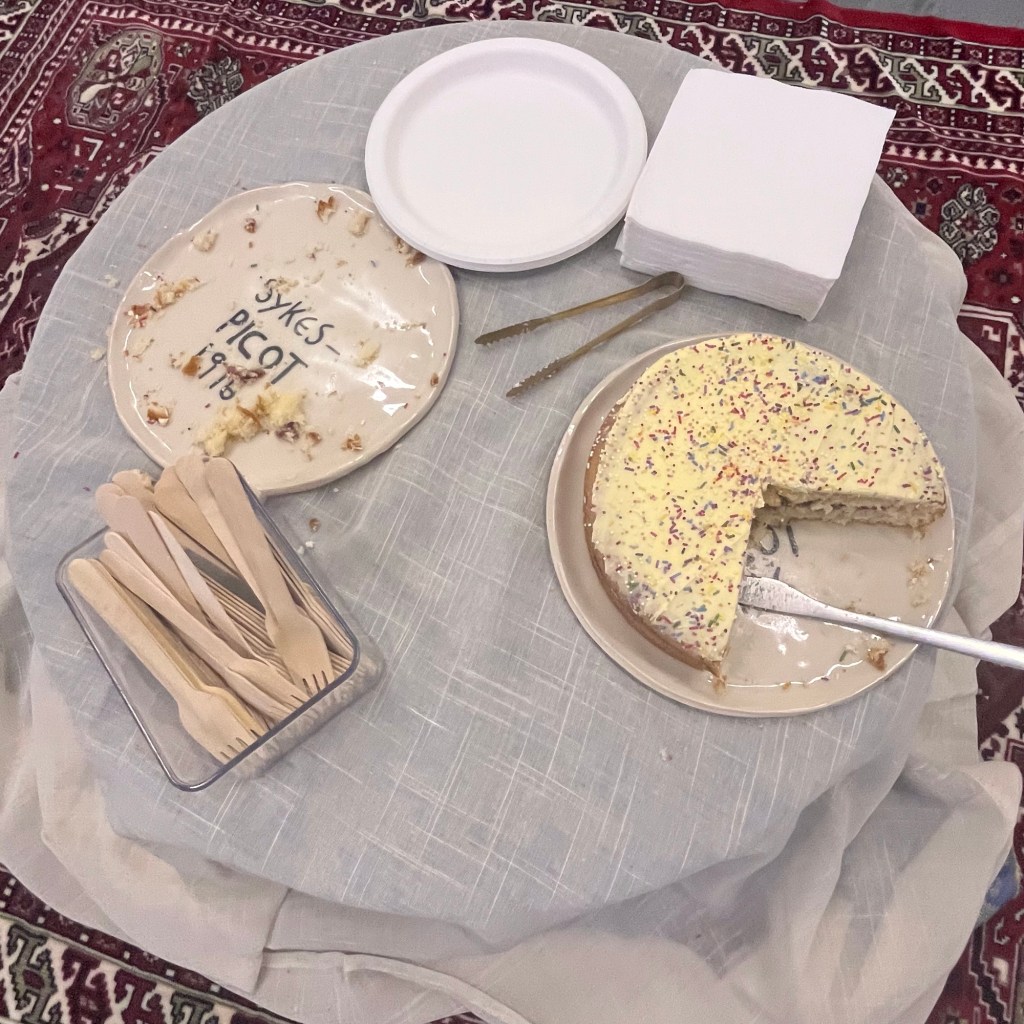
But despite the excitement, I had a difficult experience when I volunteered to invigilate for a day. The Biennial was short of volunteers, and I wanted to help. Yet what I found most challenging was being present in front of my own work: the Sykes–Picot plates, left exactly as they had been on opening night, still holding the crumbs of cake.

When visitors arrived, I would usually begin by introducing the other artists’ works, one by one. I avoided starting with my own. I didn’t present myself as “the artist” but as someone available to guide, to answer questions. I wanted to hear honest responses without the filter of politeness.

Two moments unsettled this:

– First, a group of visitors stopped at my work, were deeply moved, and immediately linked it to what is happening in Gaza. They asked questions, spoke at length, and even wanted a photo of me with the piece.

– Then, two other visitors became emotional as we discussed the history of Sykes–Picot. They spoke of the weariness of violence, of how exhausting it is to keep watching the news. One woman broke down in tears. I felt her exhaustion echo within me, though I tried to remain composed and gently encouraged her to look at the other works.

In those moments, I realised how much people need space to voice their rejection of violence and injustice. We all long for ways to speak out, to push against the weight of helplessness or guilt.. yet, after those encounters, I knew I couldn’t invigilate again. The conclusion was clear: invigilating is not for me.

Posted in 2025-2026, collaboration, curation, Exhibitions, Project, Reflection, Research

The Right Map – My wild Summer 

For more than three months this year, my life was consumed by The Right Map. Coordinating and organising eight shows ( Unstable 1,2,3,4, Account, Account Not Recognised, Slip Stream and In Search of Swallow and Amazon show/fundraising event) across Liverpool was a huge undertaking logistically, emotionally, and artistically. It was intense work: curating, communicating with artists and collaborators, solving problems on the spot, and carrying the responsibility of holding so many different voices together in one programme.

During the summer, I couldn’t write about it.. The pace was too fast, the demands too many, and on top of that, family responsibilities and personal challenges were pulling me in different directions. I was tired, grateful, overwhelmed, and very often carrying mixed feelings that left little room for reflection.

Looking back, I see the full image: what worked, what I loved, what was difficult, and where I grew. Writing from this distance feels possible, even necessary. I realise that part of my practice is not only in the making or the showing but also in reflecting.

The Right Map reminded me of this: the gaps, the tensions and the silences were as important as the works themselves. The experience was more than making artworks. It was about what happens when we work together, recognising where we succeeded so we can carry that forward, and where things did not work so we can avoid them in the future.

In the next posts, I want to unpack some of the moments that stayed with me: the artworks that resonated deeply, the tensions that tested me, the negotiations and miscommunications that revealed the realities of working collectively, and the unexpected joys that reminded me why I do this work.

I needed time to arrive here. To allow the intensity to pass, and to feel ready to write. Now, I can see The Right Map not only as a demanding project but as a turning point in how I think about curation, collaboration, and care in my practice..

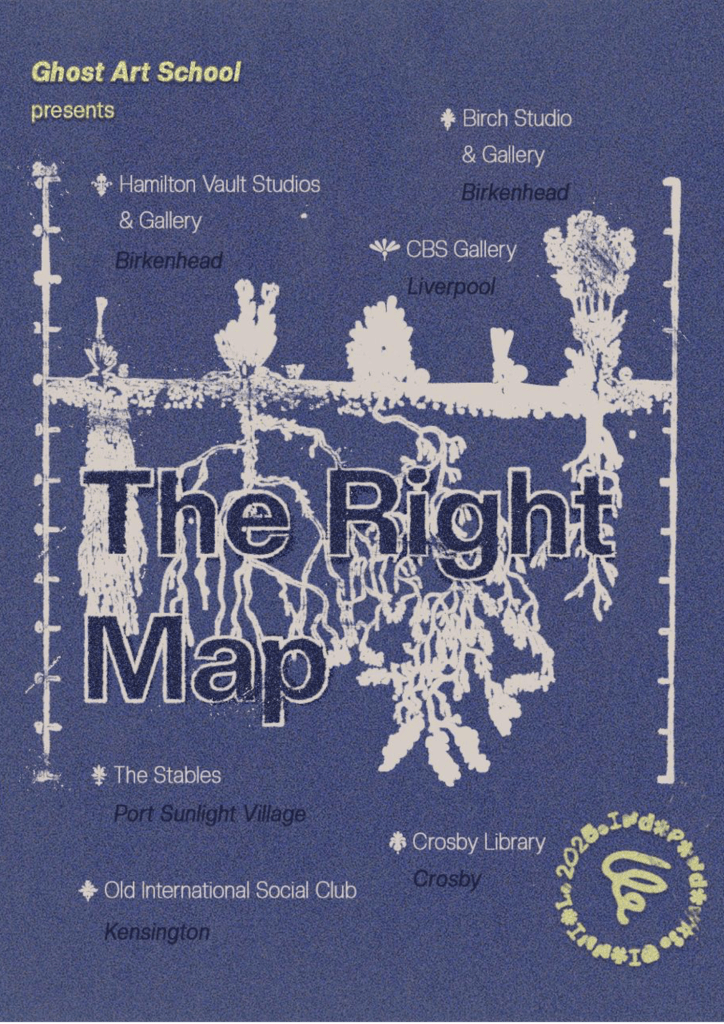
The Right Map was a series of exhibitions presented by Ghost Art School as part of the Independents Biennial. Emerging from the spirit of Ghost Art School, it celebrated artists who move between margins, who learn in the cracks, who map their own routes when none are given.

Here, the map was never fixed, drawn in gestures, erased by time, redrawn in conversation, in defiance, in care. The Right Map asked not where we are going, but how we move… and who gets to move with us.

The Right Map 36 artists: Alison Reid, Alma Stritt, Charli Kleeman, Chelsea Johnson, Chris Roberts, Colm Moore, Conner Browne, Cos Ahmet, Danielle Freakley, David W Hicks, Eleanor Capstick, Finn Roberts, Gary Finnegan, Gwendolin Kircali, Halyna Maystrenko-Grant, Hannah Browne, Harriet Morley, Igor Prato Luna, Jasmir Creed, Jessica Crowe, Karema Munassar, Lily Patricija, Mai Sanchez, Marie-Sofie Braune, Molly Lindsay, Molly Mousdell, Phoebe Thomas, Priya Foster, Ritu Arya, Rory Macbeth, Sonic Relics, Theodora Koumbouzis, Tom Doubtfire, Tom Kelly, Valentina Passerini, and Xueying Zhang 

Posted in Drawings, Exhibitions, Experiments, Project, Reflection, Writing

Crash Test

Earlier this month, a group of us, friends/artists gathered at Birch Studios & Gallery in Wirral, for a one-night experiment we called Crash Test. Half exhibition, half crit, half scratch night. Crash Test was a place to try things out, to test-drive new work and unfinished thoughts in a space where feedback was as valued as the visuals.

The idea was simple: set up something raw, something you’re unsure about, and invite others to respond. The name Crash Test seemed fitting, not just for its visual punch, but because it captured the risk, the speed, and the impact of trying something unpolished in public.

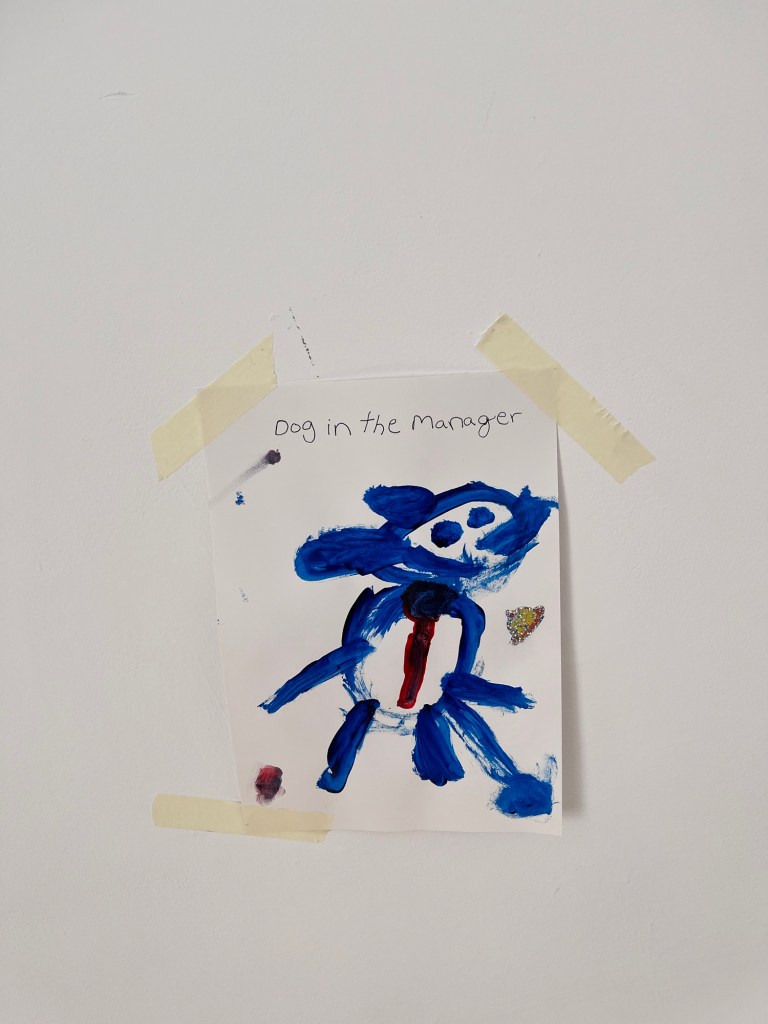
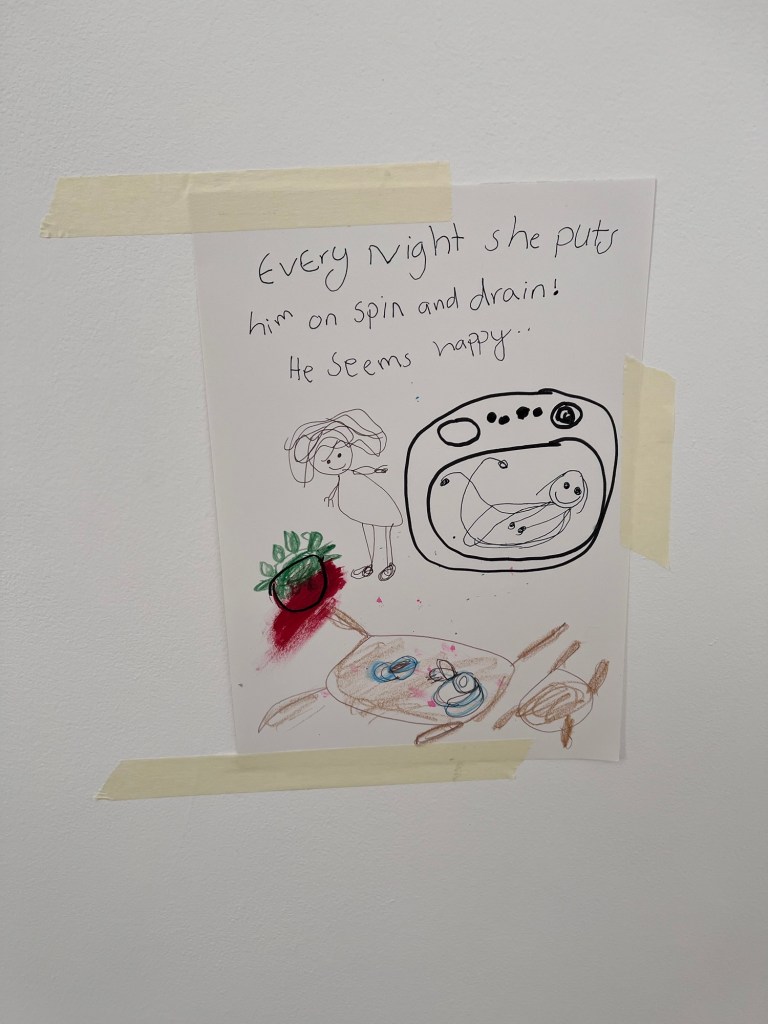
I brought along some child-like drawings, experimenting with simplicity, ambiguity, and humour. The feedback I received was encouraging, people connected with the looseness, the absurdity, and the layered messages behind the bright colours and crayon lines.

That said, for the upcoming Show ‘Unstable’ as part of the Independents Biennial, I want to develop something more dynamic and expansive, something less stable and more open-ended. I’m thinking of revisiting the Moon Litters idea. There’s something about the unpredictability of that work, the way it can shift and change over the exhibition’s duration that feels right for where I’m at now. It allows space for other voices, movements, and moments to enter.

My work 😬
Posted in collaboration, Exhibitions, Experiments, Research

The Right Map

Poster credit: Phoebe Thomas

Coordinating The Right Map for the Ghost Art School artists was intended as an act of support for others. But in the process, I found myself unexpectedly charting new ground in my own practice. What began as a curatorial and facilitative role gradually unfolded into a deep personal enquiry, one that significantly shaped my ongoing research in social sculpture.

I began to notice shifts in my own thinking. Supporting artists to articulate their intentions, reflect on their choices, and ground their practice compelled me to ask the same of myself. It was not a passive role; it was active, dynamic, and generative.

Interestingly, throughout The Right Map, I found myself increasingly drawn to the curatorial aspects of my work more than the making itself. It’s not just about presenting artworks, it’s about orchestrating experiences, holding conversations, shaping encounters. I became fascinated with how frameworks are built, how meaning is constructed around and through art. In many ways, the coordination itself became a form of social sculpture.

This shift is not about stepping away from being an artist…it’s about understanding the expanded field in which I operate. Curation, facilitation, research, and community-building have become a core tool kit in my practice. Through coordinating The Right Map, I gained new confidence in embracing this hybridity. I no longer see it as fragmented, but rather as a cohesive and intentional mode of working that reflects my values and voice.

https://www.instagram.com/p/DJov3YBo9Yg/?igsh=Mnd6MWh3MXRuaDQy

Posted in 2024/2025, Assignments, Reflection

Unit 1 Assessment

Learning Outcome 1:
Formulate, describe and implement a challenging and self-directed programme of study, relating to your Study Statement. (Assessment Criteria: Enquiry):

My work explores topics of communication, connection, and collective experience through projects such as Al-Mayida, Letters to the Moon, asemic writing, and childlike drawings. Each project looks at how art fosters debate, narrative, and inclusivity. Interviews with Pedro Reyes about social sculpture, White Pube’s new book, and Axis’ Artists That Write have all inspired me. Furthermore, the Art for the Earth’s Sake initiative stressed the importance of adopting an ecocentric perspective to social practice. All of these influences have shaped my self-directed method, in which I investigate and learn from literature and artists, as well as my own artworks.

Learning Outcome 2:
Implement appropriate working methods for building an independent and effective self-organisation that enables the critical engagement with practice-based research.
(Assessment Criteria: Process):

In projects such as Al-Mayida, I experiment with diverse curatorial approaches, but in Letters to the Moon, I prioritise participant interaction. My process-driven approach accepts ambiguity and improvisation, which is consistent with Jonathan’s reflection in action research. The final session of Art for Earth’s Sake was especially powerful, as we discussed how artists can practise sustainability, set a good example, and utilise art as a tool for social and environmental change. 

Learning Outcome 3:
Communicate a critical understanding of your developing practice.
(Assessment Criteria: Knowledge, Communication):

My work is a type of social sculpture, an ever-changing discussion that connects personal and collective experiences. Projects such as Al-Mayida focus on unity and history, whereas Letters to the Moon promotes communication and community involvement. My efforts with asemic writing and childlike drawing disrupt art’s traditional hierarchies, emphasising authenticity and accessibility.

At last, I want to utilise art to promote social interactions and spark meaningful discourse about sociopolitical and environmental challenges. Through documentation, reflections, short courses, and visits, I hope to create work that promotes connection, dialogue, and communal action.

Feedback requests:

I would appreciate feedback on two experiments I’m currently working on: Asemic writing with translation and childlike drawings. Both approaches are new and quite different from one another.

Posted in 2024/2025, Exhibitions, Experiments, Visit, Writing

Childlike Drawing

Book cover

As part of my ongoing exploration of communication, I recently created a series of childlike drawings for an upcoming exhibition in Glasgow, documenting my journey to Auchingarrich Park for the Pitch 2024 Ghost Art School exhibition.

Childlike drawings carry a unique authenticity and emotional impact. They are often raw, unfiltered, and filled with a sense of honesty. By using this approach, I aim to challenge traditional notions of what serious art should look like. 

My practice has always focused on breaking down barriers and fostering meaningful connections, and this childlike style is a way to make art more accessible to a wider audience. 

One of the key aspects of my practice is questioning hierarchies within the art world. By choosing a childlike style, I’m challenging the idea that only refined, technically skilled works are valuable. Instead, I’m highlighting that artistic value lies in the ideas, emotions, and dialogue that the work generates.

The simplicity and playful nature of these drawings highlight themes of innocence and exploration. In the context of my journey to Auchingarrich Park, this approach allowed me to convey a sense of wonder and curiosity, encouraging viewers to reflect on their own memories of childhood and play.

As I continue to explore this style, I look forward to seeing the book in the exhibition and observing how people will interact with it next week.

Posted in 2024/2025, Exhibitions, Experiments

Al-Mayida at Bridewell Gallery & Studios

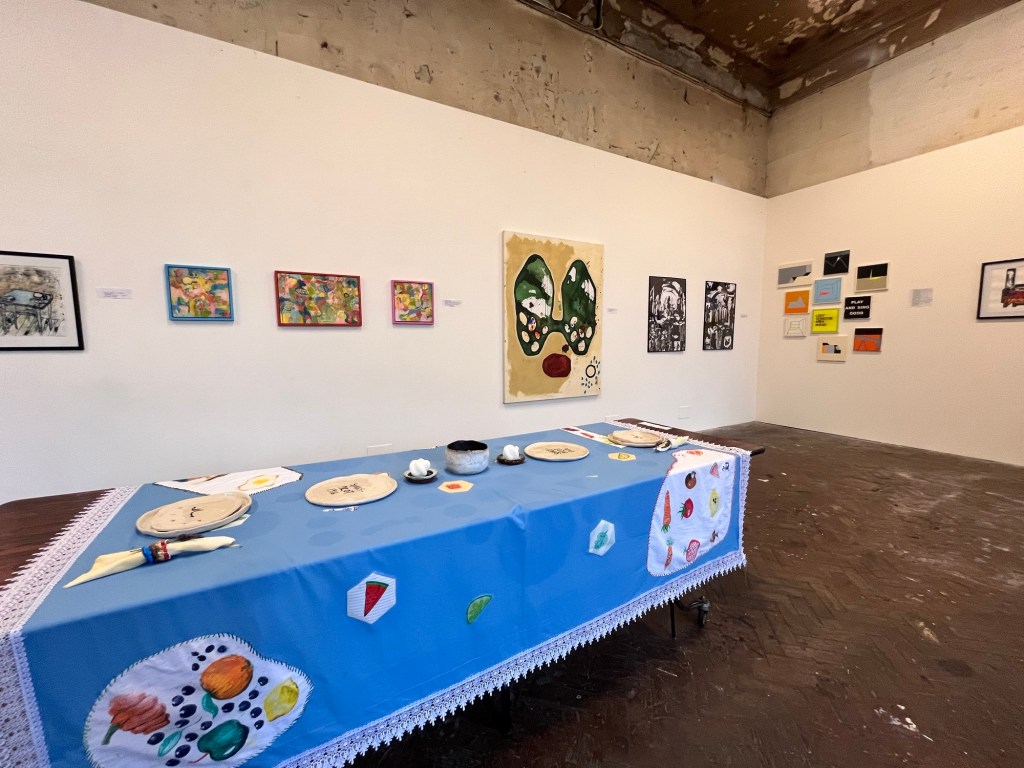
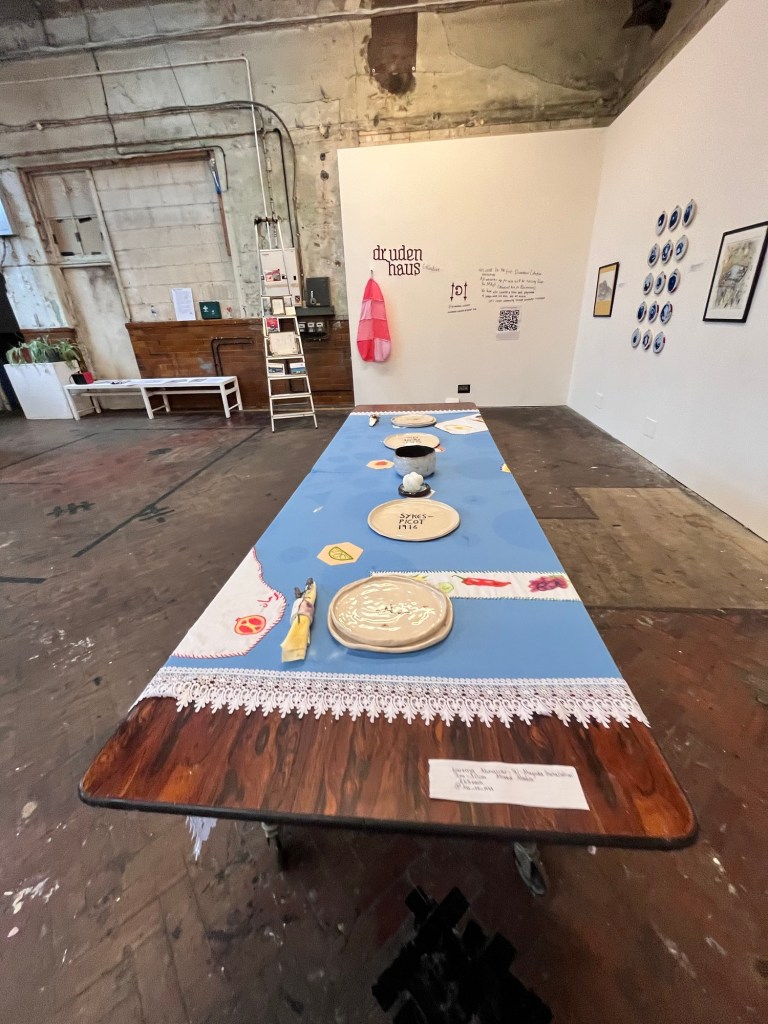
Again, Al-Mayida! The dining table is part of the DRUDENHAUS collective’s exhibition at Bridewell Gallery and Studios, Liverpool. This event includes a fundraiser for Medical Aid for Palestinians, adding a meaningful purpose to the show.

For this iteration, the work was set on a larger table than planned, shifting its dynamic. Though designed for two people, with fewer plates, and the tablecloth still bears marks left behind from previous exhibitions. The exhibition features both new and familiar artists, creating an interesting mix of perspectives.

Every curator brings a unique vision. The DRUDENHAUS collective’s decision to give the table more room to breathe was a contrast to previous presentations of Al-Mayida. This shift made me realise how flexible the work is, how it can adapt to different environments and be shaped by different interpretations.

One of the most meaningful aspects of this exhibition is its purpose as a fundraiser for Medical Aid for Palestinians. This adds weight and significance to the show. The dinner table, a place traditionally associated with hospitality, care, and conversation, becomes a symbol of solidarity. It reminds me that art doesn’t exist in isolation, it has the power to engage with real-world issues and bring people together in support of urgent causes.

Posted in Exhibitions, Motivations, Research, Visit

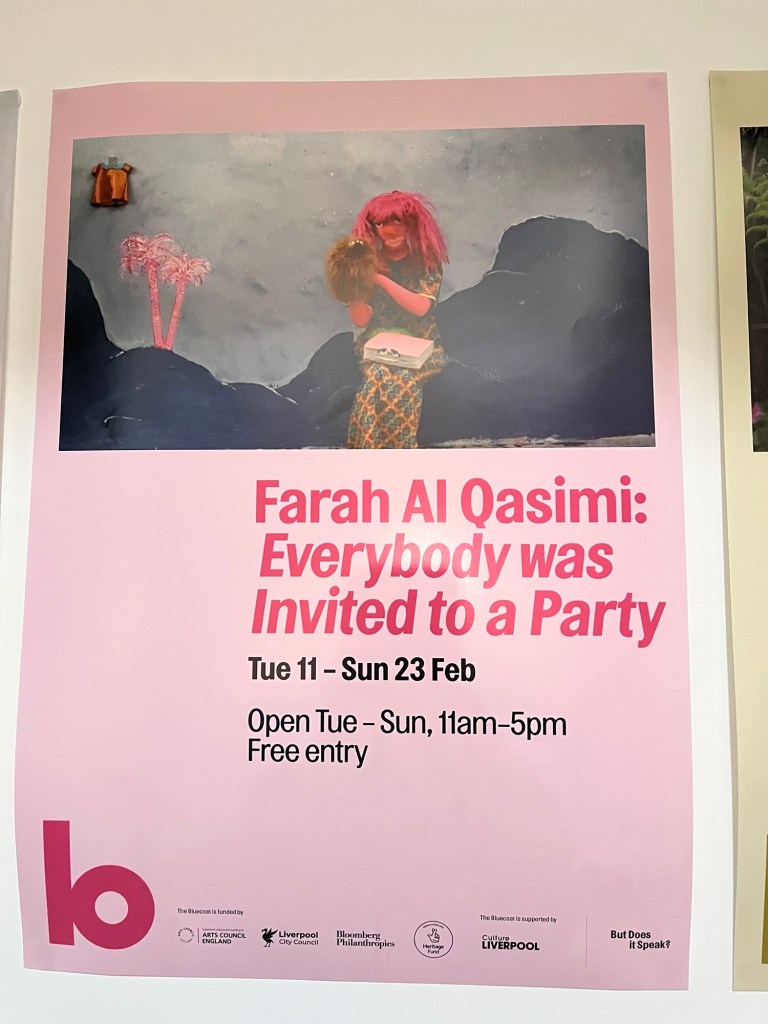
Farah Al Qasimi’s Everybody was Invited to a Party

Yesterday, I stepped into The Bluecoat and found myself transported back to my childhood in Dubai. Farah Al Qasimi’s work immediately struck a chord, filling the space with images, sounds, and moments that felt intimately familiar. In this exhibition, I wasn’t just observing, I was reliving something personal, something nostalgic. I laughed, paused, and travelled back home through her lens.

Al Qasimi, an artist from the UAE, weaves humour, memory, and language into a beautifully immersive world. Her film, Everybody was Invited to a Party, takes inspiration from Iftah Ya Simsim, the 1980s Arabic adaptation of Sesame Street. Using hand-sewn puppets and a playful approach to translation, the film highlights the fluidity , and at times, the struggles of communication.

One of the moments that resonated most with me was the pink Arabic-speaking monster struggling to order food in English. The monster’s eventual decision to learn English felt both humorous and deeply familiar. Another example was the book puppet with  text saying “I made a book to help me say the right things”. That line lingered with me. It felt so aligned with my own practice. Using language as both a tool and an obstacle, playing with its structures while trying to express something truthful.

Her use of puppetry and humour in dealing with linguistic struggles felt particularly relevant to me. I have always been interested in how objects and visual storytelling can reveal the nuances of human communication. Seeing her work has sparked new ideas about how I might further explore these themes, especially in my MA research and upcoming projects.

This exhibition reminded me that language is never just about words, it’s about memory, culture, and the ways we find (and sometimes lose) ourselves in translation. And in those moments of uncertainty, there is humour, resilience, and the power to create new meaning.

Posted in Exhibitions, Reflection

A Reflection on Culture, Unity, and Peace

This summer, I had the opportunity to showcase Al-Mayida (The Dining Table) at Birkenhead Central Library, an installation exploring the universal and symbolic significance of the dining table. And recently, the work was selected for Hypha Studios and Dispensary Gallery’s group show in Wrexham, adding a new layer of meaning by placing it in dialogue with other multidisciplinary pieces in a 15,000-square-foot exhibition space. With its vibrant, community-centered focus, Al-Mayida became a platform for discussing culture, peace, and the shared human experience of gathering. Moving the installation from Birkenhead Library to the larger venue in Wrexham taught me to consider how an artwork’s message and impact evolve with changes in environment and scale.

The dining table holds a unique, cross-cultural significance, serving as a setting for family meals, heartfelt conversations, and shared memories. With Al-Mayida, I aimed to capture these moments by creating an immersive, interactive experience that emphasises gathering, storytelling, and unity. Drawing from a blend of artistic mediums—ceramics, textiles, and Arabic calligraphy—the installation celebrates the act of coming together, inviting audiences to reflect on what it means to share a meal, both literally and symbolically.

On the final day of Al-Mayida, I introduced a dinner set, with each item inscribed with the Arabic word for peace—سلام (Salam). “Peace,” as a concept and a word, transcends borders, symbolising our shared humanity and fostering dialogue around unity and understanding. This white ceramic set, with its minimalist design, carries a calm, contemplative energy, resonating with the installation’s message of harmony.

As a closing touch to the exhibition, I crafted three large plates inscribed with references to the Sykes-Picot Agreement, the 1916 colonial pact that divided the Middle East into spheres of influence and reshaped its geopolitical landscape. This historical reference acknowledged the dining table not only as a place for personal stories but also as a platform for global reflection. These plates became symbols of resilience, encouraging visitors to consider how history shapes our identities, our relationships, and our ongoing quest for self-determination.

The presence of these plates alongside the Salam ceramic set introduces a compelling tension—a juxtaposition between the ideals of peace and unity and the complex legacies of political history. I hope these pieces spark conversations about the ways past injustices continue to impact the present, inspiring a shared commitment to a more peaceful future.

Reflecting on Al-Mayida, I see a pathway forward that embraces community involvement, broadens cultural exploration, and deepens historical reflection. This work has laid the foundation for a practice rooted in dialogue, shared experience, and the powerful simplicity of gathering around a table.