Posted in 2025-2026, collaboration, Project, Reading, Social Sculpture, Writing

March Shared Reading

We recently started a new group in my programme called International Shared Reading, with the support of The Reader. Instead of taking the training myself, I recommended two women from my group an assistant from Afghanistan and a volunteer from Portugal to take the paid training and co-lead the sessions alongside my co-producer, while I support them where needed. I believe that our strength comes from building a strong team rather than individual effort.

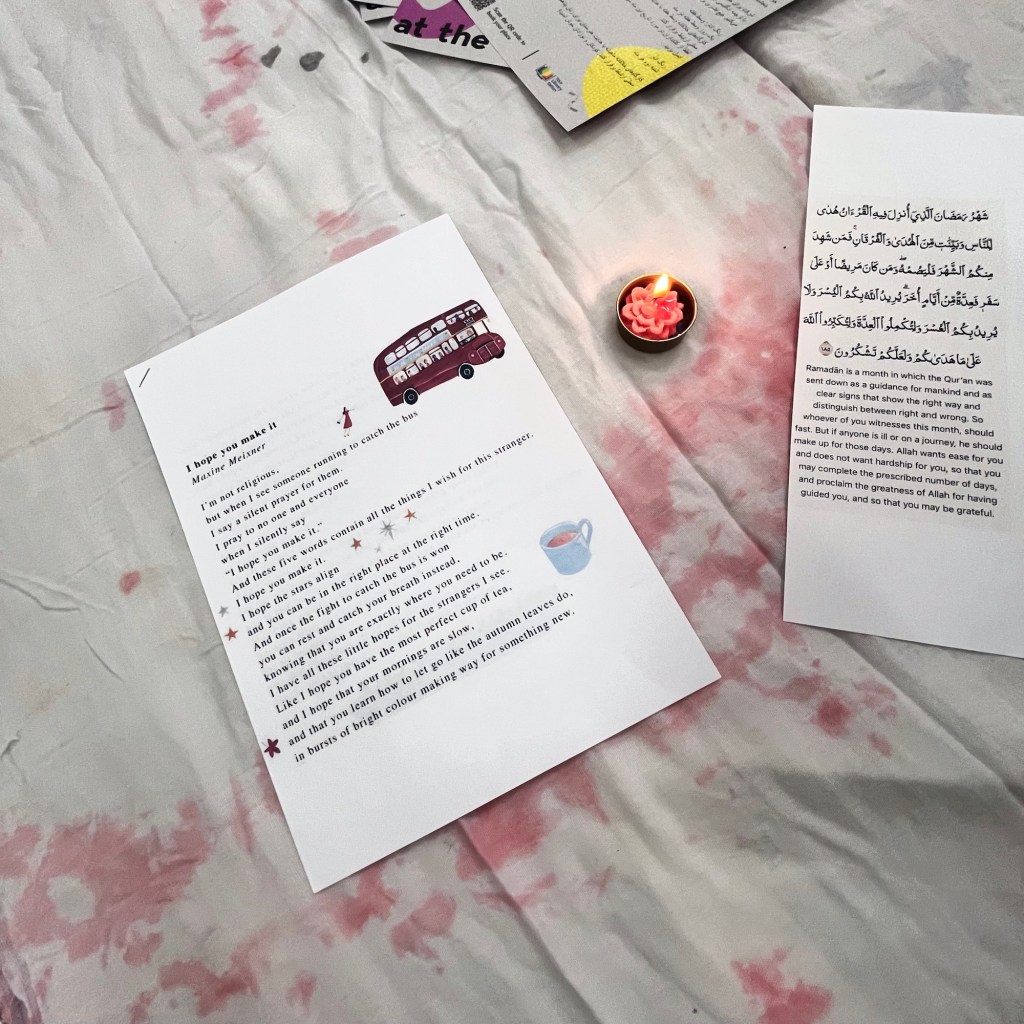
As part of the preparations for our upcoming Iftar gathering, I led a special reading session. It created a space to ask questions and learn more about Ramadan. We read a poem together, spoke about prayer, and people asked many questions about fasting and other related topics. Questions are welcome, they help clarify misunderstandings. When I went home that evening, I kept thinking about our conversation. Later, a volunteer sent a beautiful message in our group chat thanking me for the session.

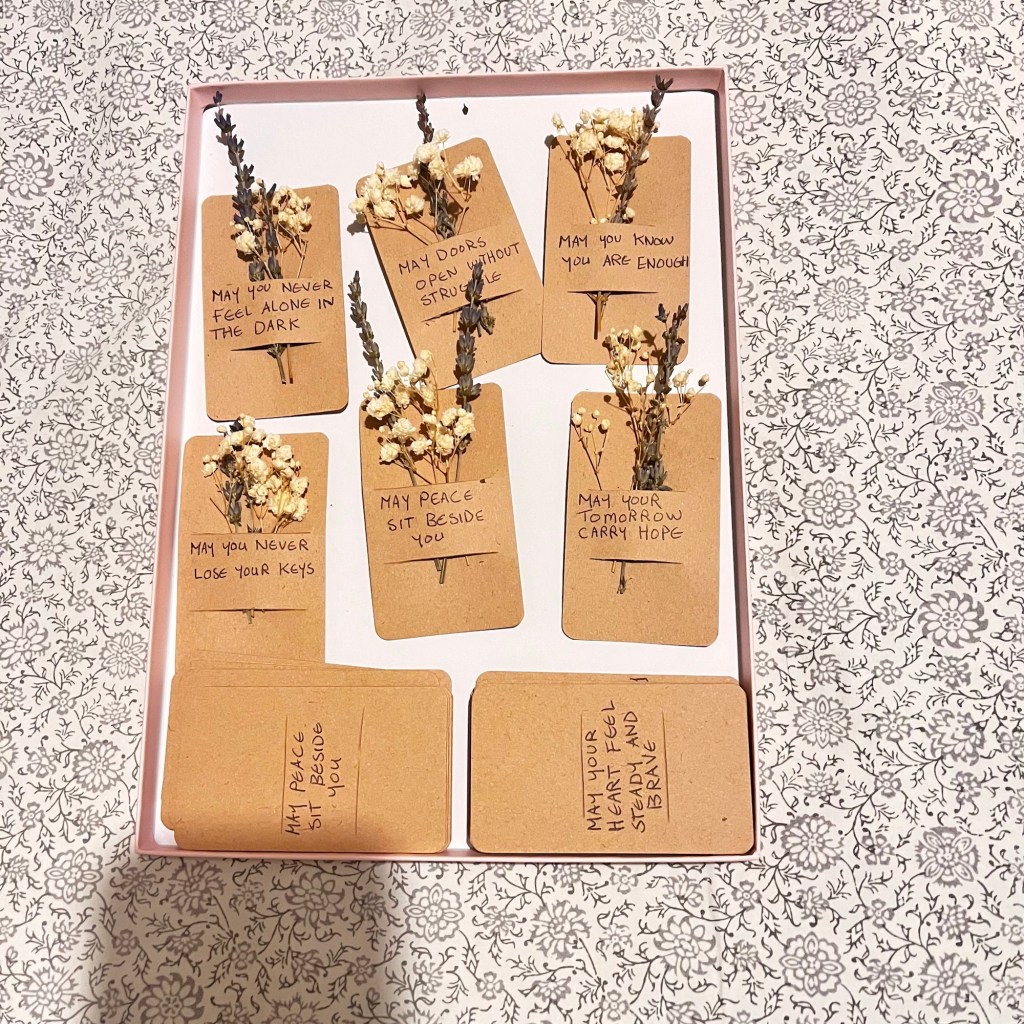
The next day I decided to create small blessing or affirmation cards for our guests, inspired by the poem we read together. I Hope You Make It, a poem by Maxine Meixner, is written in a simple and beautiful way. The words can reach people without challenging them with difficult language. I spent the day writing my simple prayers and preparing the cards so I could finish them at the library the next day.

The cards are simple and decorated with flowers. I chose lavender because it has a gentle, calming scent. In a way, the cards became a small social sculpture, something guests could take with them, carrying the memory of the Iftar after they leave.

Posted in 2025-2026, Books, Reading, Translation, Writing

Wanderer (2009)

Wanderer (2009) by Rory Macbeth is an English translation of Kafka’s The Metamorphosis, produced without knowledge of the German language. To understand the context of this post, it’s helpful to read the previous one.

German capitalises all nouns. When Kafka writes “den Augen” “the eyes”, Macbeth’s translation becomes “towards Augen”, as if Augen were a geographical location. This is not a mistranslation in the traditional sense; rather, it is a relocation of meaning. The work does not simply translate German into English. Instead, it appears to misread or mishear it, treating certain German nouns as destinations and following sound rather than semantic fidelity. In doing so, it produces something that feels both derivative and entirely new.

This method continues throughout. Kafka’s “sein Zimmer, ein richtiges”, translated into English as “his room, a proper human room”, becomes in Macbeth’s version “since summer, the rich man”, an apparent phonetic drift. At several points, Gregor’s sister’s name, Grete, is also translated as “great”. For example, Kafka’s “Komm, Grete” appears in Macbeth’s version as “Commandant! Great!” while the standard English translation reads “Grete, come”. These shifts suggest that Macbeth is not translating through grammar but by ear, treating German as sound material to be sculpted into English.

As the text progresses, one can sense a shift from guessing through sound to asserting narrative intention. At first, the work reads like a linguistic experiment, a kind of phonetic dérive. Gradually, however, something changes. The more one reads, the more an independent narrative begins to solidify; it begins to feel like the writer claiming territory. Wanderer begins to detach itself from The Metamorphosis. Betty starts to echo, but not duplicate, Grete. Threads remain visible, yet they no longer bind the text to its origin. By the end of the story, the authorial voice becomes unmistakable, and Wanderer tests how far transformation can go before it becomes authorship. Macbeth’s restrained conclusion expands into something vast, and the writer steps forward!

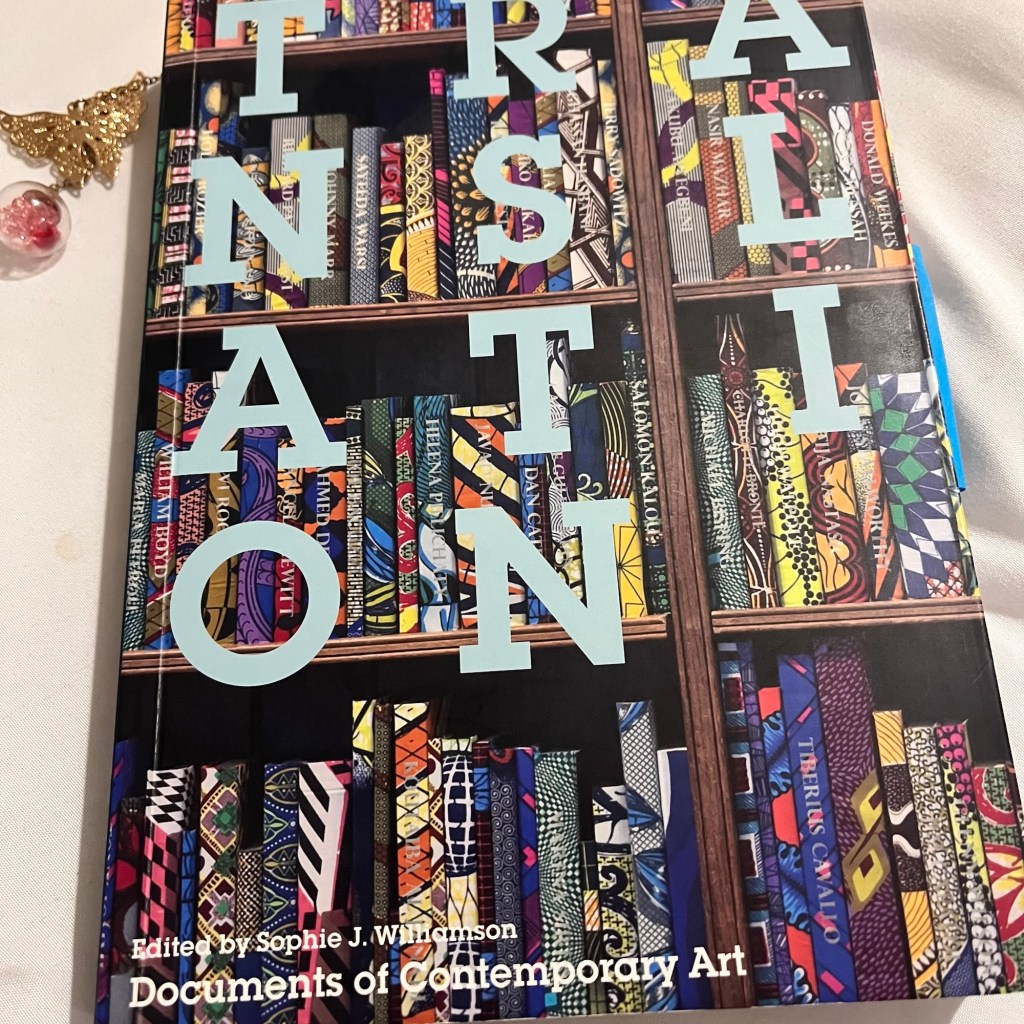
This raises the question of where translation ends and authorship begins. In Translation by Sophie J. Williamson (p. 43), a selected passage from Walter Benjamin’s essay The Task of the Translator states that “a translation issues from the original — not so much from its life as from its afterlife”. Benjamin’s idea of translation as a text’s afterlife helps illuminate what is at stake here, yet Macbeth also seems to exceed this model. Benjamin suggests that translation renews the original by revealing the hidden kinship between languages, allowing the text to unfold further in time. Translation, for him, is not reproduction but continuation, a stage in the original’s ongoing life.


Posted in 2025-2026, Books, Reading, Reflection, Social Sculpture, Writing

Gogol, Kafka and Macbeth

This post introduces the next, which will focus on Wanderer (2009) by Rory Macbeth, an English translation of The Metamorphosis produced without knowledge of the German language. Instead of translating through grammar or meaning, Macbeth works by visually and phonetically interpreting the German text and reconstructing it into English. The result is a work that exists somewhere between translation and authorship.

It’s important to briefly touch on The Metamorphosis (1915) by Franz Kafka before writing about Wanderer, and I’ll also use this opportunity to mention The Overcoat (1842) by Nikolai Gogol. I referred to Gogol’s story in our session when we discussed avoiding direct expressions of trauma during Zoe’s presentation. For me, Kafka and Gogol employ absurdity and a kind of quiet defeatism as narrative strategies through which trauma is expressed indirectly.

The Metamorphosis is a small text, yet incredibly heavy in its existential weight. The narrative begins with an unexplained event, Gregor Samsa’s transformation into a giant insect, presented without cause or preamble. Instead of questioning the transformation itself, the narrative quickly shifts to the practical consequences of his condition. His family who once depended entirely on his income, gradually begin to see him less as a son or brother and more as a burden. One gradually senses that the true transformation is not merely physical but human and moral. The story is existential in its questioning, absurd in its world, surreal in its structure, and deeply social in its critique…

Akaky Akakievich, the protagonist of The Overcoat, lives a lonely, repetitive life and struggles to make even minor changes. It takes him a long time to save enough money to buy a new coat, but when he finally does, the simple act of wearing something new gives him confidence and a glimpse of happiness. This joy is short lived… The coat is stolen on his way home! He desperately tries to retrieve it, fails, falls ill, and dies shortly afterwards. In the end, his ghost wanders the city stealing coats from others. The story oscillates between the real and the surreal, it’s sad, absurd, brief, yet emotionally expansive. It’s often seen as an early example of the absurd bureaucratic protagonist and is believed to have influenced many writers. For me, it’s enough to recall Dostoevsky’s saying “We all came out from Gogol’s The Overcoat”.

The Overcoat and The Metamorphosis are both essential reading for lovers of short fiction. They present deliberately ordinary protagonists, characters who almost disappear rather than dominate the plot, humans positioned at a humble level far removed from heroic or supernatural figures. These are stories that sometimes make you want to step inside the page and shake the character awake. In Gogol’s story, the narrator also seems strangely unconcerned with certain details or histories of events. A similar feeling emerges in Kafka.. What happened to Gregor Samsa is, in some sense, not important. Although he lives believing he is essential to his family, they ultimately continue without him, and his perceived importance dissolves.

This becomes significant for me when thinking about Wanderer. I sense something familiar here, perhaps one leading to the other, at least in my perception. Just as the lives of Akaky and Gregor seem strangely insignificant within their own stories, the linguistic accuracy of the text also becomes strangely insignificant in Macbeth’s work. Regardless of the original context or linguistic accuracy, the act of translation itself becomes conceptually aligned with the story. This also resonates with my own interest in communication and miscommunication as a form of social sculpture, where meaning is shaped collectively rather than fixed.. It raises questions about what is essential and what is not. What carries meaning? What survives translation? What do we choose to care about, and who decides this?

Posted in 2025-2026, Books, Reading, Reflection, Research, Translation, Writing

Translation #2

After reading Translation, I found myself asking what I would add if I were given the chance to contribute more pages to the book. Three came to mind: Omar Bahabri the translator, Arnaud Balard’s Deaf Flag, Adriano Celentano’s Prisencolinensinainciusol, and Wanderer by Rory Macbeth particularly after What Is a Minor Literature?//1986 by Deleuze and Guattari page.

The first story is a Yemeni tale set during the period of British occupation in southern Yemen. Omar Bahabri was a Yemeni tea merchant who spoke English through his work with foreign traders. At a time when the British struggled to communicate with the local population due to the lack of Arabic translators, Omar was called upon to help. The British asked him to translate pamphlets intended to win the trust and loyalty of the Yemeni people. Omar translated their demands into Arabic, and pamphlets were printed and distributed by aircraft across the country.

Some time later, a British general visited Aden to inspect the situation. He was familiar with Arabic, so he picked up a handful of the pamphlets and read them. He asked the officer in charge about their purpose and was told they were meant to encourage public support for British rule. The officer explained that the pamphlets called on people to join the Allies and support them. The general replied that the pamphlets read “Buy the finest tea from Omar Bahabri” . And here only reference I found in English: https://www.jstor.org/stable/48752006

Whether the story is true or not is hardly important here. What matters is how brilliantly it portrays the fate of outsiders who believe they can exploit local language and people for their own ends, only to find those intentions quietly undermined in favour of distinctly Yemeni interests. It also led me to reflect on the fact that the British occupied Aden for 128 years, from 1839 to 1967, yet hardly any of them learned Arabic. From this, it becomes easier to understand why the French aggressively imposed their language in colonised territories, and how English was forced upon Indigenous populations in North America, Australia, and New Zealand. This reinforces my belief that language is essential to the survival of culture and heritage.

Thinking about this story alongside Translation, I realised that what draws me in is not accuracy, but refusal. Translation here is not a neutral act. It becomes a space of misalignment, humour, survival, and agency. Language appears to serve power, while quietly redirecting it elsewhere.

So yes, I already know what my next ceramic piece will be.. A tea set! A familiar site of hospitality, negotiation, and politeness. Cups that sit between people, holding conversation, holding silence or things that are never quite said…

Posted in 2025-2026, Reading, Reflection, Writing

Translation by Sophie J. Williamsons

Jonathan recommended this book to me twice. Before I ordered it, I assumed it might be similar to Against Expression by Kenneth Goldsmith and Craig Dworkin, a great book in its own right on conceptual writing. But I found myself loving Williamson’s Translation much more. It feels like a fruit salad, a wide variety of flavours, each sweet or sour in its own way, yet deeply enjoyable together. While Against Expression is larger in size, Translation feels more balanced and brings together a broader range of international voices.

Before even reading the Translation introduction, I couldn’t resist starting with Frantz Fanon and James Baldwin. I love both of their styles, it’s heavy, yet smooth in motion and settling deep in the soul. The anthology brings together an impressive mix of writers and artists, including Shirin Neshat, Jess Darling, Yinka Shonibare, Stephen Morton, Susan Hiller, Walid Raad, Walter Benjamin, and many others.

There were several moments where I had to pause, wanting to comment or reflect. Although the contributors come from very different backgrounds and perspectives, you still feel that they share something. Language is not just words or signs; it reflects how far the human mind can reach in understanding its surroundings what is seen and unseen. It is about comprehension, and about noticing what might otherwise remain incomprehensible.

Shirin Neshat’s page took me back to my childhood in Dubai. Growing up across different cultures, I’ve come to see communication as a vast ocean. It can feel overwhelming and frightening at times, but it also has a magical quality: moments where connection happens without you fully understanding how.

Where I grew up, our neighbours formed a small, diverse world. To the right was an Iranian Shia family; to the left, a Yemeni one. After our Emirati neighbours moved away, we had Palestinian, Pakistani and Omani neighbours opposite us. They were all kind and friendly, with children who played together on the sandy street before the area became very posh and built up. Our relationships were friendly, formal, and respectful, shaped by care and sharing.

I formed a close bond with our Iranian neighbours, and their daughter became my best friend. We grew into each other’s families, spending time playing and eating together, getting into trouble, being told off, and sharing fun (she’s the one I mentioned in the Dear Moon preface). Her parents did not speak Arabic well, and in their home they spoke Farsi. I loved listening to them, I couldn’t understand but I relied on facial expressions and tone of voice, especially when we were in trouble and her translations were completely inaccurate..

I didn’t learn about Sunni and Shia differences until middle school. I once asked my friend to join my prayer, She refused, because I was Sunni and she was Shia..terms I had never heard before, and which were never discussed in my family. When I asked my father, he simply said: they are Shia, we are Sunni, and their prayer is slightly different. My response was simple “i thought we are just Muslims”.

I became more curious.. my religion teacher with patience and care became the target of my endless questions, until I moved to secondary school, where I continued my research. So did my library teachers, who would quietly prepare books for me to borrow. Reading history gave me joy and deeper understanding. I began to realise how many of our problems come from judging events without understanding their roots or contexts.

Prayer might seem like a diversion here, but it still feels connected to languages. I began practising prayer at around 11 or 12 years old, not through parental guidance but after being dared by a cousin, I was the youngest in my extended family to do so and he mocked my attempts.

What I’ll never forget, my very very first attempt. I was almost 5 years old. My second sister had been born ill, and when she was one month old, my father took her to hospital one evening while my mother was unwell. No one explained anything to me.. and I was scared seeing my mum crying… I took a prayer mat, faced a random direction, put one of my mother’s headscarves on and stood there silently. I didn’t know what to say.. No one had taught me how to speak to God. I only knew that we believe in Allah our creator (Allah is the Arabic word for God, used by Arab Christians too)… So I just cried and simply said “please don’t let my baby sister die”. She came home the next day and grew up to become my moody sister!

Later, I understood why my parents were soo panicked. Back in Yemen, they had lost their first child, a baby boy… I was born after him, small and sick. My grandmother took responsibility for caring for me, and five women from her family and circle breastfed me until my mother recovered. I grew up with five “milk mothers” and milk siblings. In my village, some babies had one or two. I had five! Perhaps that explains why I grew up with the smallest body, it might have been that extra dose😂

This came back to me while reading Gayatri Spivak’s The Politics of Translation page. She mentioned Mahasweta Devi’s story Stanadayini’s translations. One English translation is titled Breast-Giver, another The Wet Nurse. Spivak notes that when you read both translations side by side, the loss of rhetorical silence from one translation to the other becomes clear. This reminded me of Rory Macbeth’s Wanderer the translation of Kafka’s Metamorphosis translated from German into English without him being able to read or speak German. Years ago, he told me: “I don’t believe there is such a thing as an accurate translation”.

This thought led me to the Qur’an. As Muslims, we believe the Arabic Qur’an to be the direct word of God, linguistically, structurally, and even mathematically unique. No Arabic writer has ever matched its form. Translations exist, but they are treated as interpretations, not replacements. The Arabic text itself is carried and protected by Muslims across languages and cultures, unchanged and only recited in Arabic.

Perhaps that, is part of what this anthology keeps circling back to: the beauty, limits, and responsibility of language and everything that slips through when we try to carry meaning from one place to another. I do believe that a translator can’t separate their life experience and feelings from their work; these inevitably shape their understanding. In this way, the translator and the original writer become new collaborators.

Posted in 2025-2026, Assignments, Reading, Research, Social Sculpture, Writing

MA Fine Art Digital Student Research Paper

Some advice from someone who went through this during one of the strangest periods of my life: first, believe me you will be fine! Secondly, anyone who has reached this point is capable and already moving in the right direction.

Choose what genuinely interests you. Read from different sources and use their reading lists, references, and resources to trace where ideas began. Have conversations with yourself about your work, explain what you are doing as if you were lecturing a BA student or leading a workshop; ask yourself what you would share and why!

You don’t need to read every book from the first page to the last.. Use the index to search for your key words, this is especially helpful when time is tight.

After I submitted my final assignments, I shared my research draft with my artist friends and just received praise. Later, I shared it with a friend who is a midwife and a PhD researcher in gynaecology. She gave me the most valuable feedback and asked thoughtful, constructive questions. This made me feel genuinely confident about the work; if someone outside your field can engage with your writing , that is a very good sign. My advice, therefore, is to share your second draft with the right non-artist friend from a different profession. It can open your eyes to perspectives that no artist including yourself could see.

Some “Don’t” Advice I Wish I Had Given Myself!

  • Don’t leave “small” tasks until the last minute.

They are the easiest to forget and can cause unnecessary stress close to submission, title’s page, formatting, construction, references, PDF …etc

  • Don’t rely on memory alone when submitting work.

Overwhelm and fatigue can make important details easy to miss, use a checklist instead, revisit the research guid’s page on your course blog!!

  • Don’t rename files by changing word order.

Playing with wording in file names can quickly become confusing; numbering drafts is far clearer.

  • Don’t hesitate to explain personal circumstances.

Even if it feels close to the deadline, communicating difficulties puts you on safer ground.

  • Don’t limit your reading to your own cohort’s blogs.

You miss valuable learning by not looking at work from earlier years.

Final Paper:

Third Final Draft:

Second Draft :

First Draft:

Posted in 2025-2026, Moon, Reflection, Writing

Observing the Moon

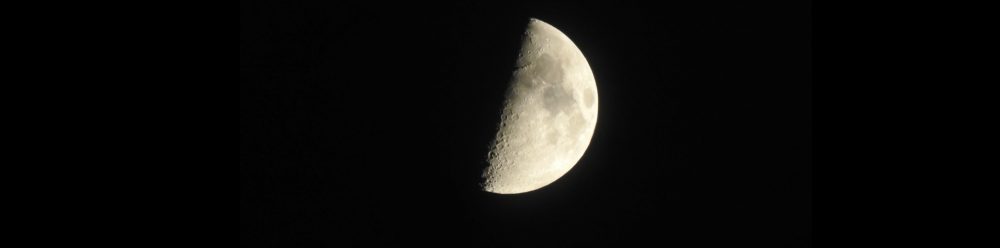
4th Nov 2025, 11:01pm

Watching the last full moon of 2025 felt unexpectedly emotional. It was calm, yet it carried the feeling of an ending. Standing beneath it, I became aware of how much the year had held, and knowing it was the final full moon of the year added to its weight.

The year won’t close with certainty or clarity, but that feels honest. Some things remain unsettled, and perhaps they are meant to. Was it a success or a failure? Worth it or not? Happy or sad? Peace or war? Friend or enemy? Continue or leave? Life always carries these questions. But the moon reminds us that there is always a return. A new moon will be born, and the phases will continue, because the moon does not seek resolution.

There was a quiet mix of emotions, gratitude, sadness, relief, they all sharing the same space. I felt small under the sky, but not alone. The moon remained constant shining whether it was seen or not, especially in UK weather and that brought a sense of comfort. Sometimes it is not important to be seen, as long as you carry your own light. Clouds may block it for a while, but they can never take that light away.

Posted in 2025-2026, collaboration, Motivations, Reflection, Research, Uncategorized, Writing

Feedback!

What can I say… this experience has reminded me why I love working collectively and why it is so important not to rely on a single resource or only on self-knowledge.

Giving feedback as a group is such a powerful idea and such a beautiful way to enrich one another’s reflection on our practice. I genuinely loved sharing my thoughts with each of my peers and reading theirs in return. The work is amazing, it expresses human experience in such diverse ways, full of richness, honesty and genuine emotion. I felt truly honoured to be among them and lucky to witness their progress over time.

It was emotional to reflect on how we are growing together, holding each other’s hands virtually on this journey with such care and generosity. It reminded me of Jonathan’s first session in October 2024, when he spoke about kindness and compassion and how these could become the strength of our collective and our cohort. Throughout the course, he has guided us with constant care and kindness, so it is no surprise that he created this opportunity: for each of us to write short feedback for one another on a shared Miro board dedicated to every artist.

My peers’ feedback has genuinely boosted my confidence and trust in my practice. Of course, there are always things missing, intentionally or not, due to circumstances and the challenges of process. But receiving feedback that recognises your efforts is deeply energising, especially as a socially engaged artist, where the social aspect is the heart of the work.

I will definitely return to this Miro board whenever I need to. It has become a beautiful space, full of thoughts floating in this quiet corner of cyberspace.

Posted in 2025-2026, Reading, Reflection, Research, Writing

Beuys and Sylvester

When I was reading for my research paper, I kept thinking about the unusual and slightly funny relationship between the German artist Joseph Beuys and the British critic David Sylvester! They were both major figures in modern art, but they never managed to build a close or comfortable connection.

Sylvester saw how important Beuys was. He never denied Beuys’s impact or how strongly he shaped his time, just as Duchamp had done for modern art. Even so, their relationship never became warm or collaborative. Sylvester had deep, ongoing conversations with many artists, but with Beuys he stayed distant, almost cautious.

This shows clearly in his writing. Sylvester never wrote a whole book about Beuys, nor explored him in the focused way he did with others. Beuys appears only here and there, usually as one example inside bigger discussions about conceptual art and post Duchamp ideas. Important, yes, but never at the centre.

The moment that captures their dynamic best is a small story Sylvester shared in About Modern Art, 2002 p.514-15. Beuys came to visit him at his flat in South London, bringing his wife, children and another friend. Before they entered, Sylvester asked him to remove his shoes, which he always asked visitors to do to protect his antique Persian carpets. Beuys refused!! His hat and clothes were part of his artistic identity and he would not take them off.. Sylvester refused too!! So they stood outside on the pavement, stuck between two different kinds of pride.

The more I think about it, the more I wonder what felt most important at that moment. For Sylvester, was it the artwork he lived with the antique rugs he treasured and protected or the chance to welcome an artist who was reshaping the art world? And for Beuys, a well established artist known for his big ideas, what mattered more being treated as a significant cultural figure, someone above everyday rules, or simply being a human guest respecting the home he was entering?!

In that moment, neither chose flexibility… And because of that, the visit never really began!

I find this story surprisingly touching…These were people who changed the direction of art, yet a simple request about shoes created a pause they could not overcome. Their relationship was always a mix of respect, misunderstanding, admiration and a bit of irritation.

They never became close, but their awkward meetings reveal something real about personality, ego and the small rituals of daily life. Maybe that is why I keep returning to this story. It shows how the biggest ideas in art can be interrupted by tiny habits and decisions. And sometimes, the most memorable parts of art history are not the grand gestures, but the little ones, like the moment when two strong characters collide at a doorway🙃

Posted in 2025-2026, Reflection, Research, Writing

Animals Metaphors in Art

When revisiting my research statement from last year, I found myself returning to the ideas of care and failure within social sculpture. These themes continue to shape my practice and felt essential to include in my research paper. However, my section on animals in art grew too large for the word count and began to pull the paper away from its main focus. I removed it, but after simplifying and editing it, the section stands on its own and is worth sharing here.

My interest in non-human metaphors comes from noticing how artists and writers use animals to express political tension, historical memory and emotional states that might otherwise be silenced. These strategies reveal relationships between power, vulnerability and resistance, and they raise questions about ethics and communication that deeply influence my practice.

Animals and Non-human Metaphors in the Work of Joseph Beuys and Tania Bruguera

Animals sit at the centre of Joseph Beuys’s practice, shaping his ideas on power, vulnerability and transformation. The coyote in I Like America and America Likes Me symbolised Indigenous people and the pre-colonial landscape. For Beuys, it embodied an idealised belief in the intelligence and vitality of the natural world. The coyote represented resistance to American imperialism during the Vietnam War and carried his hopes for future healing between cultures and species.

In How to Explain Pictures to a Dead Hare, Beuys moved slowly through the gallery with his face covered in honey and gold leaf, whispering explanations to the dead animal in his arms. The hare, associated with intuition, knowledge and resurrection, became a metaphor for what cannot be reached by rational language. Marina Abramović’s re-performance in 2005 affirmed the lasting resonance of this symbolic encounter between human and non-human life.

Where Beuys often turned to animals as partners in myth, intuition and healing, Tania Bruguera approaches them in relation to power, authority and political memory. Her interventions expose the structures that shape public life and the institutional spaces that maintain them.

In Tatlin’s Whisper 5, Bruguera used two mounted police officers and their horses to carry out crowd-control tactics inside Tate Modern. The horses were trained for authority and control and entered the space with an unmistakable sense of force. Their presence transformed the gallery from a site of passive viewing into a charged environment where visitors were physically steered, separated and confronted. The work made visible the techniques of state power, such as dispersal, redirection and intimidation, which usually operate outside cultural institutions.

This action gained further weight when placed in the context of the building itself. Tate Modern stands on a history shaped by colonial wealth. Henry Tate’s fortune, although not derived from enslaved ownership, came from the sugar industry, which relied on enslaved labour in the Caribbean. The arrival of horses trained for policing, inside a space funded by a colonial economy, formed a powerful collision of past and present. Visitors were not only witnessing a performance but experiencing an enactment of authority within a space built from historical exploitation. The work stripped away any illusion of institutional neutrality and revealed how cultural venues remain entwined with systems of control.

Bruguera’s The Burden of Guilt, created between 1997 and 1999, offers another approach to the animal body. Drawing on a Cuban story of Indigenous resistance, she performed with a lamb carcass around her neck and ate soil mixed with saltwater. The lamb suggested innocence and sacrifice, becoming a sign of communal grief and historical responsibility. Eating earth became a way to carry memory physically, as if the body itself were absorbing history and mourning.

Bruguera and Beuys both use animals to raise moral, political and spiritual questions, yet their motivations diverge. Beuys turns towards healing, intuition and mythic reconciliation. Bruguera challenges institutional power, colonial violence and endurance under authority. In both cases, animals operate as active agents of meaning rather than decorative symbols. Their presence forces audiences to confront issues that are emotional, ethical and political.

Although the symbolism in both artists’ use of animals is powerful, I remain uneasy about the incorporation of real animals and human parts in art. Ethical questions arise about the process, the treatment of bodies and the implications of using them. I also wonder whether there are clear rules or guidelines, and how far artists are permitted to go.

Animal Metaphors in Literature

My favourite use of animals since childhood has always been in literature, storytelling and cartoons (Oh God, who does not like Shaun the Sheep!).. It feels playful, imaginative and often a very indirect way to speak the truth, especially when living under a dictatorship or in a place where free speech is a crime. Writers across cultures have used non-human characters to challenge authority and reflect on the human condition. Here are three examples from different cultures that I read and appreciate for their political and social insights.

In George Orwell’s Animal Farm, the animals rise up in search of equality, only for their revolution to collapse into tyranny. The pigs become the new political leaders, while the other animals represent broader society. I cannot help thinking about the Arab Spring when I read it. As someone who witnessed those moments of hope, I later realised how much of it was false, planned in advance and driven by forces far beyond ordinary people. Many were drawn into it with naivety, without knowledge, and without considering the consequences.

Kafka’s The Metamorphosis uses Gregor Samsa’s transformation into an insect to explore alienation and the erosion of identity. His inability to communicate and his slow disappearance from the concerns of his family reflect the conditions that made him feel powerless long before he changed form. It reminds me a great deal of social life in Europe. There is a sense of absence that hides beneath the appearance of belonging, and a feeling that you are present, yet not fully seen.

Kalila wa Dimna  (کلیله و دمنه), is a collection of fables in which animals take on human roles and dilemmas. The book contains fifteen chapters filled with stories that feature animal characters as heroes, advisers and rulers. One of the central figures is the lion, who appears as a king, attended by his loyal ox and two jackals of the title, Kalila and Dimna, serve both as narrators and as key characters within the tales. The work most likely originated from an ancient Indian text, translated to Arabic and later travelled across cultures and languages.

The stories appear simple but contain hidden meanings that allowed authors to criticise rulers while avoiding punishment. The animal characters become subtle tools for examining authority and ethical responsibility. For me, this is one of the best examples of how wisdom was taught during the Islamic Golden Age. It shows that people have always found ways to teach, influence and communicate important ideas while reducing the risks that come with speaking openly.

Finally, in Orwell, animals reveal the collapse of idealism. In Kafka, they expose psychological and social erasure. In Kalila wa Dimna, they protect dissenting views. In Bruguera and Beuys, they carry political, spiritual and historical weight. Non-human imagery creates space for reflection on power, vulnerability and the possibility of transformation. It encourages viewers to reconsider the boundaries between human and animal, self and other, institution and individual.

Books :

Kafka, F.Metamorphosis. Franz Kafka

Munshi, N. Kalila and Dimna. Translated by W. Thackston.

Orwell, G. Animal farm.