Posted in 2025-2026, Books, Reading, Translation, Writing

Wanderer (2009)

Wanderer (2009) by Rory Macbeth is an English translation of Kafka’s The Metamorphosis, produced without knowledge of the German language. To understand the context of this post, it’s helpful to read the previous one.

German capitalises all nouns. When Kafka writes “den Augen” “the eyes”, Macbeth’s translation becomes “towards Augen”, as if Augen were a geographical location. This is not a mistranslation in the traditional sense; rather, it is a relocation of meaning. The work does not simply translate German into English. Instead, it appears to misread or mishear it, treating certain German nouns as destinations and following sound rather than semantic fidelity. In doing so, it produces something that feels both derivative and entirely new.

This method continues throughout. Kafka’s “sein Zimmer, ein richtiges”, translated into English as “his room, a proper human room”, becomes in Macbeth’s version “since summer, the rich man”, an apparent phonetic drift. At several points, Gregor’s sister’s name, Grete, is also translated as “great”. For example, Kafka’s “Komm, Grete” appears in Macbeth’s version as “Commandant! Great!” while the standard English translation reads “Grete, come”. These shifts suggest that Macbeth is not translating through grammar but by ear, treating German as sound material to be sculpted into English.

As the text progresses, one can sense a shift from guessing through sound to asserting narrative intention. At first, the work reads like a linguistic experiment, a kind of phonetic dérive. Gradually, however, something changes. The more one reads, the more an independent narrative begins to solidify; it begins to feel like the writer claiming territory. Wanderer begins to detach itself from The Metamorphosis. Betty starts to echo, but not duplicate, Grete. Threads remain visible, yet they no longer bind the text to its origin. By the end of the story, the authorial voice becomes unmistakable, and Wanderer tests how far transformation can go before it becomes authorship. Macbeth’s restrained conclusion expands into something vast, and the writer steps forward!

This raises the question of where translation ends and authorship begins. In Translation by Sophie J. Williamson (p. 43), a selected passage from Walter Benjamin’s essay The Task of the Translator states that “a translation issues from the original — not so much from its life as from its afterlife”. Benjamin’s idea of translation as a text’s afterlife helps illuminate what is at stake here, yet Macbeth also seems to exceed this model. Benjamin suggests that translation renews the original by revealing the hidden kinship between languages, allowing the text to unfold further in time. Translation, for him, is not reproduction but continuation, a stage in the original’s ongoing life.


Posted in 2025-2026, Books, Reading, Reflection, Social Sculpture, Writing

Gogol, Kafka and Macbeth

This post introduces the next, which will focus on Wanderer (2009) by Rory Macbeth, an English translation of The Metamorphosis produced without knowledge of the German language. Instead of translating through grammar or meaning, Macbeth works by visually and phonetically interpreting the German text and reconstructing it into English. The result is a work that exists somewhere between translation and authorship.

It’s important to briefly touch on The Metamorphosis (1915) by Franz Kafka before writing about Wanderer, and I’ll also use this opportunity to mention The Overcoat (1842) by Nikolai Gogol. I referred to Gogol’s story in our session when we discussed avoiding direct expressions of trauma during Zoe’s presentation. For me, Kafka and Gogol employ absurdity and a kind of quiet defeatism as narrative strategies through which trauma is expressed indirectly.

The Metamorphosis is a small text, yet incredibly heavy in its existential weight. The narrative begins with an unexplained event, Gregor Samsa’s transformation into a giant insect, presented without cause or preamble. Instead of questioning the transformation itself, the narrative quickly shifts to the practical consequences of his condition. His family who once depended entirely on his income, gradually begin to see him less as a son or brother and more as a burden. One gradually senses that the true transformation is not merely physical but human and moral. The story is existential in its questioning, absurd in its world, surreal in its structure, and deeply social in its critique…

Akaky Akakievich, the protagonist of The Overcoat, lives a lonely, repetitive life and struggles to make even minor changes. It takes him a long time to save enough money to buy a new coat, but when he finally does, the simple act of wearing something new gives him confidence and a glimpse of happiness. This joy is short lived… The coat is stolen on his way home! He desperately tries to retrieve it, fails, falls ill, and dies shortly afterwards. In the end, his ghost wanders the city stealing coats from others. The story oscillates between the real and the surreal, it’s sad, absurd, brief, yet emotionally expansive. It’s often seen as an early example of the absurd bureaucratic protagonist and is believed to have influenced many writers. For me, it’s enough to recall Dostoevsky’s saying “We all came out from Gogol’s The Overcoat”.

The Overcoat and The Metamorphosis are both essential reading for lovers of short fiction. They present deliberately ordinary protagonists, characters who almost disappear rather than dominate the plot, humans positioned at a humble level far removed from heroic or supernatural figures. These are stories that sometimes make you want to step inside the page and shake the character awake. In Gogol’s story, the narrator also seems strangely unconcerned with certain details or histories of events. A similar feeling emerges in Kafka.. What happened to Gregor Samsa is, in some sense, not important. Although he lives believing he is essential to his family, they ultimately continue without him, and his perceived importance dissolves.

This becomes significant for me when thinking about Wanderer. I sense something familiar here, perhaps one leading to the other, at least in my perception. Just as the lives of Akaky and Gregor seem strangely insignificant within their own stories, the linguistic accuracy of the text also becomes strangely insignificant in Macbeth’s work. Regardless of the original context or linguistic accuracy, the act of translation itself becomes conceptually aligned with the story. This also resonates with my own interest in communication and miscommunication as a form of social sculpture, where meaning is shaped collectively rather than fixed.. It raises questions about what is essential and what is not. What carries meaning? What survives translation? What do we choose to care about, and who decides this?

Posted in 2025-2026, Reading, Reflection, Writing

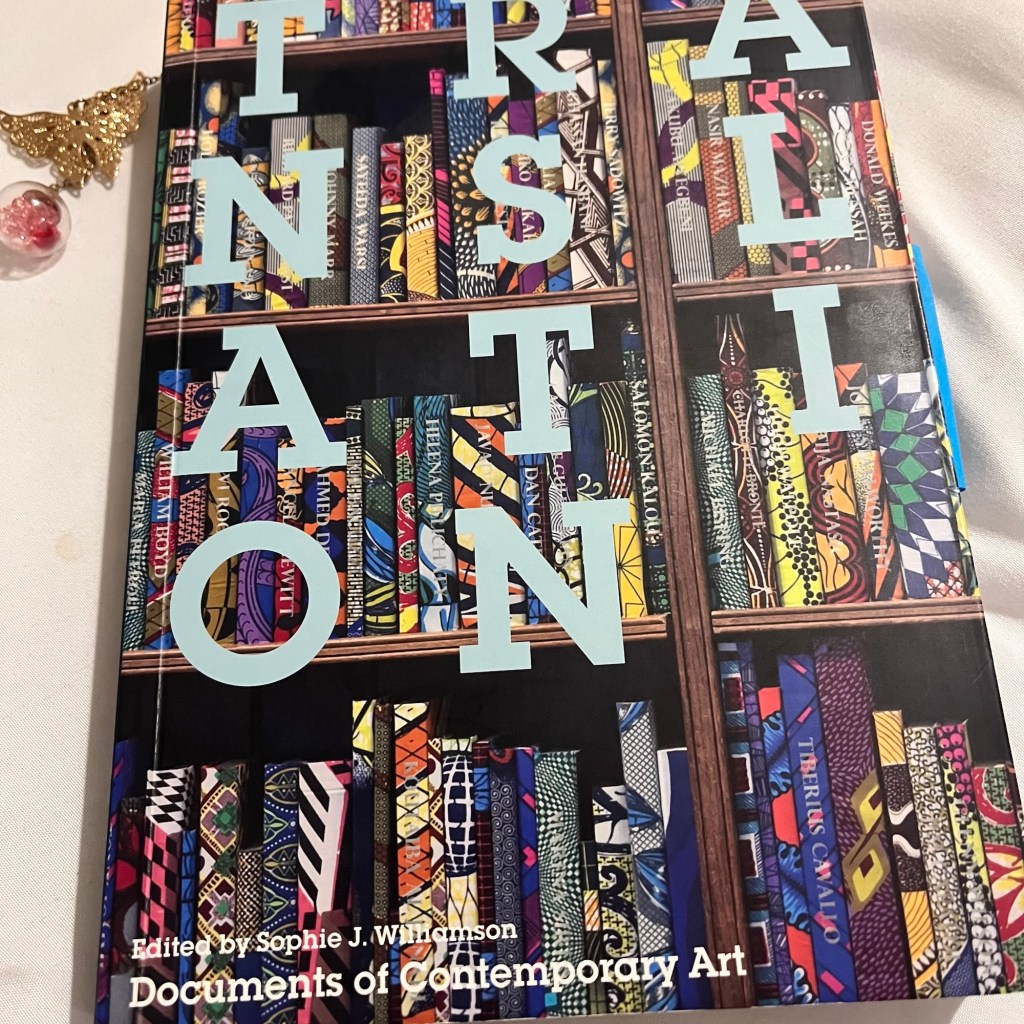
Translation by Sophie J. Williamsons

Jonathan recommended this book to me twice. Before I ordered it, I assumed it might be similar to Against Expression by Kenneth Goldsmith and Craig Dworkin, a great book in its own right on conceptual writing. But I found myself loving Williamson’s Translation much more. It feels like a fruit salad, a wide variety of flavours, each sweet or sour in its own way, yet deeply enjoyable together. While Against Expression is larger in size, Translation feels more balanced and brings together a broader range of international voices.

Before even reading the Translation introduction, I couldn’t resist starting with Frantz Fanon and James Baldwin. I love both of their styles, it’s heavy, yet smooth in motion and settling deep in the soul. The anthology brings together an impressive mix of writers and artists, including Shirin Neshat, Jess Darling, Yinka Shonibare, Stephen Morton, Susan Hiller, Walid Raad, Walter Benjamin, and many others.

There were several moments where I had to pause, wanting to comment or reflect. Although the contributors come from very different backgrounds and perspectives, you still feel that they share something. Language is not just words or signs; it reflects how far the human mind can reach in understanding its surroundings what is seen and unseen. It is about comprehension, and about noticing what might otherwise remain incomprehensible.

Shirin Neshat’s page took me back to my childhood in Dubai. Growing up across different cultures, I’ve come to see communication as a vast ocean. It can feel overwhelming and frightening at times, but it also has a magical quality: moments where connection happens without you fully understanding how.

Where I grew up, our neighbours formed a small, diverse world. To the right was an Iranian Shia family; to the left, a Yemeni one. After our Emirati neighbours moved away, we had Palestinian, Pakistani and Omani neighbours opposite us. They were all kind and friendly, with children who played together on the sandy street before the area became very posh and built up. Our relationships were friendly, formal, and respectful, shaped by care and sharing.

I formed a close bond with our Iranian neighbours, and their daughter became my best friend. We grew into each other’s families, spending time playing and eating together, getting into trouble, being told off, and sharing fun (she’s the one I mentioned in the Dear Moon preface). Her parents did not speak Arabic well, and in their home they spoke Farsi. I loved listening to them, I couldn’t understand but I relied on facial expressions and tone of voice, especially when we were in trouble and her translations were completely inaccurate..

I didn’t learn about Sunni and Shia differences until middle school. I once asked my friend to join my prayer, She refused, because I was Sunni and she was Shia..terms I had never heard before, and which were never discussed in my family. When I asked my father, he simply said: they are Shia, we are Sunni, and their prayer is slightly different. My response was simple “i thought we are just Muslims”.

I became more curious.. my religion teacher with patience and care became the target of my endless questions, until I moved to secondary school, where I continued my research. So did my library teachers, who would quietly prepare books for me to borrow. Reading history gave me joy and deeper understanding. I began to realise how many of our problems come from judging events without understanding their roots or contexts.

Prayer might seem like a diversion here, but it still feels connected to languages. I began practising prayer at around 11 or 12 years old, not through parental guidance but after being dared by a cousin, I was the youngest in my extended family to do so and he mocked my attempts.

What I’ll never forget, my very very first attempt. I was almost 5 years old. My second sister had been born ill, and when she was one month old, my father took her to hospital one evening while my mother was unwell. No one explained anything to me.. and I was scared seeing my mum crying… I took a prayer mat, faced a random direction, put one of my mother’s headscarves on and stood there silently. I didn’t know what to say.. No one had taught me how to speak to God. I only knew that we believe in Allah our creator (Allah is the Arabic word for God, used by Arab Christians too)… So I just cried and simply said “please don’t let my baby sister die”. She came home the next day and grew up to become my moody sister!

Later, I understood why my parents were soo panicked. Back in Yemen, they had lost their first child, a baby boy… I was born after him, small and sick. My grandmother took responsibility for caring for me, and five women from her family and circle breastfed me until my mother recovered. I grew up with five “milk mothers” and milk siblings. In my village, some babies had one or two. I had five! Perhaps that explains why I grew up with the smallest body, it might have been that extra dose😂

This came back to me while reading Gayatri Spivak’s The Politics of Translation page. She mentioned Mahasweta Devi’s story Stanadayini’s translations. One English translation is titled Breast-Giver, another The Wet Nurse. Spivak notes that when you read both translations side by side, the loss of rhetorical silence from one translation to the other becomes clear. This reminded me of Rory Macbeth’s Wanderer the translation of Kafka’s Metamorphosis translated from German into English without him being able to read or speak German. Years ago, he told me: “I don’t believe there is such a thing as an accurate translation”.

This thought led me to the Qur’an. As Muslims, we believe the Arabic Qur’an to be the direct word of God, linguistically, structurally, and even mathematically unique. No Arabic writer has ever matched its form. Translations exist, but they are treated as interpretations, not replacements. The Arabic text itself is carried and protected by Muslims across languages and cultures, unchanged and only recited in Arabic.

Perhaps that, is part of what this anthology keeps circling back to: the beauty, limits, and responsibility of language and everything that slips through when we try to carry meaning from one place to another. I do believe that a translator can’t separate their life experience and feelings from their work; these inevitably shape their understanding. In this way, the translator and the original writer become new collaborators.

Posted in 2025-2026, Reflection, Research, Writing

Animals Metaphors in Art

When revisiting my research statement from last year, I found myself returning to the ideas of care and failure within social sculpture. These themes continue to shape my practice and felt essential to include in my research paper. However, my section on animals in art grew too large for the word count and began to pull the paper away from its main focus. I removed it, but after simplifying and editing it, the section stands on its own and is worth sharing here.

My interest in non-human metaphors comes from noticing how artists and writers use animals to express political tension, historical memory and emotional states that might otherwise be silenced. These strategies reveal relationships between power, vulnerability and resistance, and they raise questions about ethics and communication that deeply influence my practice.

Animals and Non-human Metaphors in the Work of Joseph Beuys and Tania Bruguera

Animals sit at the centre of Joseph Beuys’s practice, shaping his ideas on power, vulnerability and transformation. The coyote in I Like America and America Likes Me symbolised Indigenous people and the pre-colonial landscape. For Beuys, it embodied an idealised belief in the intelligence and vitality of the natural world. The coyote represented resistance to American imperialism during the Vietnam War and carried his hopes for future healing between cultures and species.

In How to Explain Pictures to a Dead Hare, Beuys moved slowly through the gallery with his face covered in honey and gold leaf, whispering explanations to the dead animal in his arms. The hare, associated with intuition, knowledge and resurrection, became a metaphor for what cannot be reached by rational language. Marina Abramović’s re-performance in 2005 affirmed the lasting resonance of this symbolic encounter between human and non-human life.

Where Beuys often turned to animals as partners in myth, intuition and healing, Tania Bruguera approaches them in relation to power, authority and political memory. Her interventions expose the structures that shape public life and the institutional spaces that maintain them.

In Tatlin’s Whisper 5, Bruguera used two mounted police officers and their horses to carry out crowd-control tactics inside Tate Modern. The horses were trained for authority and control and entered the space with an unmistakable sense of force. Their presence transformed the gallery from a site of passive viewing into a charged environment where visitors were physically steered, separated and confronted. The work made visible the techniques of state power, such as dispersal, redirection and intimidation, which usually operate outside cultural institutions.

This action gained further weight when placed in the context of the building itself. Tate Modern stands on a history shaped by colonial wealth. Henry Tate’s fortune, although not derived from enslaved ownership, came from the sugar industry, which relied on enslaved labour in the Caribbean. The arrival of horses trained for policing, inside a space funded by a colonial economy, formed a powerful collision of past and present. Visitors were not only witnessing a performance but experiencing an enactment of authority within a space built from historical exploitation. The work stripped away any illusion of institutional neutrality and revealed how cultural venues remain entwined with systems of control.

Bruguera’s The Burden of Guilt, created between 1997 and 1999, offers another approach to the animal body. Drawing on a Cuban story of Indigenous resistance, she performed with a lamb carcass around her neck and ate soil mixed with saltwater. The lamb suggested innocence and sacrifice, becoming a sign of communal grief and historical responsibility. Eating earth became a way to carry memory physically, as if the body itself were absorbing history and mourning.

Bruguera and Beuys both use animals to raise moral, political and spiritual questions, yet their motivations diverge. Beuys turns towards healing, intuition and mythic reconciliation. Bruguera challenges institutional power, colonial violence and endurance under authority. In both cases, animals operate as active agents of meaning rather than decorative symbols. Their presence forces audiences to confront issues that are emotional, ethical and political.

Although the symbolism in both artists’ use of animals is powerful, I remain uneasy about the incorporation of real animals and human parts in art. Ethical questions arise about the process, the treatment of bodies and the implications of using them. I also wonder whether there are clear rules or guidelines, and how far artists are permitted to go.

Animal Metaphors in Literature

My favourite use of animals since childhood has always been in literature, storytelling and cartoons (Oh God, who does not like Shaun the Sheep!).. It feels playful, imaginative and often a very indirect way to speak the truth, especially when living under a dictatorship or in a place where free speech is a crime. Writers across cultures have used non-human characters to challenge authority and reflect on the human condition. Here are three examples from different cultures that I read and appreciate for their political and social insights.

In George Orwell’s Animal Farm, the animals rise up in search of equality, only for their revolution to collapse into tyranny. The pigs become the new political leaders, while the other animals represent broader society. I cannot help thinking about the Arab Spring when I read it. As someone who witnessed those moments of hope, I later realised how much of it was false, planned in advance and driven by forces far beyond ordinary people. Many were drawn into it with naivety, without knowledge, and without considering the consequences.

Kafka’s The Metamorphosis uses Gregor Samsa’s transformation into an insect to explore alienation and the erosion of identity. His inability to communicate and his slow disappearance from the concerns of his family reflect the conditions that made him feel powerless long before he changed form. It reminds me a great deal of social life in Europe. There is a sense of absence that hides beneath the appearance of belonging, and a feeling that you are present, yet not fully seen.

Kalila wa Dimna  (کلیله و دمنه), is a collection of fables in which animals take on human roles and dilemmas. The book contains fifteen chapters filled with stories that feature animal characters as heroes, advisers and rulers. One of the central figures is the lion, who appears as a king, attended by his loyal ox and two jackals of the title, Kalila and Dimna, serve both as narrators and as key characters within the tales. The work most likely originated from an ancient Indian text, translated to Arabic and later travelled across cultures and languages.

The stories appear simple but contain hidden meanings that allowed authors to criticise rulers while avoiding punishment. The animal characters become subtle tools for examining authority and ethical responsibility. For me, this is one of the best examples of how wisdom was taught during the Islamic Golden Age. It shows that people have always found ways to teach, influence and communicate important ideas while reducing the risks that come with speaking openly.

Finally, in Orwell, animals reveal the collapse of idealism. In Kafka, they expose psychological and social erasure. In Kalila wa Dimna, they protect dissenting views. In Bruguera and Beuys, they carry political, spiritual and historical weight. Non-human imagery creates space for reflection on power, vulnerability and the possibility of transformation. It encourages viewers to reconsider the boundaries between human and animal, self and other, institution and individual.

Books :

Kafka, F.Metamorphosis. Franz Kafka

Munshi, N. Kalila and Dimna. Translated by W. Thackston.

Orwell, G. Animal farm.
Posted in 2025-2026, Lectures 2025-2026, Reflection, Research, Writing

1–1 Tutorial 6th October 2025

On Monday, I joined the open 1–1 tutorial with Jonathan. I really needed that conversation, my thoughts were fighting inside my head, and sometimes talking is the best way to organise them.

We discussed many different things. Jonathan has a great way of asking the kind of questions I should be asking myself. I feel that if I had one good question every day, I’d probably write on my blog much more often.

We talked about The Right Map exhibition series and my experiences, how much I learned from working with different people, and how I feel about working with different groups: one more formal and structured, and the other relaxed and informal. Although I’m an organised person who likes to plan ahead, I found that I have the ability to be adaptable and ready to work in fast-paced situations, finding solutions in the moment. It was a challenge, but it also increased my confidence.

I know people have different styles of thinking and working, and as long as we trust each other’s intentions and skills, things go smoothly. We can fill each other’s gaps, and I was definitely learning so much from our team.

For me, the goal of The Right Map was to create a free and welcoming space where everyone could learn and grow together. That’s what makes a social sculpture, and that’s the goal of making this kind of art.

We also talked about the CBS show Sculpture (see my previous post), which reminded me that I should share the short text I wrote for it, along with the 50-word bio I submitted, and the one I received written by artist Cos Ahmet, which my sculpture responded to.

Here are the two secret bios:

Cos Ahmet:

Tropes corporeal fragmented, human, other. Limbs without a host, the skin of things physical, digital. Choreographic. The material’s immaterial states between liminal space on the threshold of self, other. Dust.

Me:

A child took up her pen, signing walls with her name. We’ll play socially… I’ll sculpt the riddle. Language won’t matter; wisdom gathered on page 104–105. Forgive the broken clock!

Another part of our discussion was about Social Publishing, a lecture by Allegra Baggio Corradi that I listened to after the printing meeting with Alex Schady. Jonathan had attended that session too, so it was wonderful to exchange thoughts and notes with someone who was there. We both agreed how inspiring it was. I realised how much it connected with my ongoing project Writing Letters to the Moon.

Learning about Social Publishing, even just understanding its definition, helped me see what I’ve been doing from a new perspective. I’ve always thought of my book as a sculpture, its process far removed from traditional publishing. I don’t see myself as an author but as an artist, still figuring out what that means!!

These days it’s hard not to wonder are artists becoming celebrities, activists, or something in between? Genuine voices, attention-seekers or good actors? There’s definitely more to write about this.. I feel like I’ve gathered so much new information, yet the more I learn, the more I realise how far I am from finding the right answers.. And the higher I try to rise, the lighter I have to become, learning to let go of things and sometimes people along the way.. 

Posted in Exhibitions, Experiments, Moon, Reflection, Research, Visit, Writing

Trusting the Process.. Interim Show 2025

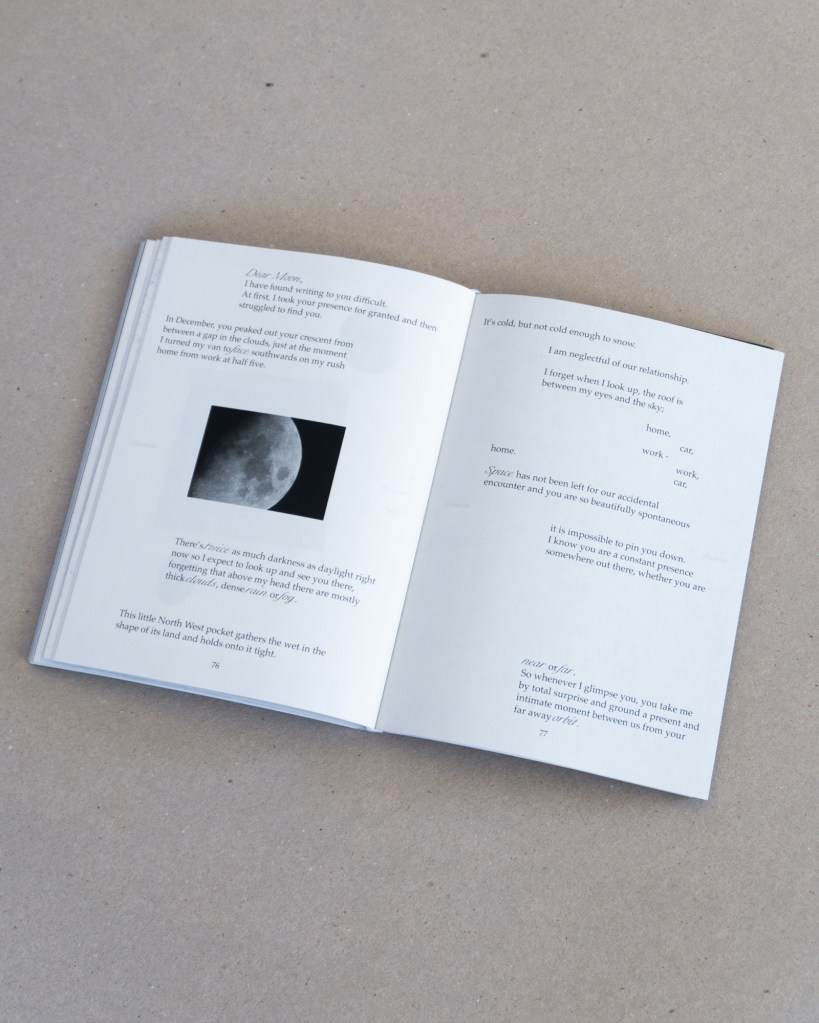
Since October, I’ve been immersed in the making of Dear Moon. What began as a simple idea grew into something layered and full of meaning. Over these months, I’ve learnt so much, not just about putting together a book, but about myself. The skills I’ve had to call on managing, organising, communicating, publishing, sharing all came with challenges. I had to practise patience.. I had to listen. And more than anything, I had to trust the process!

There were many moments when I didn’t know exactly where it was heading, but I allowed myself to follow the rhythm of the work, and something beautiful came through. I’m especially grateful that the work is expanding being read, being held and I’ve been watching it with a sort of quiet pride.

Still, I have to be honest. Sharing Dear Moon in public spaces hasn’t felt completely right. I tried presenting it in a vibrant setting, but I could feel the book asking for something else, something slower, more still. It asks the reader to sit, pause, and take time. And that’s hard to find in environments filled with movement.

So, although I didn’t quite succeed in the way I had imagined, I don’t see it as failure. Instead, I see it as another learning. The challenge now is to explore different ways a book like this can live in public space. How do I present it in a way that honours its pace and stillness? How can I guide people toward it gently, instead of expecting it to compete for attention?

I’m still learning, and I’m open. I’m proud of Dear Moon, and I know it will keep finding its way as long as I keep listening.

Posted in collaboration, Moon, Project, Reflection, Research, Writing

A Collaboration on Dear Moon (Service Point JNG)

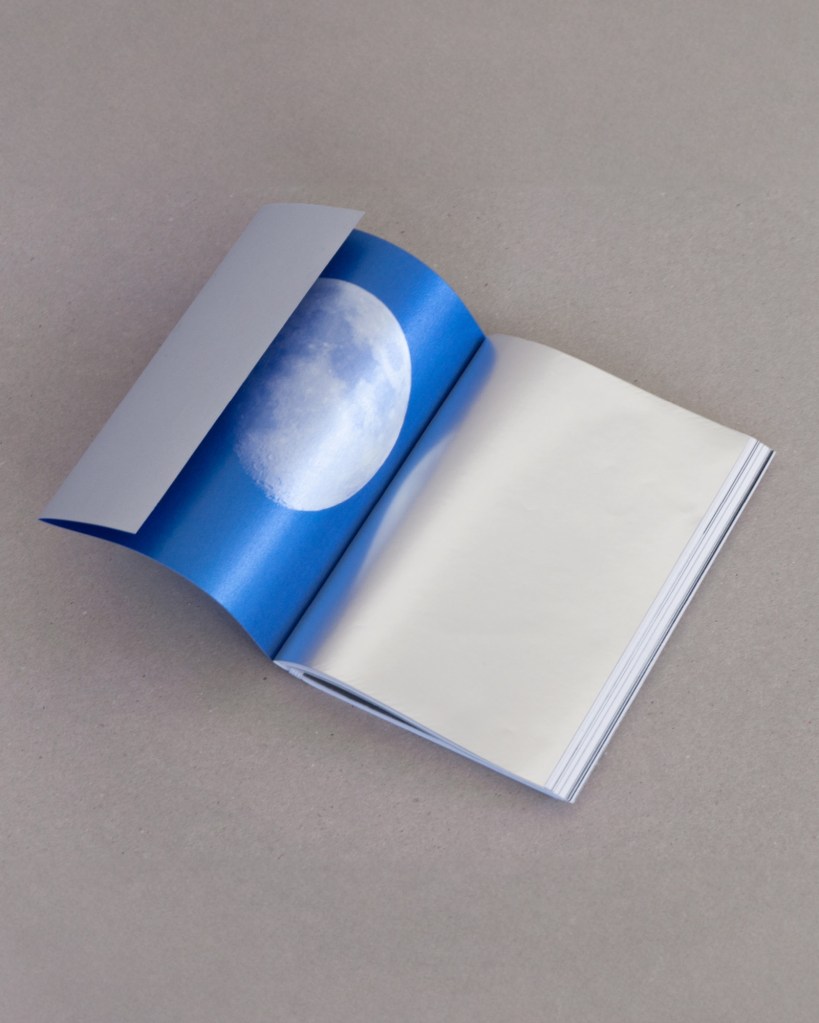
Working on Dear Moon has been one of the most personal and expansive projects I’ve ever taken on. While the words came slowly, shaped by honesty and quiet reflection, the visual form of the book took a different kind of journey, one that became stronger and more meaningful through collaboration.

I had the pleasure of working with Jiayi and GG, two recent MA Graphic Design graduates from the university. They took on the challenge of designing Dear Moon and brought their own vision to it. Where I had initially imagined something simple, quiet, and almost invisible in its design letting the words do all the work they brought something else entirely: depth, elegance, and boldness in aesthetic.

Their design sensibility was so different from mine. I approached the book with simplicity, wanting to preserve the gentle rhythm of the letters and photographs without interruption. I didn’t want the visuals to overpower the messages within. But what Jiayi and GG brought was not overpowering it was enhancing. They introduced a poetic visual language: deep blues, moonscapes that speak for themselves, layout choices that echo the movement of tides and emotion. They weren’t just decorating; they were interpreting.

Looking at the final book now, I see a true collaboration. It’s no longer just a collection of letters; it’s a designed experience. A conversation between stillness and form.

Collaborating in this way has taught me the value of letting go. Of sharing creative control. Of trusting others to hold your work with care and transform it with love and intention. I feel Dear Moon is stronger because of this process, and I’m grateful to Jiayi and GG for reminding me how powerful cross-disciplinary work can be.

https://www.instagram.com/p/DHa-GsDKStV/?igsh=MWVza3g4eGFrZ2g0bw==

Posted in 2024/2025, Exhibitions, Motivations, Reflection, Writing

First Review in Art in Liverpool

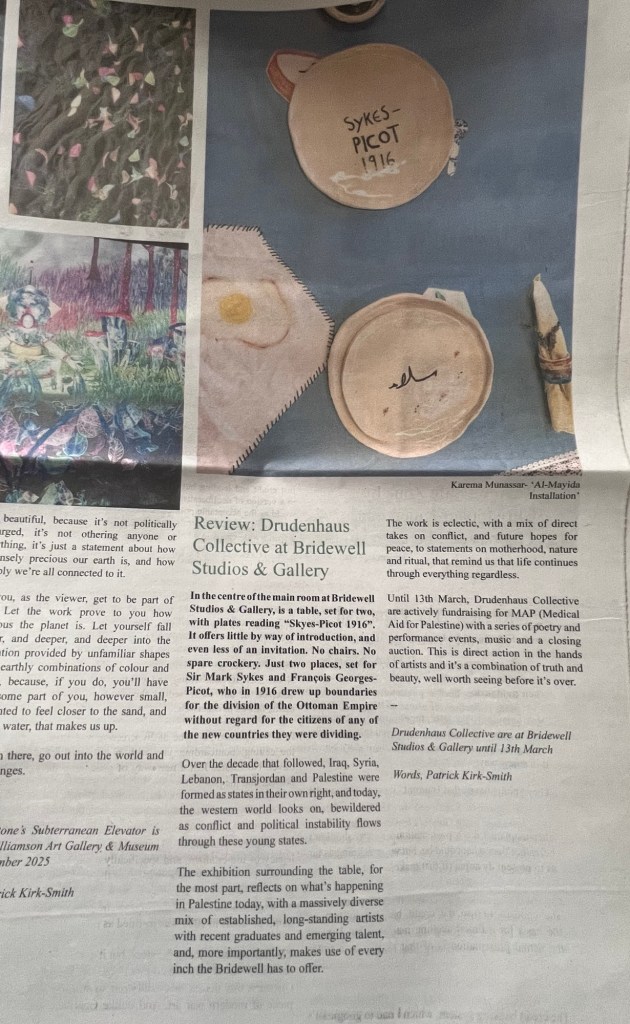
I recently received my first review (which I see as feedback) in Art in Liverpool, written by Patrick Kirk-Smith, about my Al-Mayida installation as part of the Drudenhaus Collective at Bridewell Studios & Gallery. Seeing my work in print, positioned within a broader reflection on history, conflict, and artistic response—has given me space to consider how this moment connects with my ongoing practice.

He writes:

“In the centre of the main room at Bridewell Studios & Gallery is a table, set for two, with plates reading ‘Sykes-Picot 1916’. It offers little by way of introduction, and even less of an invitation. No chairs. No spare crockery. Just two places, set for Sir Mark Sykes and François Georges-Picot, who in 1916 drew up boundaries for the division of the Ottoman Empire without regard for the citizens of any of the new countries they were dividing…”

This review captures the essence of Al-Mayida, how history’s decisions linger in the present, shaping lives and political realities.

As I navigate my MA, this review serves as both encouragement and reflection. It affirms that my work is engaging with complex socio-political themes in a way that resonates beyond the gallery. It also challenges me to refine my approach, how can I sharpen these conversations while maintaining the poetic, unsettling subtlety that Al-Mayida holds?

The Drudenhaus Collective’s fundraising for Medical Aid for Palestine (MAP) adds another layer to this. Art, for me, has always been a site of action as much as expression. This project reinforces my belief that creative practice can exist in solidarity, bringing history into the present not just for reflection, but for tangible impact.

Posted in 2024/2025, Exhibitions, Experiments, Visit, Writing

Childlike Drawing

Book cover

As part of my ongoing exploration of communication, I recently created a series of childlike drawings for an upcoming exhibition in Glasgow, documenting my journey to Auchingarrich Park for the Pitch 2024 Ghost Art School exhibition.

Childlike drawings carry a unique authenticity and emotional impact. They are often raw, unfiltered, and filled with a sense of honesty. By using this approach, I aim to challenge traditional notions of what serious art should look like. 

My practice has always focused on breaking down barriers and fostering meaningful connections, and this childlike style is a way to make art more accessible to a wider audience. 

One of the key aspects of my practice is questioning hierarchies within the art world. By choosing a childlike style, I’m challenging the idea that only refined, technically skilled works are valuable. Instead, I’m highlighting that artistic value lies in the ideas, emotions, and dialogue that the work generates.

The simplicity and playful nature of these drawings highlight themes of innocence and exploration. In the context of my journey to Auchingarrich Park, this approach allowed me to convey a sense of wonder and curiosity, encouraging viewers to reflect on their own memories of childhood and play.

As I continue to explore this style, I look forward to seeing the book in the exhibition and observing how people will interact with it next week.

Posted in Experiments, Research, Writing

Hehehe!! A Scanner, Asemic Writing, and an Unexpected Translation

I had fun playing with a new scanner I bought to help me upload the physical Moon Letters to my computer. The quality is great, and I immediately thought—this would be perfect for digitising my Asemic writing.

I decided to experiment: I uploaded a piece of Asemic writing, then tried a translation tool to read the text from the image. I wasn’t expecting much, Asemic writing is by definition without a fixed meaning, existing in a space between language and pure form. But to my surprise, I got three translated lines.

This unexpected outcome was a moment of algorithmic improvisation, a piece of text I never wrote was suddenly part of the work. The machine involved itself in the process, introducing an element beyond my control, much like the way audiences reinterpret asemic writing in unpredictable ways.

Two questions immediately came to mind:

• What does it mean for an asemic text to be “translated”?

• Does this process create a new kind of auto-generated asemic language, where machine logic meets human mark-making?

This might just be the beginning of a new asemic project. And, I’m excited to experiment more, to invite the machine into the asemic process, and to see where this unexpected collaboration between human intention and machine misinterpretation leads me.