Posted in 2025-2026, collaboration, Exhibitions, Project, Reflection

The Right Map Reflection: Communication Through Hands

I showed a new work in the group exhibition Slip Stream at CBS Gallery 1st July , curated by Phoebe Thomas. The curatorial framework set us an unusual challenge: each artist was given a 50-word anonymous biography of another contributor. Without names, without identities, we had to respond to these fragments and create a work that became, in some way, a conversation.

My response was a sculpture that invited people to communicate through their hands. The idea began with a conversation I had with my tutor, Jonathan, about how deafblind people often use touch as their primary language. That image stayed with me, of words transformed into hand movements, of dialogue carried through the skin.

I worked with a carpenter to build a wooden structure, box-like and slightly absurd. In fact, he thought it was a lab project at first, not an artwork. It has two circular holes on each side, just large enough for a hand to slip through. Inside, participants could meet in the middle, fingertips searching for another human presence.

What unfolded was fascinating. Some people laughed, finding the whole set-up comical. Others hesitated, uncertain about the strangeness of touching an unseen hand. A few lingered, holding on quietly as though the box had suspended time and language. I loved how the responses varied, awkwardness, tenderness, curiosity, even vulnerability.

For me, the sculpture is about the fragility of communication. We take for granted the ease of speaking or looking, but when those channels are removed, what remains? What does it mean to reach out when you cannot see or hear the other person? In the gallery, the box became a stage for these encounters: funny, intimate, and unsettling all at once.

This work revealed something important about my practice. I often circle back to questions of language, misunderstanding, and how people find ways to connect across barriers. I came to see how even the simplest gestures can be at once symbolic and deeply tangible. In its awkwardness, the sculpture echoed the curatorial task we had taken on blindly, while also reflecting my interest in co-production: an exploration of indirect connection, partial knowledge, and the fragile space between concealment and encounter.

Posted in 2025-2026, collaboration, curation, Exhibitions, Reflection

Invigilator X Artist

Someone: Should artists invigilate their own exhibition?

Me: Absolutely not!

We finally opened our first exhibition Unstable #1 on the festival’s opening day 7th of June . The works were powerful, the team was wonderful, and I learned so much from them. I remain deeply grateful to everyone who came, especially my tutor Jonathan. The exhibition brought together artists from Liverpool, London, Glasgow, Germany, and even as far as Australia.

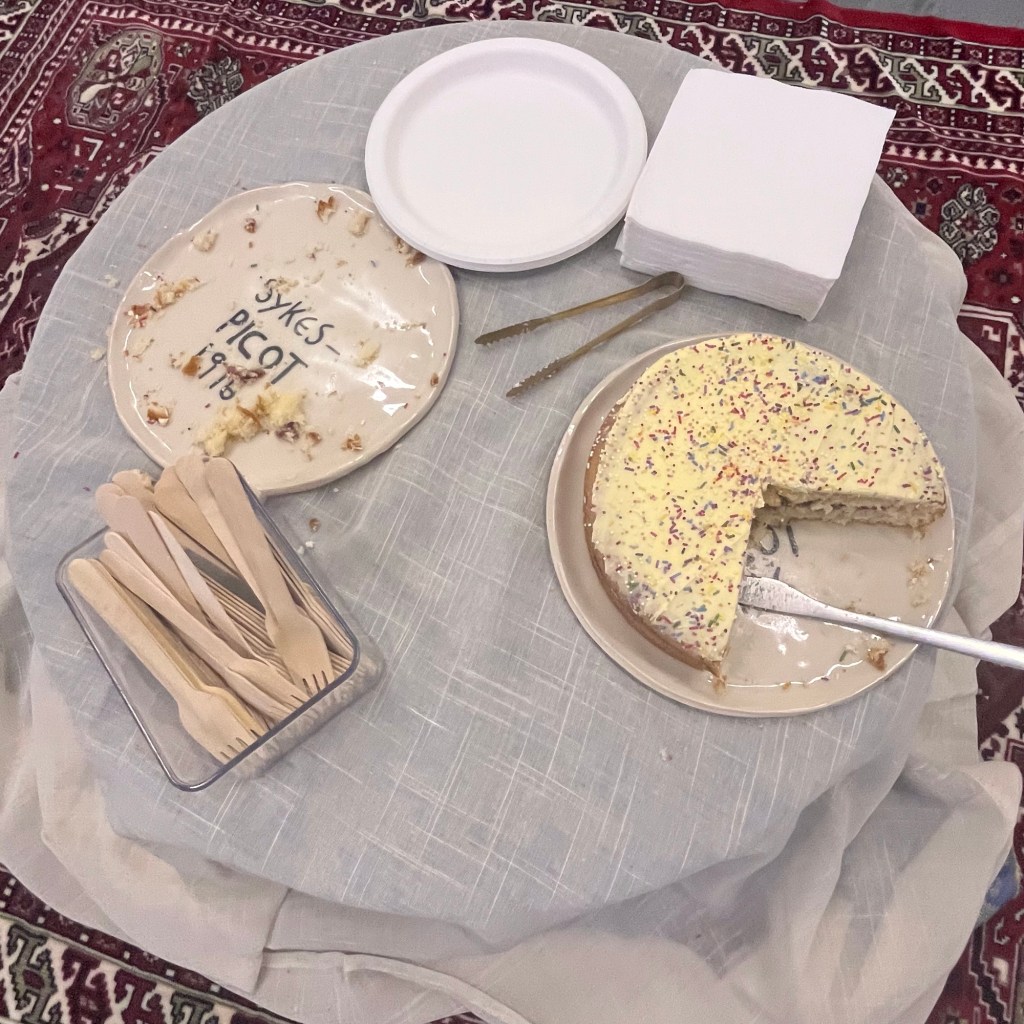
But despite the excitement, I had a difficult experience when I volunteered to invigilate for a day. The Biennial was short of volunteers, and I wanted to help. Yet what I found most challenging was being present in front of my own work: the Sykes–Picot plates, left exactly as they had been on opening night, still holding the crumbs of cake.

When visitors arrived, I would usually begin by introducing the other artists’ works, one by one. I avoided starting with my own. I didn’t present myself as “the artist” but as someone available to guide, to answer questions. I wanted to hear honest responses without the filter of politeness.

Two moments unsettled this:

– First, a group of visitors stopped at my work, were deeply moved, and immediately linked it to what is happening in Gaza. They asked questions, spoke at length, and even wanted a photo of me with the piece.

– Then, two other visitors became emotional as we discussed the history of Sykes–Picot. They spoke of the weariness of violence, of how exhausting it is to keep watching the news. One woman broke down in tears. I felt her exhaustion echo within me, though I tried to remain composed and gently encouraged her to look at the other works.

In those moments, I realised how much people need space to voice their rejection of violence and injustice. We all long for ways to speak out, to push against the weight of helplessness or guilt.. yet, after those encounters, I knew I couldn’t invigilate again. The conclusion was clear: invigilating is not for me.

Posted in 2025-2026, collaboration, curation, Exhibitions, Project, Reflection, Research

The Right Map – My wild Summer 

For more than three months this year, my life was consumed by The Right Map. Coordinating and organising eight shows ( Unstable 1,2,3,4, Account, Account Not Recognised, Slip Stream and In Search of Swallow and Amazon show/fundraising event) across Liverpool was a huge undertaking logistically, emotionally, and artistically. It was intense work: curating, communicating with artists and collaborators, solving problems on the spot, and carrying the responsibility of holding so many different voices together in one programme.

During the summer, I couldn’t write about it.. The pace was too fast, the demands too many, and on top of that, family responsibilities and personal challenges were pulling me in different directions. I was tired, grateful, overwhelmed, and very often carrying mixed feelings that left little room for reflection.

Looking back, I see the full image: what worked, what I loved, what was difficult, and where I grew. Writing from this distance feels possible, even necessary. I realise that part of my practice is not only in the making or the showing but also in reflecting.

The Right Map reminded me of this: the gaps, the tensions and the silences were as important as the works themselves. The experience was more than making artworks. It was about what happens when we work together, recognising where we succeeded so we can carry that forward, and where things did not work so we can avoid them in the future.

In the next posts, I want to unpack some of the moments that stayed with me: the artworks that resonated deeply, the tensions that tested me, the negotiations and miscommunications that revealed the realities of working collectively, and the unexpected joys that reminded me why I do this work.

I needed time to arrive here. To allow the intensity to pass, and to feel ready to write. Now, I can see The Right Map not only as a demanding project but as a turning point in how I think about curation, collaboration, and care in my practice..

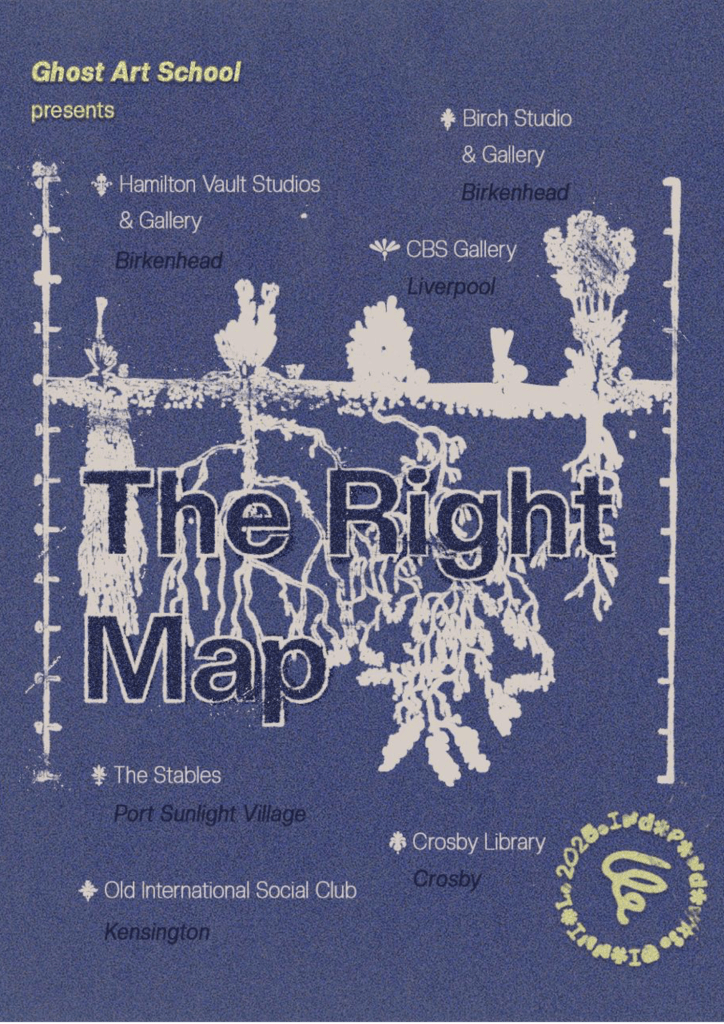
The Right Map was a series of exhibitions presented by Ghost Art School as part of the Independents Biennial. Emerging from the spirit of Ghost Art School, it celebrated artists who move between margins, who learn in the cracks, who map their own routes when none are given.

Here, the map was never fixed, drawn in gestures, erased by time, redrawn in conversation, in defiance, in care. The Right Map asked not where we are going, but how we move… and who gets to move with us.

The Right Map 36 artists: Alison Reid, Alma Stritt, Charli Kleeman, Chelsea Johnson, Chris Roberts, Colm Moore, Conner Browne, Cos Ahmet, Danielle Freakley, David W Hicks, Eleanor Capstick, Finn Roberts, Gary Finnegan, Gwendolin Kircali, Halyna Maystrenko-Grant, Hannah Browne, Harriet Morley, Igor Prato Luna, Jasmir Creed, Jessica Crowe, Karema Munassar, Lily Patricija, Mai Sanchez, Marie-Sofie Braune, Molly Lindsay, Molly Mousdell, Phoebe Thomas, Priya Foster, Ritu Arya, Rory Macbeth, Sonic Relics, Theodora Koumbouzis, Tom Doubtfire, Tom Kelly, Valentina Passerini, and Xueying Zhang 

Posted in collaboration, Exhibitions, Experiments, Research

The Right Map

Poster credit: Phoebe Thomas

Coordinating The Right Map for the Ghost Art School artists was intended as an act of support for others. But in the process, I found myself unexpectedly charting new ground in my own practice. What began as a curatorial and facilitative role gradually unfolded into a deep personal enquiry, one that significantly shaped my ongoing research in social sculpture.

I began to notice shifts in my own thinking. Supporting artists to articulate their intentions, reflect on their choices, and ground their practice compelled me to ask the same of myself. It was not a passive role; it was active, dynamic, and generative.

Interestingly, throughout The Right Map, I found myself increasingly drawn to the curatorial aspects of my work more than the making itself. It’s not just about presenting artworks, it’s about orchestrating experiences, holding conversations, shaping encounters. I became fascinated with how frameworks are built, how meaning is constructed around and through art. In many ways, the coordination itself became a form of social sculpture.

This shift is not about stepping away from being an artist…it’s about understanding the expanded field in which I operate. Curation, facilitation, research, and community-building have become a core tool kit in my practice. Through coordinating The Right Map, I gained new confidence in embracing this hybridity. I no longer see it as fragmented, but rather as a cohesive and intentional mode of working that reflects my values and voice.

https://www.instagram.com/p/DJov3YBo9Yg/?igsh=Mnd6MWh3MXRuaDQy

Posted in Experiments, Moon, Project, Reflection, Research

Becoming an Audience to Our Own Work!

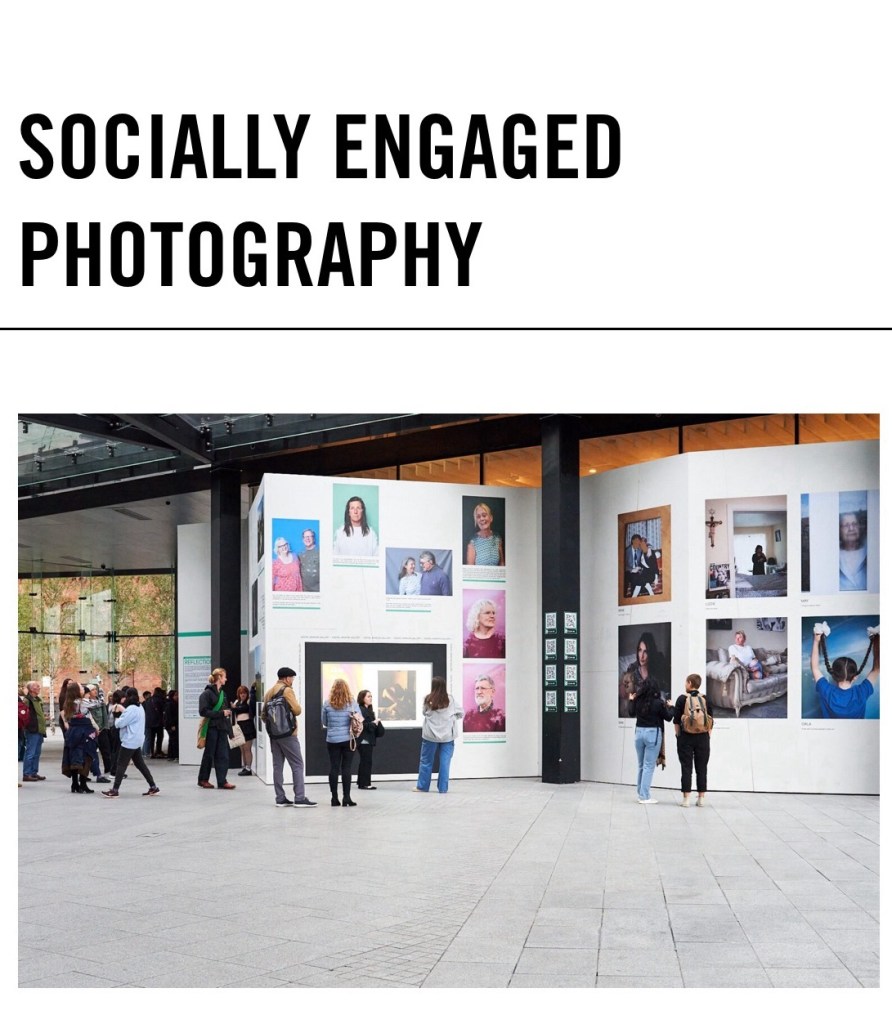
19 artists from across the country and beyond, working across different disciplines, were selected for Open Eye Gallery’s Socially Engaged Photography programme. The session began gently with an icebreaker to help us introduce ourselves and connect, opening into a space full of layered questions and open dialogue.

One phrase stayed with me: “Becoming an audience to your own work.” It’s the idea that the artist creates a framework for others to shape, leading to outcomes unknown even to them. This made me reflect on Dear Moon, a book project I designed. By the end, I felt less like its author and more like its audience. The photographs simply held space—the real substance came from the contributors’ words. Their voices carried the project forward.

In breakout groups, we explored definitions of socially engaged practice. From using art as a collaborative tool for justice (Sholette & Bass) to fostering shared understanding and personal growth (Matarasso), the emphasis was clear: this work is about people, not product. It’s about ethics, active listening, and creating conditions for transformation.

I feel genuinely grateful to have been selected for this course and to be mentored by Elizabeth Wewiora. I look forward to continuing the journey and exploring how it might help shape my research around social sculpture.

Posted in 2024/2025, Assignments, Reflection

Unit 1 Assessment

Learning Outcome 1:
Formulate, describe and implement a challenging and self-directed programme of study, relating to your Study Statement. (Assessment Criteria: Enquiry):

My work explores topics of communication, connection, and collective experience through projects such as Al-Mayida, Letters to the Moon, asemic writing, and childlike drawings. Each project looks at how art fosters debate, narrative, and inclusivity. Interviews with Pedro Reyes about social sculpture, White Pube’s new book, and Axis’ Artists That Write have all inspired me. Furthermore, the Art for the Earth’s Sake initiative stressed the importance of adopting an ecocentric perspective to social practice. All of these influences have shaped my self-directed method, in which I investigate and learn from literature and artists, as well as my own artworks.

Learning Outcome 2:
Implement appropriate working methods for building an independent and effective self-organisation that enables the critical engagement with practice-based research.
(Assessment Criteria: Process):

In projects such as Al-Mayida, I experiment with diverse curatorial approaches, but in Letters to the Moon, I prioritise participant interaction. My process-driven approach accepts ambiguity and improvisation, which is consistent with Jonathan’s reflection in action research. The final session of Art for Earth’s Sake was especially powerful, as we discussed how artists can practise sustainability, set a good example, and utilise art as a tool for social and environmental change. 

Learning Outcome 3:
Communicate a critical understanding of your developing practice.
(Assessment Criteria: Knowledge, Communication):

My work is a type of social sculpture, an ever-changing discussion that connects personal and collective experiences. Projects such as Al-Mayida focus on unity and history, whereas Letters to the Moon promotes communication and community involvement. My efforts with asemic writing and childlike drawing disrupt art’s traditional hierarchies, emphasising authenticity and accessibility.

At last, I want to utilise art to promote social interactions and spark meaningful discourse about sociopolitical and environmental challenges. Through documentation, reflections, short courses, and visits, I hope to create work that promotes connection, dialogue, and communal action.

Feedback requests:

I would appreciate feedback on two experiments I’m currently working on: Asemic writing with translation and childlike drawings. Both approaches are new and quite different from one another.

Posted in Exhibitions, Motivations, Research, Visit

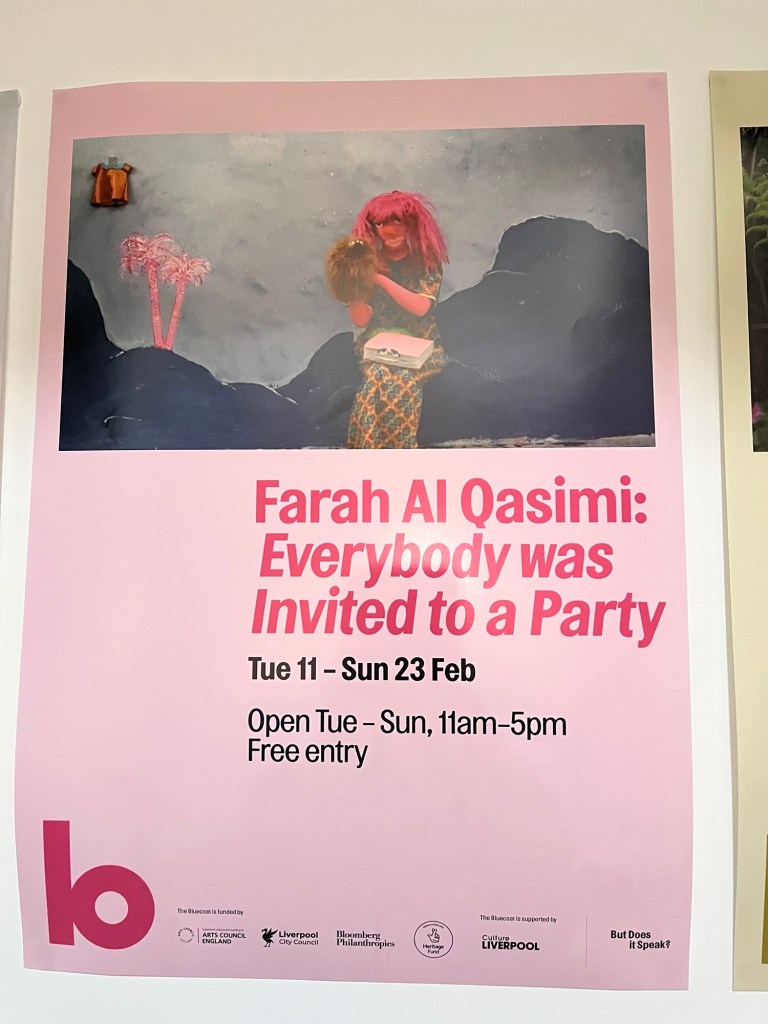
Farah Al Qasimi’s Everybody was Invited to a Party

Yesterday, I stepped into The Bluecoat and found myself transported back to my childhood in Dubai. Farah Al Qasimi’s work immediately struck a chord, filling the space with images, sounds, and moments that felt intimately familiar. In this exhibition, I wasn’t just observing, I was reliving something personal, something nostalgic. I laughed, paused, and travelled back home through her lens.

Al Qasimi, an artist from the UAE, weaves humour, memory, and language into a beautifully immersive world. Her film, Everybody was Invited to a Party, takes inspiration from Iftah Ya Simsim, the 1980s Arabic adaptation of Sesame Street. Using hand-sewn puppets and a playful approach to translation, the film highlights the fluidity , and at times, the struggles of communication.

One of the moments that resonated most with me was the pink Arabic-speaking monster struggling to order food in English. The monster’s eventual decision to learn English felt both humorous and deeply familiar. Another example was the book puppet with  text saying “I made a book to help me say the right things”. That line lingered with me. It felt so aligned with my own practice. Using language as both a tool and an obstacle, playing with its structures while trying to express something truthful.

Her use of puppetry and humour in dealing with linguistic struggles felt particularly relevant to me. I have always been interested in how objects and visual storytelling can reveal the nuances of human communication. Seeing her work has sparked new ideas about how I might further explore these themes, especially in my MA research and upcoming projects.

This exhibition reminded me that language is never just about words, it’s about memory, culture, and the ways we find (and sometimes lose) ourselves in translation. And in those moments of uncertainty, there is humour, resilience, and the power to create new meaning.

Posted in Lectures 2024/2025, Motivations, Reflection, Research

Reflections on Professionalism and Unprofessionalism

I missed the last lecture on professionalism and unprofessionalism due to family circumstances. Ironically, missing out on topics that interest me most. But watching the recording was still a rich experience, listening to the discussions and the different perspectives people brought to the conversation. 

I read the article How to Be an Unprofessional Artist by Andrew Berardini, which Jonathan shared in the lecture. And, I think the word “unprofessional” carries a certain weight, often with negative connotations. It reminds me of how the word “steal” is used provocatively in Steal Like An Artist by Austin Kleon, or how “disabled” can be perceived in different ways, negative for some, yet embraced by others as a form of identity and empowerment. Language is powerful; it doesn’t just describe the world, it shapes it. It influences how we see ourselves, how others perceive us, and what opportunities are available to us.

A key point in the discussion was how professionalism is often framed by rigid, exclusionary standards, ones that can erase individuality, lived experience, or even care. But does professionalism have to mean conforming to a narrow, predetermined image? Many so-called unprofessional traits: honesty, vulnerability, and unconventional approaches are actually strengths. They challenge existing systems, create space for new ways of thinking, and foster deeper engagement.

The tension between professional and unprofessional seems to lie in whether professionalism is dictated by external standards or defined through integrity, care, and dedication to one’s practice. If professionalism means respect for oneself, for others, and for the work, then it doesn’t have to mean suppressing individuality or creativity. I see professionalism not as following a strict rulebook, but as a commitment to craft, ethics, and meaningful engagement.

As a mother of a child with special needs, I’m particularly aware of how language shapes perception. In different contexts, the term “disabled” can be either empowering or limiting. Could “unprofessional” also be reclaimed? Maybe, but only if doing so truly empowers rather than undermines.

My own art practice naturally resists traditional notions of professionalism. Coming from multiple backgrounds, embracing mistakes, and working in multidisciplinary ways, I see value in experimentation and non-traditional approaches. Rejecting conventional professionalism doesn’t mean rejecting care, commitment, or quality. It means refusing to be boxed into a system that wasn’t designed for people with diverse experiences and ways of working. Above all, rejecting traditional professionalism can be an act of resistance, challenging exclusionary structures that dictate who belongs and what is deemed acceptable work.

I navigate between institutional and freelance work, moving fluidly between structured and independent spaces. Working with institutions while maintaining my own perspective allows me to challenge the system from within while also creating alternative ways of working. It’s about understanding the rules but choosing when and how to break them in ways that are meaningful.

This ability to shift between spaces sometimes fitting in, sometimes disrupting gives me agency. It also allows me to act as a bridge for others who feel like they don’t fit into traditional structures. This is something I see in my work, whether through Moon Letters, Creative Peers, or other social sculpture projects.

Rather than seeing professionalism and unprofessionalism as rigid opposites, I see them as fluid. True professionalism, to me, is about care, respect, and meaningful engagement, qualities that don’t require conforming to outdated norms, but rather, reimagining them.

Somewhere in Oxford…

Posted in Experiments, Research, Writing

Hehehe!! A Scanner, Asemic Writing, and an Unexpected Translation

I had fun playing with a new scanner I bought to help me upload the physical Moon Letters to my computer. The quality is great, and I immediately thought—this would be perfect for digitising my Asemic writing.

I decided to experiment: I uploaded a piece of Asemic writing, then tried a translation tool to read the text from the image. I wasn’t expecting much, Asemic writing is by definition without a fixed meaning, existing in a space between language and pure form. But to my surprise, I got three translated lines.

This unexpected outcome was a moment of algorithmic improvisation, a piece of text I never wrote was suddenly part of the work. The machine involved itself in the process, introducing an element beyond my control, much like the way audiences reinterpret asemic writing in unpredictable ways.

Two questions immediately came to mind:

• What does it mean for an asemic text to be “translated”?

• Does this process create a new kind of auto-generated asemic language, where machine logic meets human mark-making?

This might just be the beginning of a new asemic project. And, I’m excited to experiment more, to invite the machine into the asemic process, and to see where this unexpected collaboration between human intention and machine misinterpretation leads me. 


Posted in 2024/2025, Motivations, Project, Reflection, Research

Final Session: Art for the Earth’s Sake

Our last session of Art for Earth’s Sake Peer Learning, was a powerful experience exploring the intersection of creativity, sustainability, and community action.

Key Highlights:

1- Leading by Example: We discussed how artists can practise sustainably, acting as role models for others by reducing their carbon footprint and promoting eco-friendly approaches. This includes minimising the use of fossil fuels and exploring innovative tools such as digital carbon offset initiatives like Ecology.

2- Art as a Vehicle for Transition: Art has the power to shape people’s decisions and inspire social and environmental change. We explored how slow, mindful processes can create space for reflection and dialogue about the future we want to build.

3- The Role of Heart and Mind: It’s not just about being an artist but about raising awareness and fostering learning. We emphasised the importance of balancing rational thinking with heartfelt creativity to address environmental.

We took inspiration from artists such as Rebecca Chesney and Anthony Hall, and projects like the Soil Exhibition in Somerset. Additionally, ideas from thinkers like Stephen Covey’s “Three Spheres of Influence” helped us focus on what we can control, what we can influence, and what we need to let go of as individuals and as a collective.

We are encouraged to continue organising events, engaging the community, and taking part in initiatives like the Engage. By working together, we can use art as a catalyst for positive change in the world.

Stephen Covey’s concept of the Three Spheres of Influence is a framework that helps individuals focus their energy on what they can truly affect. This idea is derived from his book, The 7 Habits of Highly Effective People. The three spheres, also known as the Circles of Concern, Influence, and Control, are a way to prioritise actions and efforts effectively. The Three Spheres Explained:

1. Circle of Concern:

This represents everything you care about, including external issues such as climate change, world events, and things you have no direct control over. While it’s important to be aware of these issues, focusing too much energy here can lead to feelings of helplessness.

2. Circle of Influence:

This sphere includes aspects you can influence, such as your local community, workplace, and people around you. By focusing efforts here, you can make a meaningful impact even if you can’t solve global issues. This is where actions like raising awareness, inspiring others, and leading by example can make a difference.

3. Circle of Control:

This is the smallest sphere, encompassing only what you can directly control, your own actions, decisions, mindset, and responses. By focusing on this sphere, you ensure that your efforts are grounded in what you can actually change.

By prioritising your focus on the Circle of Control and the Circle of Influence rather than the Circle of Concern, you can channel your energy more productively, avoid burnout, and create more positive impact. This approach is particularly valuable in projects related to sustainability and social change, where large-scale problems can feel overwhelming.

In the context of “Art for Earth’s Sake” understanding these spheres can help artists and activists focus on what they can do, such as creating art that inspires action, practising sustainability in their own work, and building local community initiatives that promote change.