Posted in 2025-2026, collaboration, Experiments, Social Sculpture, Visit

Reflection on Alex Schady Workshop Collaborative Making and Social Sculpture

I took part in a workshop led by Alex Schady as part of the Fine Art Digital Residency week which thoughtfully organised by Jonathan for both MA classes. 

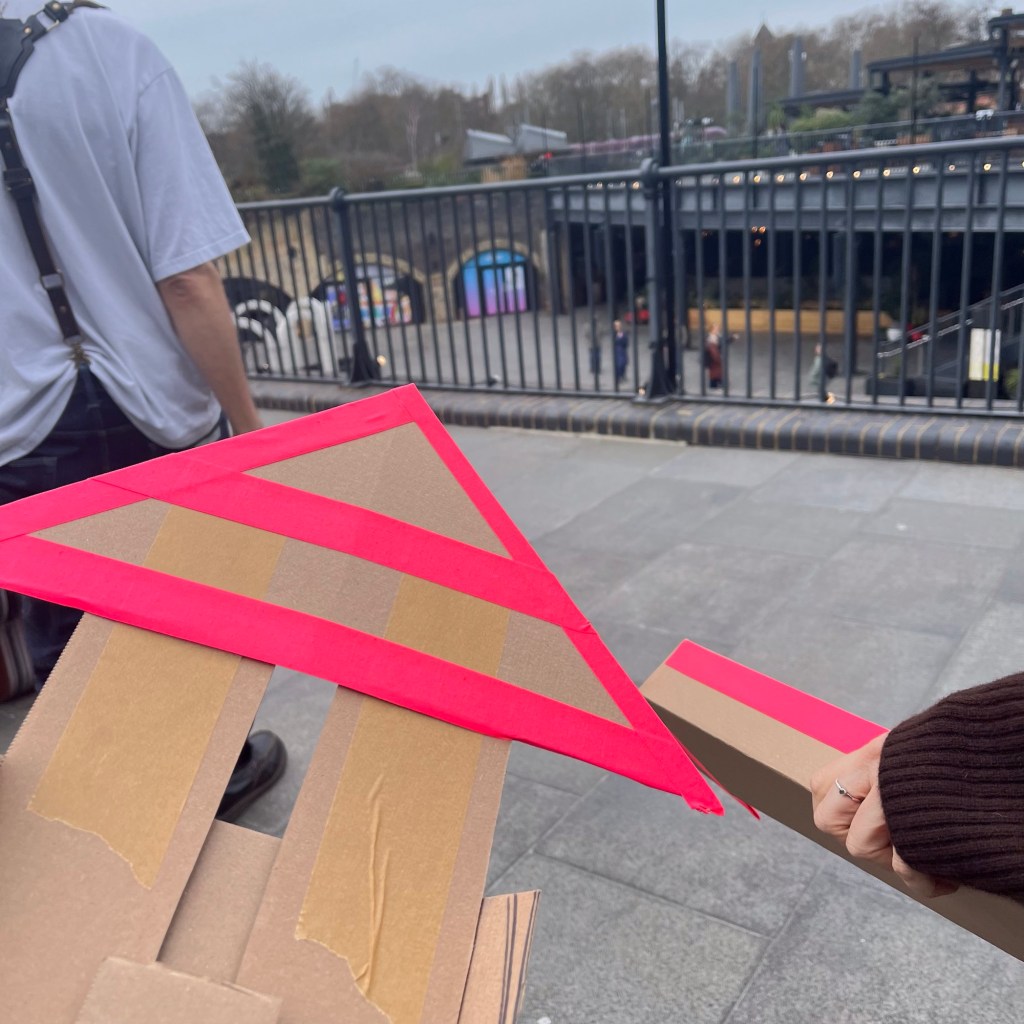
The session focused on collaborative making and began with a simple exercise: a flat sheet of cardboard was shared and each student created an arrow. I made a very simple arrow, similar to Alex’s example, while others explored more playful and experimental shapes. I noticed something familiar about my role in workshops I often observe more than I produce, watching how others approach the task becomes part of my learning process.

We then moved outside to the street and began performing with our objects, engaging with the urban environment and the people around us. The arrows shifted from being simple objects to becoming gestures in public space.. Accusatory fingers!
In the next stage we worked in pairs to create inflatable body extensions using plastic sheets. I collaborated with Rachael, and we agreed to make angel wings. The process was technically tricky, due to delicate material, but we managed to build them, and had a lot of fun experimenting with movement.

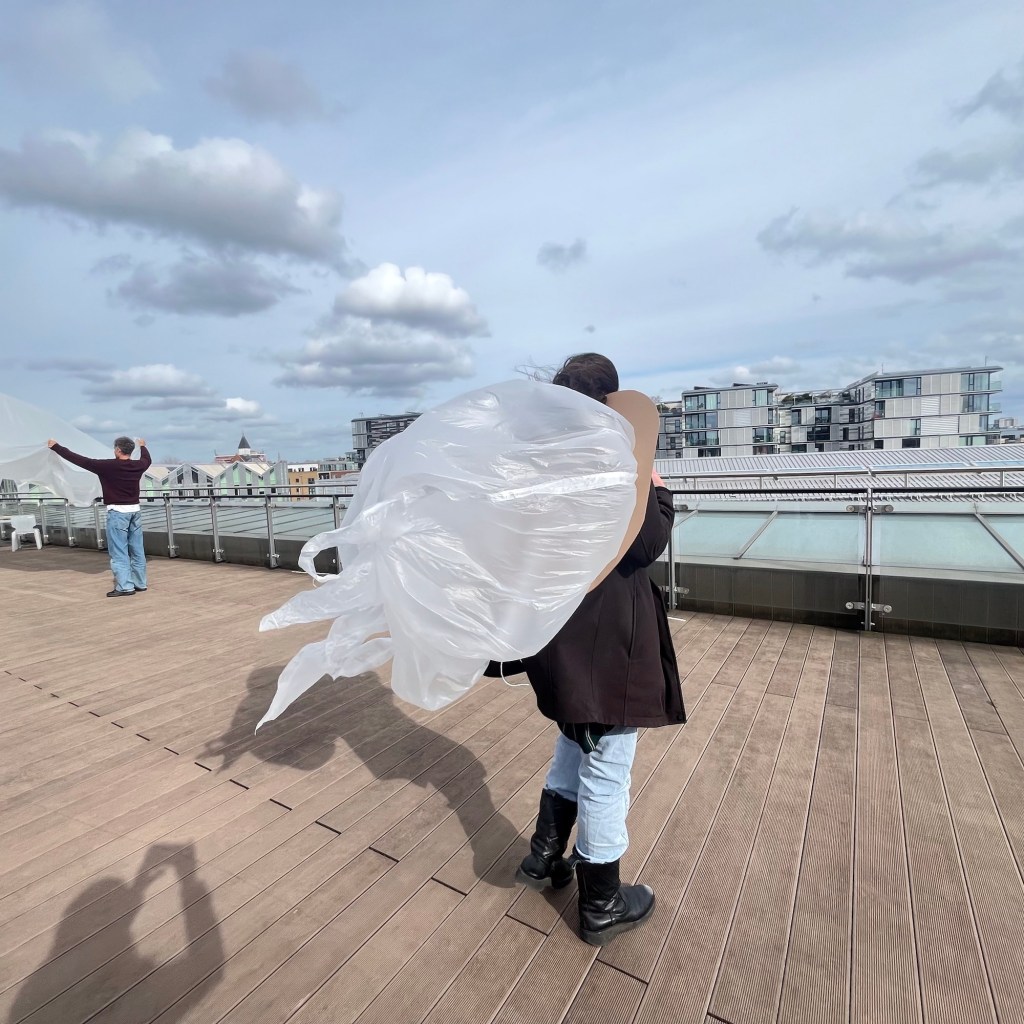
Afterwards we gathered outside for a collective performance where everyone presented their creations. Eventually groups merged and people began wearing multiple extensions, forming a kind of shared body. The performance ended with one large collective body.

What stayed with me most was the way Alex held the space. He allowed collaboration to happen naturally without pressure. No one felt forced to participate in a particular way. This made me think about concept of social sculpture and the idea that society itself can be shaped through collective processes.

The workshop felt like a small example of this idea. Through simple materials and shared actions we created a temporary social structure based on making, negotiating and performing together. 

Afterwards I visited the first-year MA students’ exhibition. It was interesting to see the space and reflect on how quickly time passes during the MA journey. It was also lovely meeting fellow artists in person for the first time there was an immediate sense of familiarity and trust. 

Although I could only stay for a few hours, the experience felt full. Sometimes a few meaningful hours can contain days of learning. Alex’s workshop demonstrated how much can happen in a short time  making, performing and collaborating and it left me wondering how much deeper this process could go if we had the opportunity to continue it over several sessions.

Posted in 2025-2026, collaboration, curation, Experiments, Motivations, Research, Social Sculpture, Visit

Free Workshops

Last Sunday, I spent a rewarding day with Ghost Art School and creatives from October Salon (a new collective in Preston led byHannah Browne). My aim was to organise a free workshops day, focused on sharing knowledge and skills without the need for materials or money. I offered an introductory session in British Sign Language (BSL), while Liverpool-based artists Tom Kelly and Tom Doubtfire generously shared aspects of their practices. Hannah provided the space in Preston, making the event possible through collaboration rather than institutional support.

The day had several clear intentions. Firstly, I wanted to gather with peers and begin the year in a meaningful, collaborative way, learning together and exchanging knowledge. Secondly, the event allowed us to engage with October Salon, an emerging creative group, and to demonstrate what can happen through collective artistic practice.

The programme began with Tom Doubtfire leading a discussion on the role of the artist and the relationship between art and activism. His reflections centred on disturbance, sustainability, sacrifice, and focus. The group discussed what it means for art to be disturbing, what sustainable practice might look like, how much we are willing to sacrifice and the importance of setting limits, also how to remain focused on our aims.

This was followed by my one-hour introduction to BSL. My motivation for teaching BSL stems from both personal conviction and historical awareness. The language was banned in the United Kingdom between 1880 and 1970, and despite its cultural and social importance, it still receives limited funding in education. BSL was officially recognised as a language in 2003 and granted legal status in 2022, yet it is still not included in the GCSE curriculum. In this context, teaching BSL freely can be understood as a quiet form of activism! Challenging ableism, questioning unequal access to culture, and sharing knowledge rather than gatekeeping it.

BSL is also highly visual and expressive, connecting strongly with creative disciplines. It can influence performance, filmmaking, choreography, and storytelling, functioning not only as a language but also as an artistic medium. More broadly, offering knowledge without payment can be seen as a response to the increasing commercialisation of the arts. It reminds us that generosity and collective growth still hold value.

The day concluded with a workshop led by Tom Kelly, which provided a joyful ending. His approach to clowning demonstrated that it’s not simply about being silly, but about exploring human emotions through humour and vulnerability. Through simple games and spontaneous interaction, the group communicated naturally, without preparation. There was a strong sense of care, kindness, and mutual respect among participants.

The structure of the day loosely echoed Joseph Beuys’ idea of the Free International University, an artist-led model of education independent from institutions and grounded in dialogue and shared learning. By offering knowledge freely and prioritising exchange over production, the gathering became less about outcomes and more about shaping a temporary community through participation.

For me, the impact of this day was more meaningful than any individual artwork I’ve made recently. It highlighted the importance of shared time, laughter, and informal learning within creative communities. It felt like an encouraging and significant beginning for the group, grounded in connection rather than productivity alone

Posted in Exhibitions, Experiments, Moon, Reflection, Research, Visit, Writing

Trusting the Process.. Interim Show 2025

Since October, I’ve been immersed in the making of Dear Moon. What began as a simple idea grew into something layered and full of meaning. Over these months, I’ve learnt so much, not just about putting together a book, but about myself. The skills I’ve had to call on managing, organising, communicating, publishing, sharing all came with challenges. I had to practise patience.. I had to listen. And more than anything, I had to trust the process!

There were many moments when I didn’t know exactly where it was heading, but I allowed myself to follow the rhythm of the work, and something beautiful came through. I’m especially grateful that the work is expanding being read, being held and I’ve been watching it with a sort of quiet pride.

Still, I have to be honest. Sharing Dear Moon in public spaces hasn’t felt completely right. I tried presenting it in a vibrant setting, but I could feel the book asking for something else, something slower, more still. It asks the reader to sit, pause, and take time. And that’s hard to find in environments filled with movement.

So, although I didn’t quite succeed in the way I had imagined, I don’t see it as failure. Instead, I see it as another learning. The challenge now is to explore different ways a book like this can live in public space. How do I present it in a way that honours its pace and stillness? How can I guide people toward it gently, instead of expecting it to compete for attention?

I’m still learning, and I’m open. I’m proud of Dear Moon, and I know it will keep finding its way as long as I keep listening.

Posted in 2024/2025, Exhibitions, Experiments, Visit, Writing

Childlike Drawing

Book cover

As part of my ongoing exploration of communication, I recently created a series of childlike drawings for an upcoming exhibition in Glasgow, documenting my journey to Auchingarrich Park for the Pitch 2024 Ghost Art School exhibition.

Childlike drawings carry a unique authenticity and emotional impact. They are often raw, unfiltered, and filled with a sense of honesty. By using this approach, I aim to challenge traditional notions of what serious art should look like. 

My practice has always focused on breaking down barriers and fostering meaningful connections, and this childlike style is a way to make art more accessible to a wider audience. 

One of the key aspects of my practice is questioning hierarchies within the art world. By choosing a childlike style, I’m challenging the idea that only refined, technically skilled works are valuable. Instead, I’m highlighting that artistic value lies in the ideas, emotions, and dialogue that the work generates.

The simplicity and playful nature of these drawings highlight themes of innocence and exploration. In the context of my journey to Auchingarrich Park, this approach allowed me to convey a sense of wonder and curiosity, encouraging viewers to reflect on their own memories of childhood and play.

As I continue to explore this style, I look forward to seeing the book in the exhibition and observing how people will interact with it next week.

Posted in Exhibitions, Motivations, Research, Visit

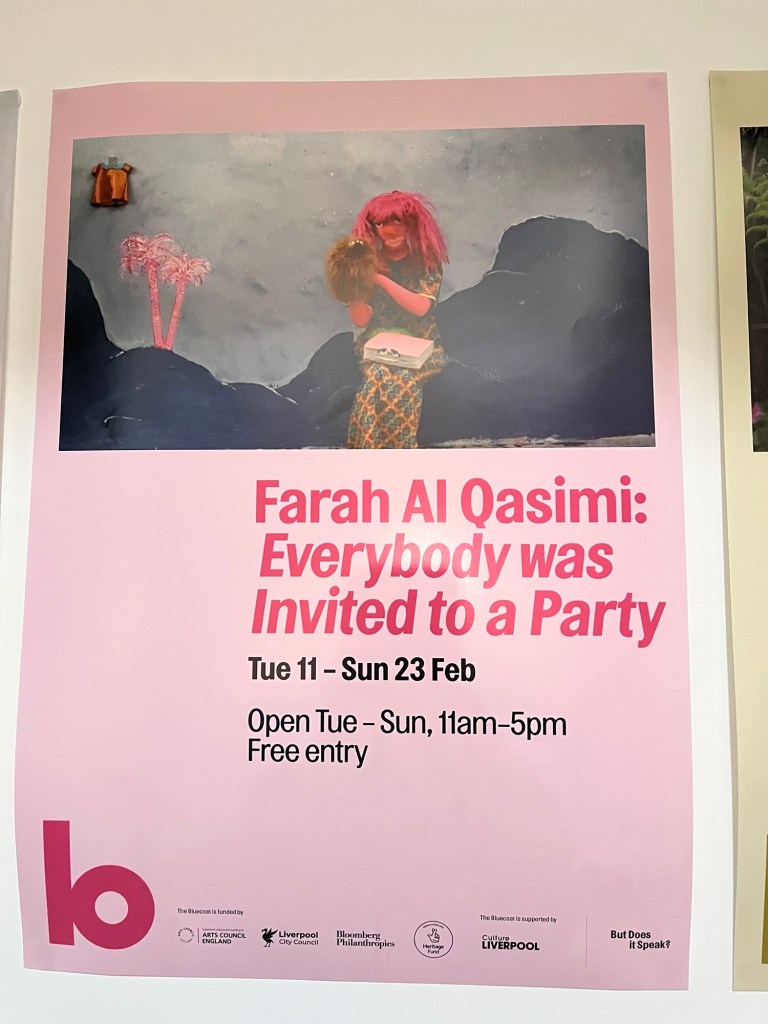
Farah Al Qasimi’s Everybody was Invited to a Party

Yesterday, I stepped into The Bluecoat and found myself transported back to my childhood in Dubai. Farah Al Qasimi’s work immediately struck a chord, filling the space with images, sounds, and moments that felt intimately familiar. In this exhibition, I wasn’t just observing, I was reliving something personal, something nostalgic. I laughed, paused, and travelled back home through her lens.

Al Qasimi, an artist from the UAE, weaves humour, memory, and language into a beautifully immersive world. Her film, Everybody was Invited to a Party, takes inspiration from Iftah Ya Simsim, the 1980s Arabic adaptation of Sesame Street. Using hand-sewn puppets and a playful approach to translation, the film highlights the fluidity , and at times, the struggles of communication.

One of the moments that resonated most with me was the pink Arabic-speaking monster struggling to order food in English. The monster’s eventual decision to learn English felt both humorous and deeply familiar. Another example was the book puppet with  text saying “I made a book to help me say the right things”. That line lingered with me. It felt so aligned with my own practice. Using language as both a tool and an obstacle, playing with its structures while trying to express something truthful.

Her use of puppetry and humour in dealing with linguistic struggles felt particularly relevant to me. I have always been interested in how objects and visual storytelling can reveal the nuances of human communication. Seeing her work has sparked new ideas about how I might further explore these themes, especially in my MA research and upcoming projects.

This exhibition reminded me that language is never just about words, it’s about memory, culture, and the ways we find (and sometimes lose) ourselves in translation. And in those moments of uncertainty, there is humour, resilience, and the power to create new meaning.

Posted in Reflection, Visit, Writing

Finding Focus: The Wastes

Last week, I attended the book launch for The Wastes, a novella by Roy Claire Potter. Potter was joined by guest artists David Jacques, Roo Dhissou, and Harriet Morley at Dead Ink Books in Liverpool. It was a wonderful evening celebrating the work of an artist and writer whose practice profoundly influenced my own during my BA studies. I liked Roy Claire’s ability to weave humour and insight into their reflections on everyday working-class life. In The Wastes, this approach shines through as memories ripple across the narrative, creating a vivid and relatable journey for the reader.

Experiencing the book and the discussions around it gave me a renewed sense of direction for my MA in Fine Art. I’ve realised that writing and participatory art are central to my practice, and I want to explore these areas with greater intention. Roy Claire’s work reminded me how powerful text can be—not just as a medium for communication but as a way to build connections.

Moving forward, I’m determined to channel more energy into developing my writing alongside my participatory projects. This means refining my approach to storytelling and reflection while exploring ways to integrate these elements into interactive art-making. I want to experiment, learn by doing, and create a structured plan to support my growth in both areas.

Attending the book launch wasn’t just about celebrating a great piece of writing—it was a reminder of my purpose and aspirations. Writing and participatory art are more than tools in my practice; they are at the core of how I want to connect with others and create art that resonates.