Posted in 2025-2026, Reflection, Research, Writing

Animals Metaphors in Art

When revisiting my research statement from last year, I found myself returning to the ideas of care and failure within social sculpture. These themes continue to shape my practice and felt essential to include in my research paper. However, my section on animals in art grew too large for the word count and began to pull the paper away from its main focus. I removed it, but after simplifying and editing it, the section stands on its own and is worth sharing here.

My interest in non-human metaphors comes from noticing how artists and writers use animals to express political tension, historical memory and emotional states that might otherwise be silenced. These strategies reveal relationships between power, vulnerability and resistance, and they raise questions about ethics and communication that deeply influence my practice.

Animals and Non-human Metaphors in the Work of Joseph Beuys and Tania Bruguera

Animals sit at the centre of Joseph Beuys’s practice, shaping his ideas on power, vulnerability and transformation. The coyote in I Like America and America Likes Me symbolised Indigenous people and the pre-colonial landscape. For Beuys, it embodied an idealised belief in the intelligence and vitality of the natural world. The coyote represented resistance to American imperialism during the Vietnam War and carried his hopes for future healing between cultures and species.

In How to Explain Pictures to a Dead Hare, Beuys moved slowly through the gallery with his face covered in honey and gold leaf, whispering explanations to the dead animal in his arms. The hare, associated with intuition, knowledge and resurrection, became a metaphor for what cannot be reached by rational language. Marina Abramović’s re-performance in 2005 affirmed the lasting resonance of this symbolic encounter between human and non-human life.

Where Beuys often turned to animals as partners in myth, intuition and healing, Tania Bruguera approaches them in relation to power, authority and political memory. Her interventions expose the structures that shape public life and the institutional spaces that maintain them.

In Tatlin’s Whisper 5, Bruguera used two mounted police officers and their horses to carry out crowd-control tactics inside Tate Modern. The horses were trained for authority and control and entered the space with an unmistakable sense of force. Their presence transformed the gallery from a site of passive viewing into a charged environment where visitors were physically steered, separated and confronted. The work made visible the techniques of state power, such as dispersal, redirection and intimidation, which usually operate outside cultural institutions.

This action gained further weight when placed in the context of the building itself. Tate Modern stands on a history shaped by colonial wealth. Henry Tate’s fortune, although not derived from enslaved ownership, came from the sugar industry, which relied on enslaved labour in the Caribbean. The arrival of horses trained for policing, inside a space funded by a colonial economy, formed a powerful collision of past and present. Visitors were not only witnessing a performance but experiencing an enactment of authority within a space built from historical exploitation. The work stripped away any illusion of institutional neutrality and revealed how cultural venues remain entwined with systems of control.

Bruguera’s The Burden of Guilt, created between 1997 and 1999, offers another approach to the animal body. Drawing on a Cuban story of Indigenous resistance, she performed with a lamb carcass around her neck and ate soil mixed with saltwater. The lamb suggested innocence and sacrifice, becoming a sign of communal grief and historical responsibility. Eating earth became a way to carry memory physically, as if the body itself were absorbing history and mourning.

Bruguera and Beuys both use animals to raise moral, political and spiritual questions, yet their motivations diverge. Beuys turns towards healing, intuition and mythic reconciliation. Bruguera challenges institutional power, colonial violence and endurance under authority. In both cases, animals operate as active agents of meaning rather than decorative symbols. Their presence forces audiences to confront issues that are emotional, ethical and political.

Although the symbolism in both artists’ use of animals is powerful, I remain uneasy about the incorporation of real animals and human parts in art. Ethical questions arise about the process, the treatment of bodies and the implications of using them. I also wonder whether there are clear rules or guidelines, and how far artists are permitted to go.

Animal Metaphors in Literature

My favourite use of animals since childhood has always been in literature, storytelling and cartoons (Oh God, who does not like Shaun the Sheep!).. It feels playful, imaginative and often a very indirect way to speak the truth, especially when living under a dictatorship or in a place where free speech is a crime. Writers across cultures have used non-human characters to challenge authority and reflect on the human condition. Here are three examples from different cultures that I read and appreciate for their political and social insights.

In George Orwell’s Animal Farm, the animals rise up in search of equality, only for their revolution to collapse into tyranny. The pigs become the new political leaders, while the other animals represent broader society. I cannot help thinking about the Arab Spring when I read it. As someone who witnessed those moments of hope, I later realised how much of it was false, planned in advance and driven by forces far beyond ordinary people. Many were drawn into it with naivety, without knowledge, and without considering the consequences.

Kafka’s The Metamorphosis uses Gregor Samsa’s transformation into an insect to explore alienation and the erosion of identity. His inability to communicate and his slow disappearance from the concerns of his family reflect the conditions that made him feel powerless long before he changed form. It reminds me a great deal of social life in Europe. There is a sense of absence that hides beneath the appearance of belonging, and a feeling that you are present, yet not fully seen.

Kalila wa Dimna  (کلیله و دمنه), is a collection of fables in which animals take on human roles and dilemmas. The book contains fifteen chapters filled with stories that feature animal characters as heroes, advisers and rulers. One of the central figures is the lion, who appears as a king, attended by his loyal ox and two jackals of the title, Kalila and Dimna, serve both as narrators and as key characters within the tales. The work most likely originated from an ancient Indian text, translated to Arabic and later travelled across cultures and languages.

The stories appear simple but contain hidden meanings that allowed authors to criticise rulers while avoiding punishment. The animal characters become subtle tools for examining authority and ethical responsibility. For me, this is one of the best examples of how wisdom was taught during the Islamic Golden Age. It shows that people have always found ways to teach, influence and communicate important ideas while reducing the risks that come with speaking openly.

Finally, in Orwell, animals reveal the collapse of idealism. In Kafka, they expose psychological and social erasure. In Kalila wa Dimna, they protect dissenting views. In Bruguera and Beuys, they carry political, spiritual and historical weight. Non-human imagery creates space for reflection on power, vulnerability and the possibility of transformation. It encourages viewers to reconsider the boundaries between human and animal, self and other, institution and individual.

Books :

Kafka, F.Metamorphosis. Franz Kafka

Munshi, N. Kalila and Dimna. Translated by W. Thackston.

Orwell, G. Animal farm.

Posted in 2025-2026, collaboration, curation, Exhibitions, Project, Reflection, Research, Social Sculpture

Account Not Recognised- Reflection of The Right Map

Account Not Recognised at Birch in June was part of The Right Map programme by Ghost Art School. The exhibition took place in the Hamilton building, which was once a bank. This setting shaped my thinking about the title and the idea of value, exchange and belonging. The phrase Account Not Recognised came from my digital text piece and reflected both a technical error and a human condition. It suggested exclusion, misunderstanding and the unstable ways in which identities and actions are acknowledged or denied.

Co- curating this show was a process of collaboration and care. We wanted to create a space that could hold protest and rest, activism and absurdity, humour and exhaustion. The title Account Not Recognised came from the familiar digital message, but in this context it became about being unseen or misread, and about the tensions between visibility and erasure.

My own contributions included a pillow, a fragment of wall text and a digital LED display. The pillow was printed with an image found online showing a crowded boat of migrants at sea, overlaid with a pixelated speech bubble saying “HELLO”. It appeared soft and domestic, yet the image beneath disrupted that comfort. The LED panel displayed inverted scrolling red text Account Not Recognised and the wall text read “Dear Moon, The war has sto…” and referred to my Dear Moon project. It was a sentence left unfinished, a letter that could not be completed…

In the centre of the gallery stood a large boat containing soil and growing sunflowers. The boat came from the Kensington community garden project by Tom D and functioned as a living sculpture. It was both landlocked and adrift, a fragile symbol of movement, care and survival.

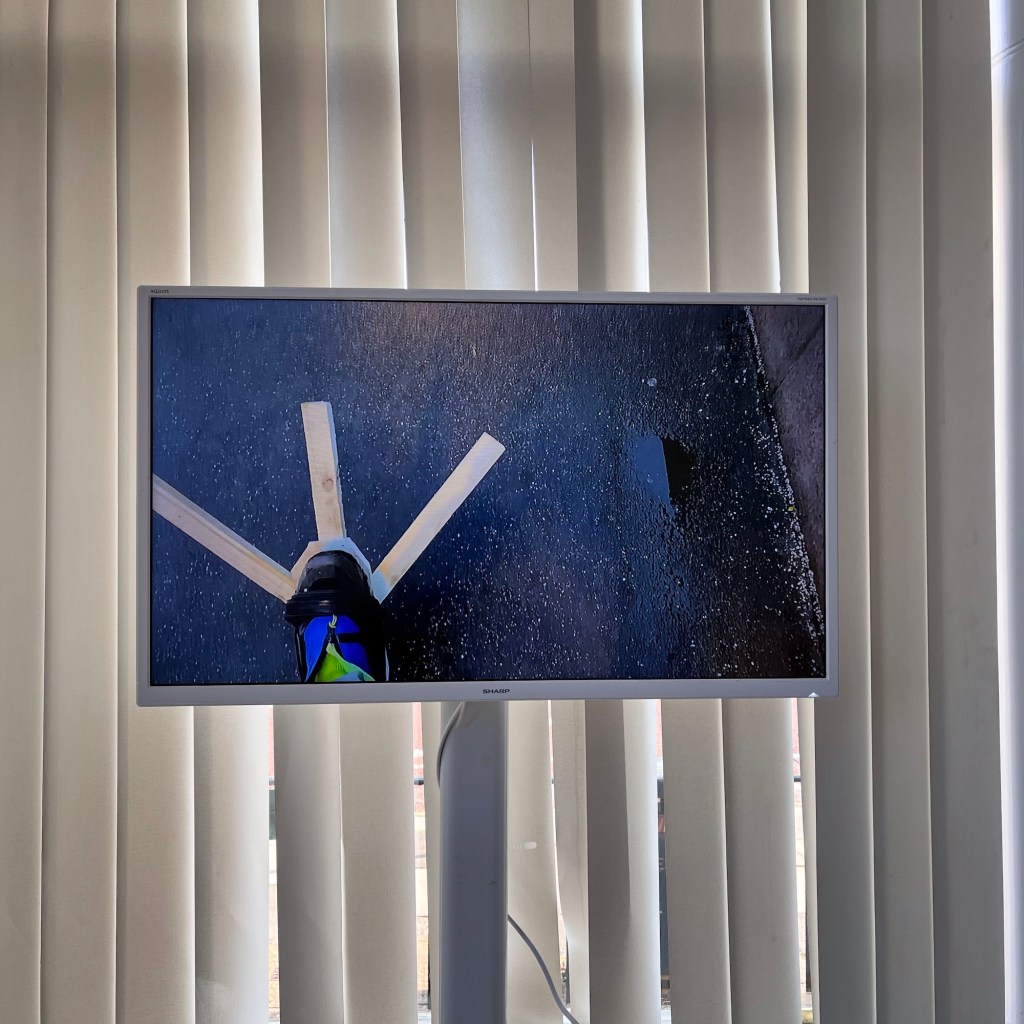
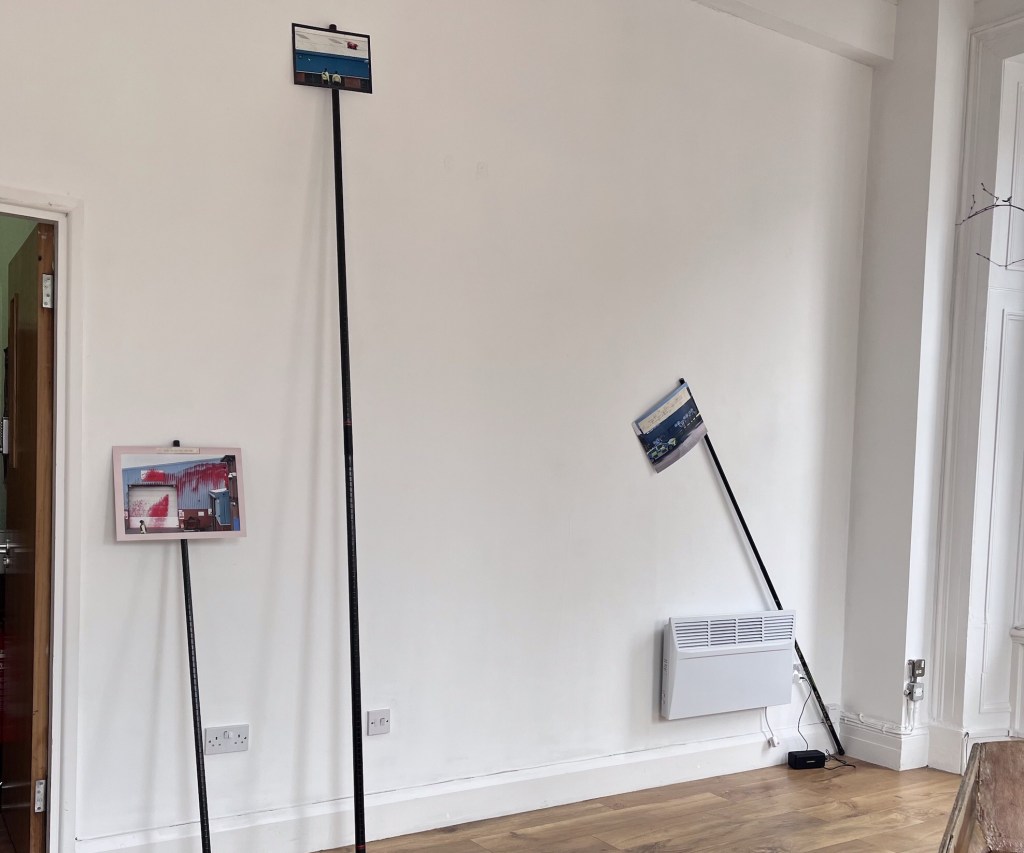
Other artists’ works brought further layers to the exhibition. Rory’s video showed a chicken foot strapped to his shoe, filmed during a protest in Russia on the second anniversary of the invasion of Ukraine. It was a quiet but powerful gesture that turned absurdity into endurance. Tom D’s photographs documented a Palestine Action protest at the Elbit Systems site in Oldham, where activists succeeded in stopping the production of weapons for the Israeli military. The red-stained facade of the building became both a wound and a mark of resistance.

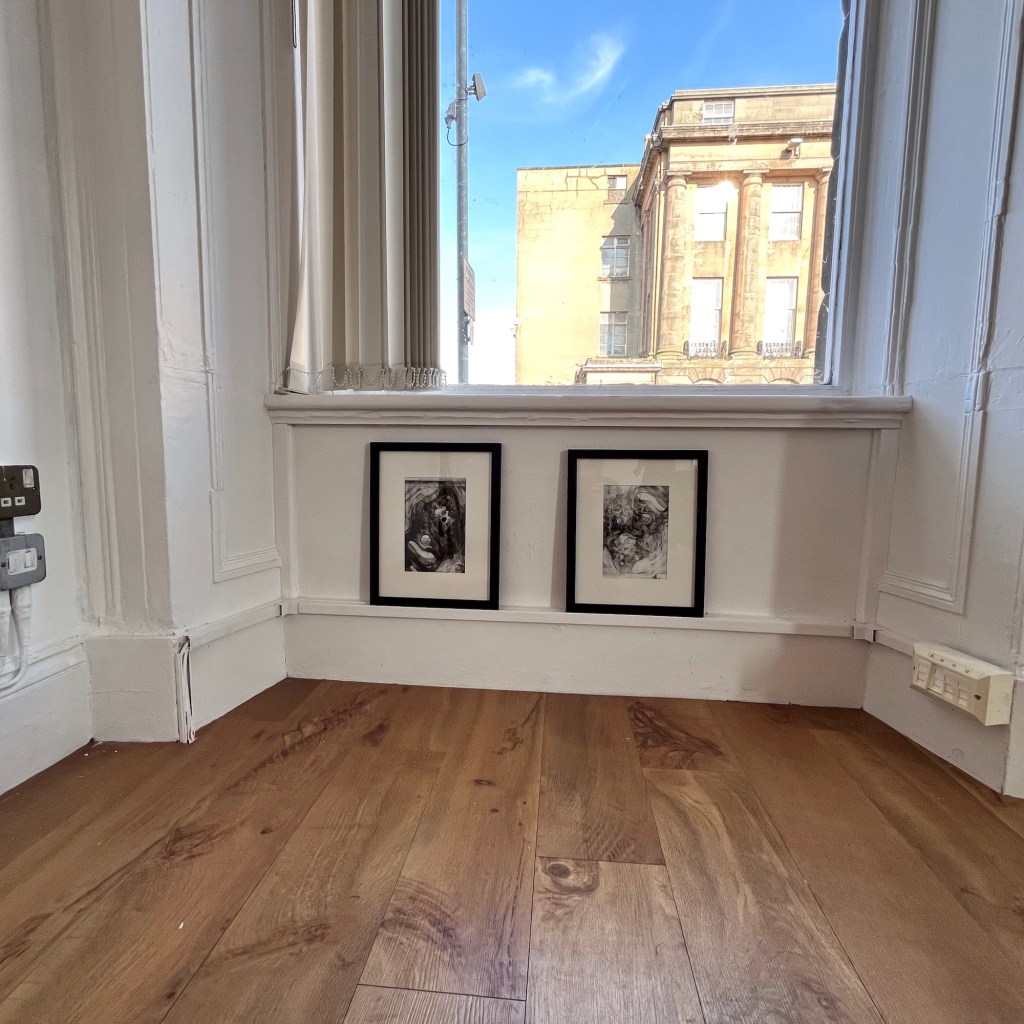
Molly’s black and white drawings added a more abstract presence.. Lily’s film, projected inside a small metal alcove, appeared to be caught mid-edit, reflecting on itself as it played.

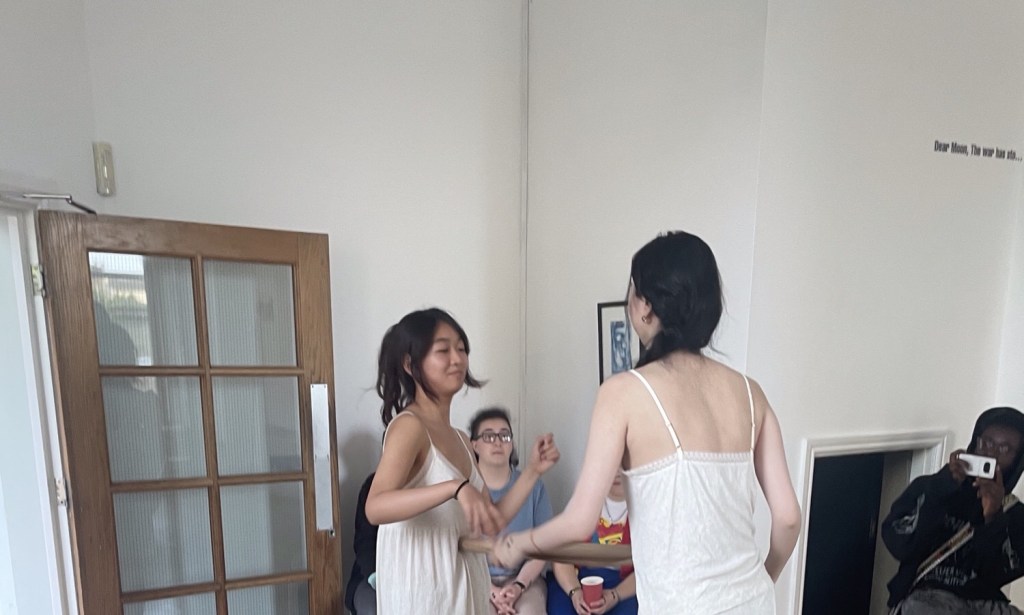
Two live performances took place on the opening night. Soop, by Hannah, Marie and Tom K, involved the audience in making a communal soup. It was messy, generous and unpredictable, reminding me of how collaboration relies on trust as well as misunderstanding. Xueying Zhang’s performance with her collaborator involved holding a cardboard pole between their bodies while slapping each other. It expressed the tension between cooperation and conflict, both intimate and absurd.

The work here whether documentary, performative or digital, asked what it means to be recognised and what is lost or gained in that process. It confirmed my interest in social sculpture and the politics of communication.

Finally, recognition is never simple or complete, yet within its uncertainty there is always room for empathy..

Posted in 2025-2026, Lectures 2025-2026, Reflection, Research, Writing

1–1 Tutorial 6th October 2025

On Monday, I joined the open 1–1 tutorial with Jonathan. I really needed that conversation, my thoughts were fighting inside my head, and sometimes talking is the best way to organise them.

We discussed many different things. Jonathan has a great way of asking the kind of questions I should be asking myself. I feel that if I had one good question every day, I’d probably write on my blog much more often.

We talked about The Right Map exhibition series and my experiences, how much I learned from working with different people, and how I feel about working with different groups: one more formal and structured, and the other relaxed and informal. Although I’m an organised person who likes to plan ahead, I found that I have the ability to be adaptable and ready to work in fast-paced situations, finding solutions in the moment. It was a challenge, but it also increased my confidence.

I know people have different styles of thinking and working, and as long as we trust each other’s intentions and skills, things go smoothly. We can fill each other’s gaps, and I was definitely learning so much from our team.

For me, the goal of The Right Map was to create a free and welcoming space where everyone could learn and grow together. That’s what makes a social sculpture, and that’s the goal of making this kind of art.

We also talked about the CBS show Sculpture (see my previous post), which reminded me that I should share the short text I wrote for it, along with the 50-word bio I submitted, and the one I received written by artist Cos Ahmet, which my sculpture responded to.

Here are the two secret bios:

Cos Ahmet:

Tropes corporeal fragmented, human, other. Limbs without a host, the skin of things physical, digital. Choreographic. The material’s immaterial states between liminal space on the threshold of self, other. Dust.

Me:

A child took up her pen, signing walls with her name. We’ll play socially… I’ll sculpt the riddle. Language won’t matter; wisdom gathered on page 104–105. Forgive the broken clock!

Another part of our discussion was about Social Publishing, a lecture by Allegra Baggio Corradi that I listened to after the printing meeting with Alex Schady. Jonathan had attended that session too, so it was wonderful to exchange thoughts and notes with someone who was there. We both agreed how inspiring it was. I realised how much it connected with my ongoing project Writing Letters to the Moon.

Learning about Social Publishing, even just understanding its definition, helped me see what I’ve been doing from a new perspective. I’ve always thought of my book as a sculpture, its process far removed from traditional publishing. I don’t see myself as an author but as an artist, still figuring out what that means!!

These days it’s hard not to wonder are artists becoming celebrities, activists, or something in between? Genuine voices, attention-seekers or good actors? There’s definitely more to write about this.. I feel like I’ve gathered so much new information, yet the more I learn, the more I realise how far I am from finding the right answers.. And the higher I try to rise, the lighter I have to become, learning to let go of things and sometimes people along the way.. 

Posted in 2025-2026, collaboration, curation, Exhibitions, Project, Reflection, Research

The Right Map – My wild Summer 

For more than three months this year, my life was consumed by The Right Map. Coordinating and organising eight shows ( Unstable 1,2,3,4, Account, Account Not Recognised, Slip Stream and In Search of Swallow and Amazon show/fundraising event) across Liverpool was a huge undertaking logistically, emotionally, and artistically. It was intense work: curating, communicating with artists and collaborators, solving problems on the spot, and carrying the responsibility of holding so many different voices together in one programme.

During the summer, I couldn’t write about it.. The pace was too fast, the demands too many, and on top of that, family responsibilities and personal challenges were pulling me in different directions. I was tired, grateful, overwhelmed, and very often carrying mixed feelings that left little room for reflection.

Looking back, I see the full image: what worked, what I loved, what was difficult, and where I grew. Writing from this distance feels possible, even necessary. I realise that part of my practice is not only in the making or the showing but also in reflecting.

The Right Map reminded me of this: the gaps, the tensions and the silences were as important as the works themselves. The experience was more than making artworks. It was about what happens when we work together, recognising where we succeeded so we can carry that forward, and where things did not work so we can avoid them in the future.

In the next posts, I want to unpack some of the moments that stayed with me: the artworks that resonated deeply, the tensions that tested me, the negotiations and miscommunications that revealed the realities of working collectively, and the unexpected joys that reminded me why I do this work.

I needed time to arrive here. To allow the intensity to pass, and to feel ready to write. Now, I can see The Right Map not only as a demanding project but as a turning point in how I think about curation, collaboration, and care in my practice..

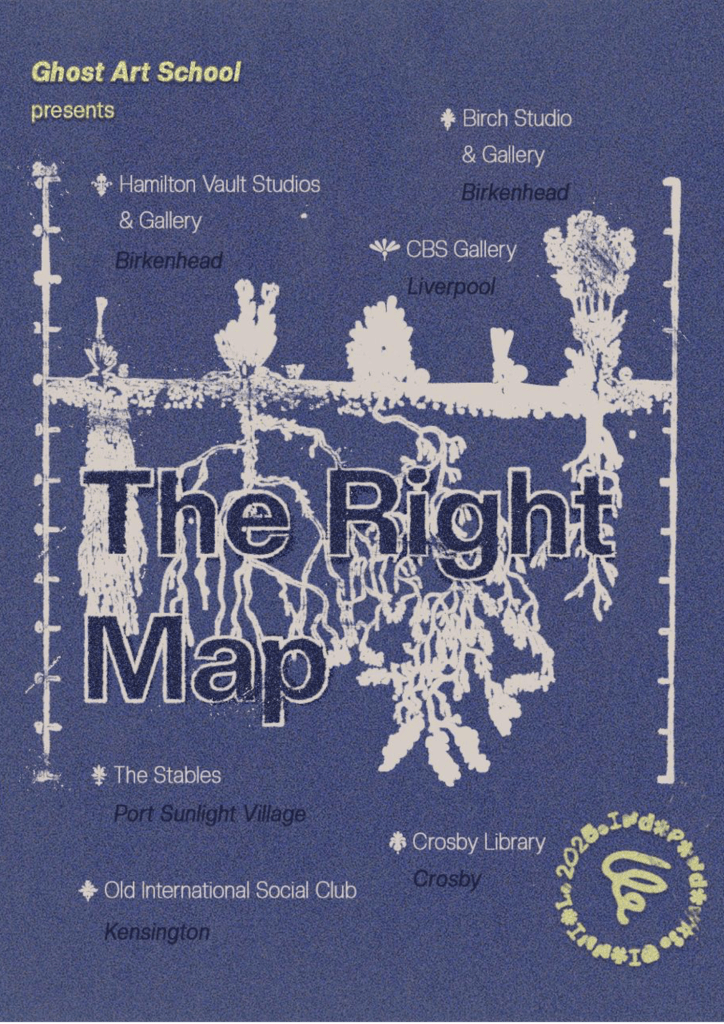
The Right Map was a series of exhibitions presented by Ghost Art School as part of the Independents Biennial. Emerging from the spirit of Ghost Art School, it celebrated artists who move between margins, who learn in the cracks, who map their own routes when none are given.

Here, the map was never fixed, drawn in gestures, erased by time, redrawn in conversation, in defiance, in care. The Right Map asked not where we are going, but how we move… and who gets to move with us.

The Right Map 36 artists: Alison Reid, Alma Stritt, Charli Kleeman, Chelsea Johnson, Chris Roberts, Colm Moore, Conner Browne, Cos Ahmet, Danielle Freakley, David W Hicks, Eleanor Capstick, Finn Roberts, Gary Finnegan, Gwendolin Kircali, Halyna Maystrenko-Grant, Hannah Browne, Harriet Morley, Igor Prato Luna, Jasmir Creed, Jessica Crowe, Karema Munassar, Lily Patricija, Mai Sanchez, Marie-Sofie Braune, Molly Lindsay, Molly Mousdell, Phoebe Thomas, Priya Foster, Ritu Arya, Rory Macbeth, Sonic Relics, Theodora Koumbouzis, Tom Doubtfire, Tom Kelly, Valentina Passerini, and Xueying Zhang 

Posted in collaboration, Exhibitions, Experiments, Research

The Right Map

Poster credit: Phoebe Thomas

Coordinating The Right Map for the Ghost Art School artists was intended as an act of support for others. But in the process, I found myself unexpectedly charting new ground in my own practice. What began as a curatorial and facilitative role gradually unfolded into a deep personal enquiry, one that significantly shaped my ongoing research in social sculpture.

I began to notice shifts in my own thinking. Supporting artists to articulate their intentions, reflect on their choices, and ground their practice compelled me to ask the same of myself. It was not a passive role; it was active, dynamic, and generative.

Interestingly, throughout The Right Map, I found myself increasingly drawn to the curatorial aspects of my work more than the making itself. It’s not just about presenting artworks, it’s about orchestrating experiences, holding conversations, shaping encounters. I became fascinated with how frameworks are built, how meaning is constructed around and through art. In many ways, the coordination itself became a form of social sculpture.

This shift is not about stepping away from being an artist…it’s about understanding the expanded field in which I operate. Curation, facilitation, research, and community-building have become a core tool kit in my practice. Through coordinating The Right Map, I gained new confidence in embracing this hybridity. I no longer see it as fragmented, but rather as a cohesive and intentional mode of working that reflects my values and voice.

https://www.instagram.com/p/DJov3YBo9Yg/?igsh=Mnd6MWh3MXRuaDQy

Posted in Experiments, Moon, Project, Reflection, Research

Becoming an Audience to Our Own Work!

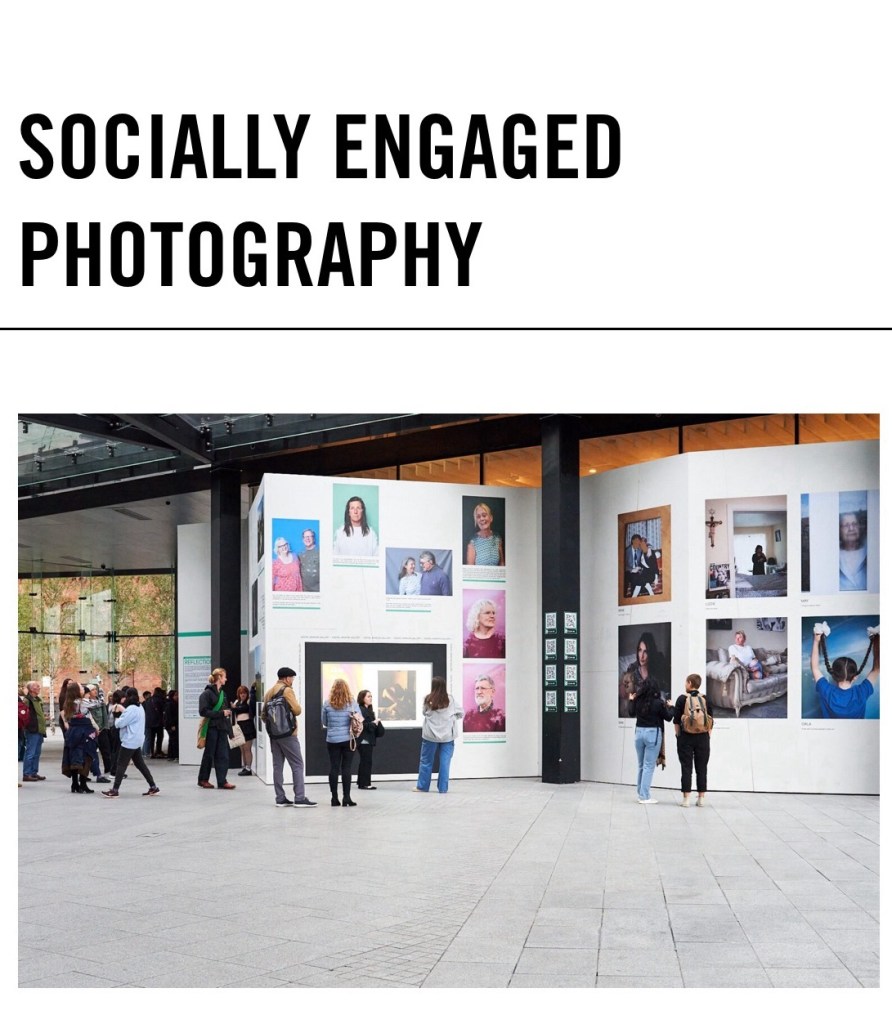
19 artists from across the country and beyond, working across different disciplines, were selected for Open Eye Gallery’s Socially Engaged Photography programme. The session began gently with an icebreaker to help us introduce ourselves and connect, opening into a space full of layered questions and open dialogue.

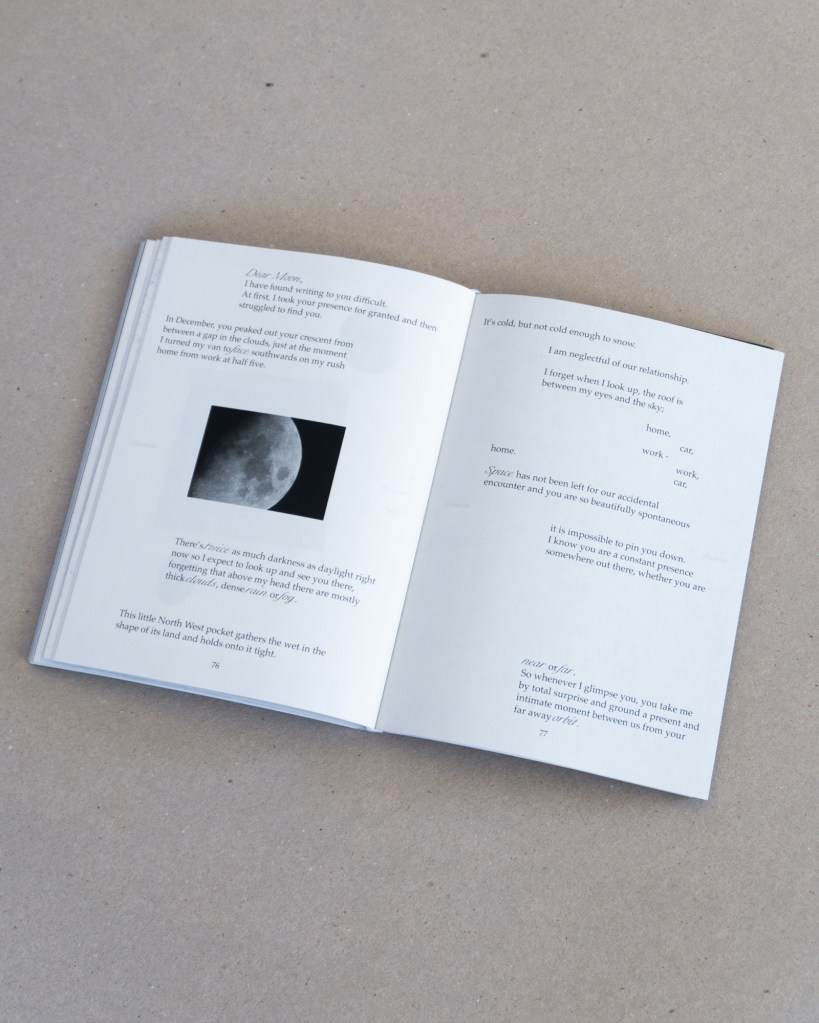
One phrase stayed with me: “Becoming an audience to your own work.” It’s the idea that the artist creates a framework for others to shape, leading to outcomes unknown even to them. This made me reflect on Dear Moon, a book project I designed. By the end, I felt less like its author and more like its audience. The photographs simply held space—the real substance came from the contributors’ words. Their voices carried the project forward.

In breakout groups, we explored definitions of socially engaged practice. From using art as a collaborative tool for justice (Sholette & Bass) to fostering shared understanding and personal growth (Matarasso), the emphasis was clear: this work is about people, not product. It’s about ethics, active listening, and creating conditions for transformation.

I feel genuinely grateful to have been selected for this course and to be mentored by Elizabeth Wewiora. I look forward to continuing the journey and exploring how it might help shape my research around social sculpture.

Posted in Exhibitions, Experiments, Moon, Reflection, Research, Visit, Writing

Trusting the Process.. Interim Show 2025

Since October, I’ve been immersed in the making of Dear Moon. What began as a simple idea grew into something layered and full of meaning. Over these months, I’ve learnt so much, not just about putting together a book, but about myself. The skills I’ve had to call on managing, organising, communicating, publishing, sharing all came with challenges. I had to practise patience.. I had to listen. And more than anything, I had to trust the process!

There were many moments when I didn’t know exactly where it was heading, but I allowed myself to follow the rhythm of the work, and something beautiful came through. I’m especially grateful that the work is expanding being read, being held and I’ve been watching it with a sort of quiet pride.

Still, I have to be honest. Sharing Dear Moon in public spaces hasn’t felt completely right. I tried presenting it in a vibrant setting, but I could feel the book asking for something else, something slower, more still. It asks the reader to sit, pause, and take time. And that’s hard to find in environments filled with movement.

So, although I didn’t quite succeed in the way I had imagined, I don’t see it as failure. Instead, I see it as another learning. The challenge now is to explore different ways a book like this can live in public space. How do I present it in a way that honours its pace and stillness? How can I guide people toward it gently, instead of expecting it to compete for attention?

I’m still learning, and I’m open. I’m proud of Dear Moon, and I know it will keep finding its way as long as I keep listening.

Posted in collaboration, Moon, Project, Reflection, Research, Writing

A Collaboration on Dear Moon (Service Point JNG)

Working on Dear Moon has been one of the most personal and expansive projects I’ve ever taken on. While the words came slowly, shaped by honesty and quiet reflection, the visual form of the book took a different kind of journey, one that became stronger and more meaningful through collaboration.

I had the pleasure of working with Jiayi and GG, two recent MA Graphic Design graduates from the university. They took on the challenge of designing Dear Moon and brought their own vision to it. Where I had initially imagined something simple, quiet, and almost invisible in its design letting the words do all the work they brought something else entirely: depth, elegance, and boldness in aesthetic.

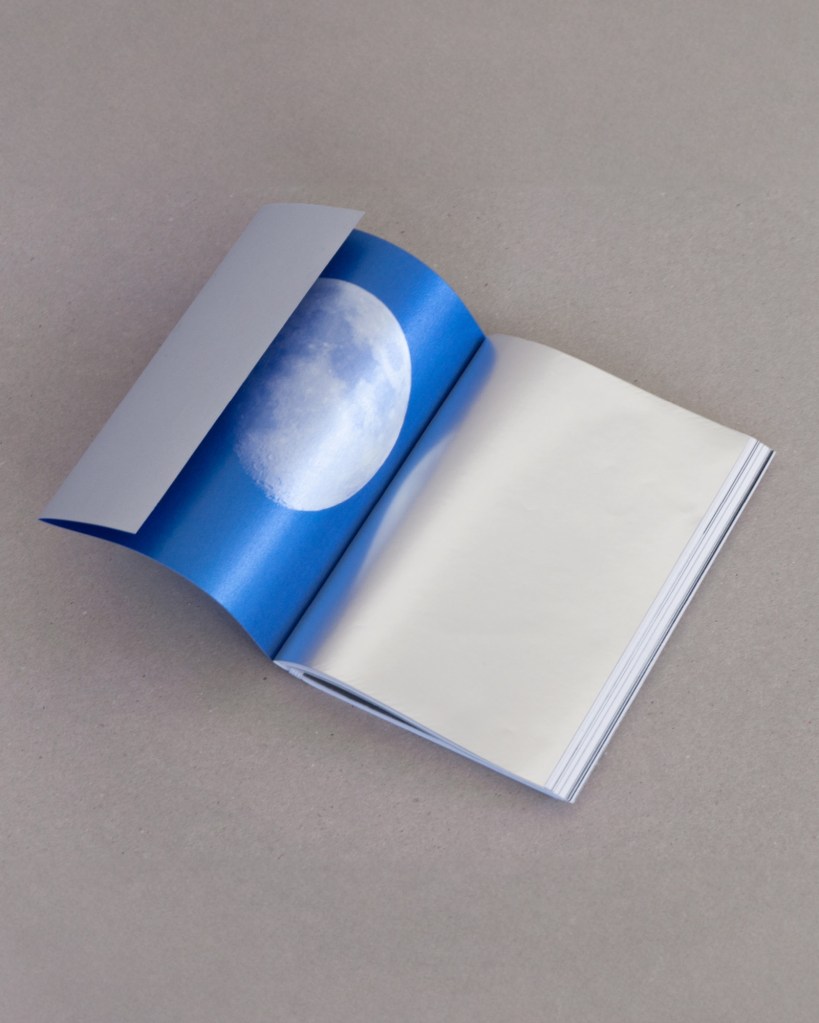
Their design sensibility was so different from mine. I approached the book with simplicity, wanting to preserve the gentle rhythm of the letters and photographs without interruption. I didn’t want the visuals to overpower the messages within. But what Jiayi and GG brought was not overpowering it was enhancing. They introduced a poetic visual language: deep blues, moonscapes that speak for themselves, layout choices that echo the movement of tides and emotion. They weren’t just decorating; they were interpreting.

Looking at the final book now, I see a true collaboration. It’s no longer just a collection of letters; it’s a designed experience. A conversation between stillness and form.

Collaborating in this way has taught me the value of letting go. Of sharing creative control. Of trusting others to hold your work with care and transform it with love and intention. I feel Dear Moon is stronger because of this process, and I’m grateful to Jiayi and GG for reminding me how powerful cross-disciplinary work can be.

https://www.instagram.com/p/DHa-GsDKStV/?igsh=MWVza3g4eGFrZ2g0bw==

Posted in Exhibitions, Motivations, Research, Visit

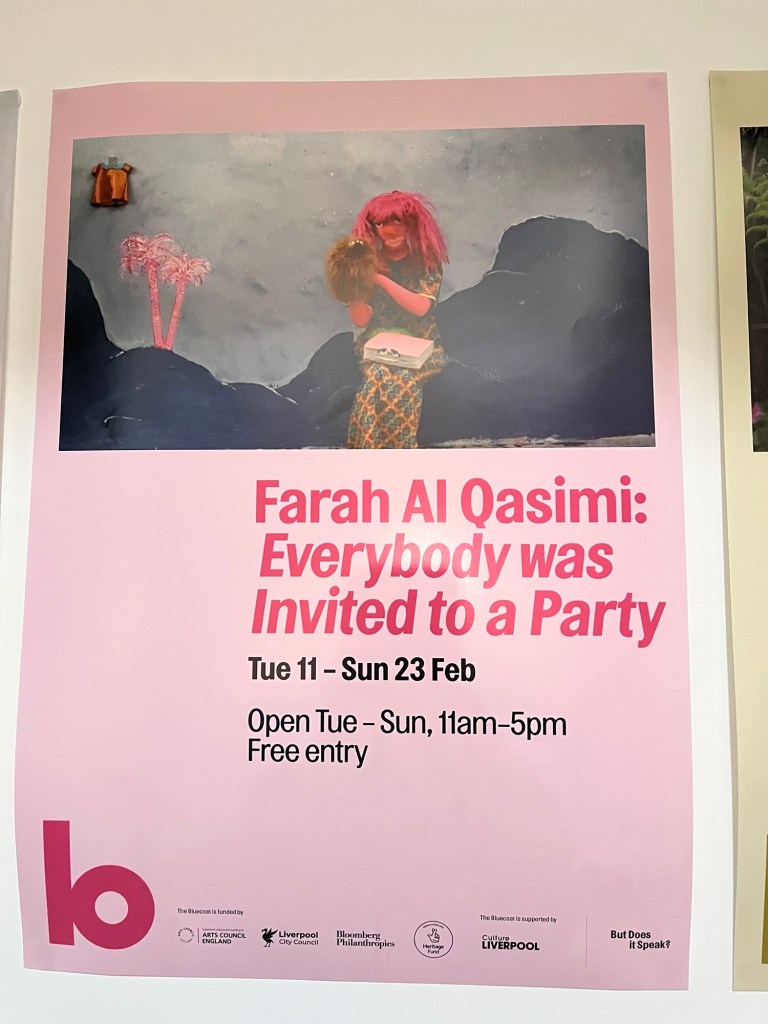
Farah Al Qasimi’s Everybody was Invited to a Party

Yesterday, I stepped into The Bluecoat and found myself transported back to my childhood in Dubai. Farah Al Qasimi’s work immediately struck a chord, filling the space with images, sounds, and moments that felt intimately familiar. In this exhibition, I wasn’t just observing, I was reliving something personal, something nostalgic. I laughed, paused, and travelled back home through her lens.

Al Qasimi, an artist from the UAE, weaves humour, memory, and language into a beautifully immersive world. Her film, Everybody was Invited to a Party, takes inspiration from Iftah Ya Simsim, the 1980s Arabic adaptation of Sesame Street. Using hand-sewn puppets and a playful approach to translation, the film highlights the fluidity , and at times, the struggles of communication.

One of the moments that resonated most with me was the pink Arabic-speaking monster struggling to order food in English. The monster’s eventual decision to learn English felt both humorous and deeply familiar. Another example was the book puppet with  text saying “I made a book to help me say the right things”. That line lingered with me. It felt so aligned with my own practice. Using language as both a tool and an obstacle, playing with its structures while trying to express something truthful.

Her use of puppetry and humour in dealing with linguistic struggles felt particularly relevant to me. I have always been interested in how objects and visual storytelling can reveal the nuances of human communication. Seeing her work has sparked new ideas about how I might further explore these themes, especially in my MA research and upcoming projects.

This exhibition reminded me that language is never just about words, it’s about memory, culture, and the ways we find (and sometimes lose) ourselves in translation. And in those moments of uncertainty, there is humour, resilience, and the power to create new meaning.

Posted in Lectures 2024/2025, Motivations, Reflection, Research

Reflections on Professionalism and Unprofessionalism

I missed the last lecture on professionalism and unprofessionalism due to family circumstances. Ironically, missing out on topics that interest me most. But watching the recording was still a rich experience, listening to the discussions and the different perspectives people brought to the conversation. 

I read the article How to Be an Unprofessional Artist by Andrew Berardini, which Jonathan shared in the lecture. And, I think the word “unprofessional” carries a certain weight, often with negative connotations. It reminds me of how the word “steal” is used provocatively in Steal Like An Artist by Austin Kleon, or how “disabled” can be perceived in different ways, negative for some, yet embraced by others as a form of identity and empowerment. Language is powerful; it doesn’t just describe the world, it shapes it. It influences how we see ourselves, how others perceive us, and what opportunities are available to us.

A key point in the discussion was how professionalism is often framed by rigid, exclusionary standards, ones that can erase individuality, lived experience, or even care. But does professionalism have to mean conforming to a narrow, predetermined image? Many so-called unprofessional traits: honesty, vulnerability, and unconventional approaches are actually strengths. They challenge existing systems, create space for new ways of thinking, and foster deeper engagement.

The tension between professional and unprofessional seems to lie in whether professionalism is dictated by external standards or defined through integrity, care, and dedication to one’s practice. If professionalism means respect for oneself, for others, and for the work, then it doesn’t have to mean suppressing individuality or creativity. I see professionalism not as following a strict rulebook, but as a commitment to craft, ethics, and meaningful engagement.

As a mother of a child with special needs, I’m particularly aware of how language shapes perception. In different contexts, the term “disabled” can be either empowering or limiting. Could “unprofessional” also be reclaimed? Maybe, but only if doing so truly empowers rather than undermines.

My own art practice naturally resists traditional notions of professionalism. Coming from multiple backgrounds, embracing mistakes, and working in multidisciplinary ways, I see value in experimentation and non-traditional approaches. Rejecting conventional professionalism doesn’t mean rejecting care, commitment, or quality. It means refusing to be boxed into a system that wasn’t designed for people with diverse experiences and ways of working. Above all, rejecting traditional professionalism can be an act of resistance, challenging exclusionary structures that dictate who belongs and what is deemed acceptable work.

I navigate between institutional and freelance work, moving fluidly between structured and independent spaces. Working with institutions while maintaining my own perspective allows me to challenge the system from within while also creating alternative ways of working. It’s about understanding the rules but choosing when and how to break them in ways that are meaningful.

This ability to shift between spaces sometimes fitting in, sometimes disrupting gives me agency. It also allows me to act as a bridge for others who feel like they don’t fit into traditional structures. This is something I see in my work, whether through Moon Letters, Creative Peers, or other social sculpture projects.

Rather than seeing professionalism and unprofessionalism as rigid opposites, I see them as fluid. True professionalism, to me, is about care, respect, and meaningful engagement, qualities that don’t require conforming to outdated norms, but rather, reimagining them.

Somewhere in Oxford…