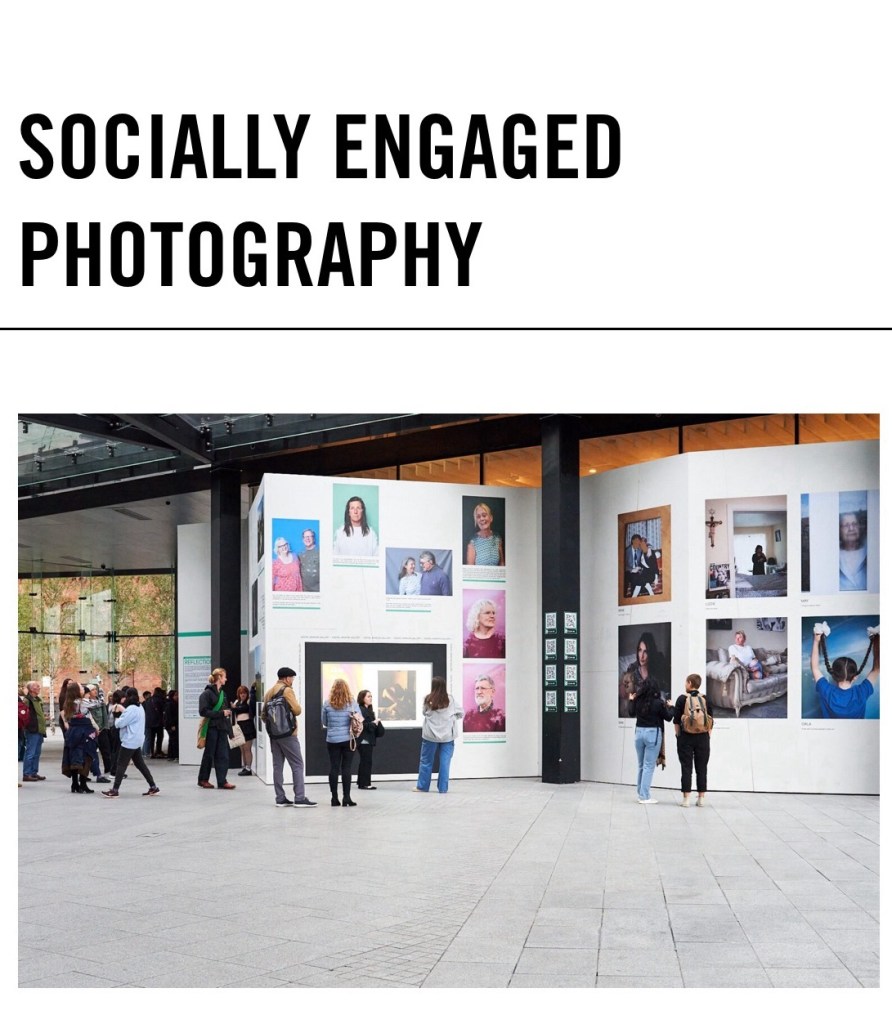
19 artists from across the country and beyond, working across different disciplines, were selected for Open Eye Gallery’s Socially Engaged Photography programme. The session began gently with an icebreaker to help us introduce ourselves and connect, opening into a space full of layered questions and open dialogue.
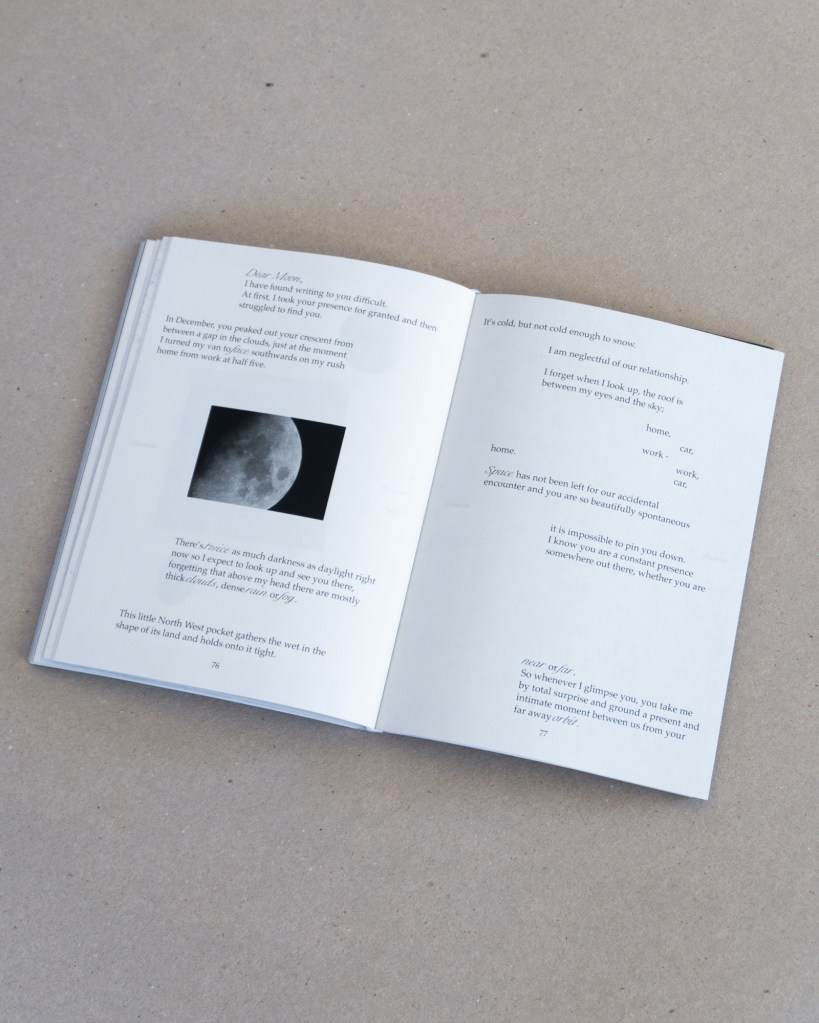
One phrase stayed with me: “Becoming an audience to your own work.” It’s the idea that the artist creates a framework for others to shape, leading to outcomes unknown even to them. This made me reflect on Dear Moon, a book project I designed. By the end, I felt less like its author and more like its audience. The photographs simply held space—the real substance came from the contributors’ words. Their voices carried the project forward.
In breakout groups, we explored definitions of socially engaged practice. From using art as a collaborative tool for justice (Sholette & Bass) to fostering shared understanding and personal growth (Matarasso), the emphasis was clear: this work is about people, not product. It’s about ethics, active listening, and creating conditions for transformation.
I feel genuinely grateful to have been selected for this course and to be mentored by Elizabeth Wewiora. I look forward to continuing the journey and exploring how it might help shape my research around social sculpture.
Since October, I’ve been immersed in the making of Dear Moon. What began as a simple idea grew into something layered and full of meaning. Over these months, I’ve learnt so much, not just about putting together a book, but about myself. The skills I’ve had to call on managing, organising, communicating, publishing, sharing all came with challenges. I had to practise patience.. I had to listen. And more than anything, I had to trust the process!
There were many moments when I didn’t know exactly where it was heading, but I allowed myself to follow the rhythm of the work, and something beautiful came through. I’m especially grateful that the work is expanding being read, being held and I’ve been watching it with a sort of quiet pride.
Still, I have to be honest. Sharing Dear Moon in public spaces hasn’t felt completely right. I tried presenting it in a vibrant setting, but I could feel the book asking for something else, something slower, more still. It asks the reader to sit, pause, and take time. And that’s hard to find in environments filled with movement.
So, although I didn’t quite succeed in the way I had imagined, I don’t see it as failure. Instead, I see it as another learning. The challenge now is to explore different ways a book like this can live in public space. How do I present it in a way that honours its pace and stillness? How can I guide people toward it gently, instead of expecting it to compete for attention?
I’m still learning, and I’m open. I’m proud of Dear Moon, and I know it will keep finding its way as long as I keep listening.
Working on Dear Moon has been one of the most personal and expansive projects I’ve ever taken on. While the words came slowly, shaped by honesty and quiet reflection, the visual form of the book took a different kind of journey, one that became stronger and more meaningful through collaboration.
I had the pleasure of working with Jiayi and GG, two recent MA Graphic Design graduates from the university. They took on the challenge of designing Dear Moon and brought their own vision to it. Where I had initially imagined something simple, quiet, and almost invisible in its design letting the words do all the work they brought something else entirely: depth, elegance, and boldness in aesthetic.
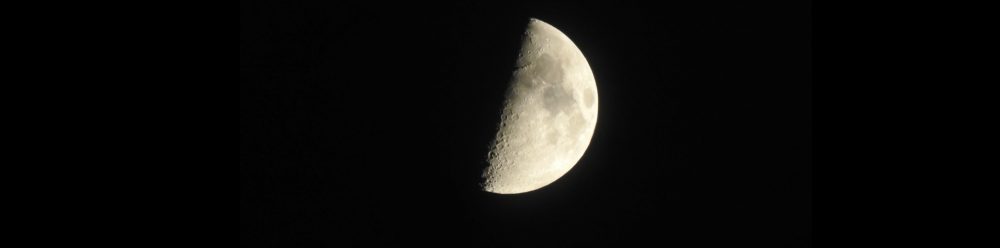
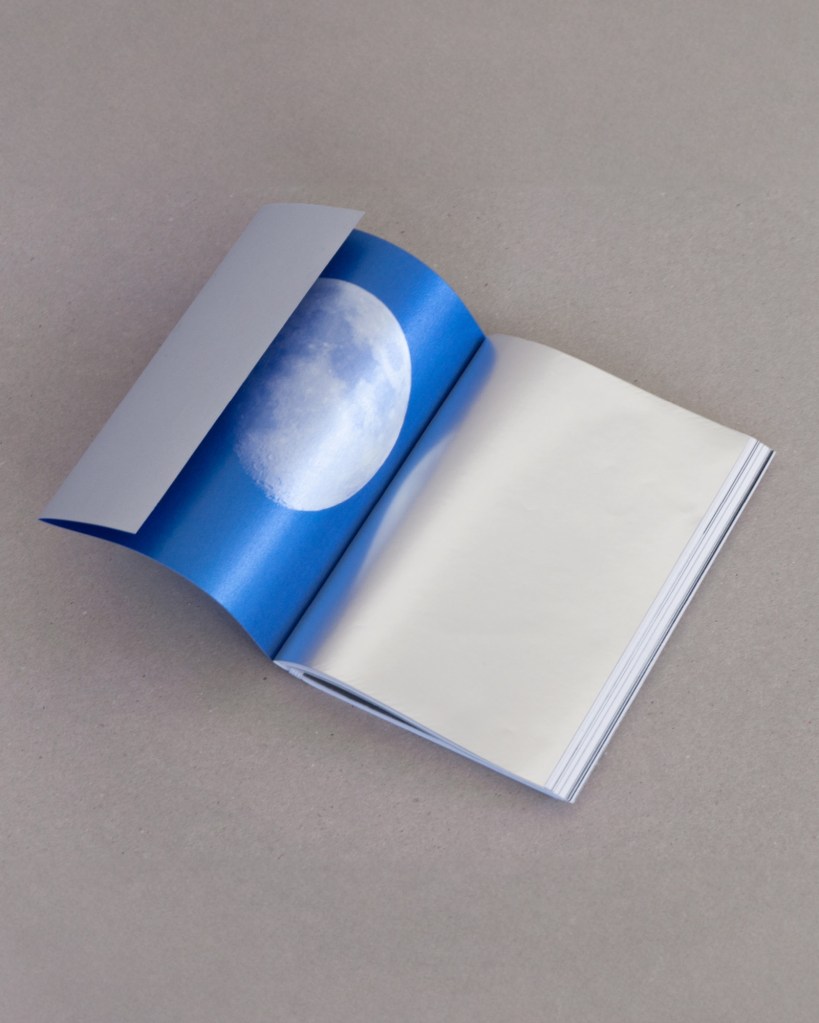
Their design sensibility was so different from mine. I approached the book with simplicity, wanting to preserve the gentle rhythm of the letters and photographs without interruption. I didn’t want the visuals to overpower the messages within. But what Jiayi and GG brought was not overpowering it was enhancing. They introduced a poetic visual language: deep blues, moonscapes that speak for themselves, layout choices that echo the movement of tides and emotion. They weren’t just decorating; they were interpreting.
Looking at the final book now, I see a true collaboration. It’s no longer just a collection of letters; it’s a designed experience. A conversation between stillness and form.
Collaborating in this way has taught me the value of letting go. Of sharing creative control. Of trusting others to hold your work with care and transform it with love and intention. I feel Dear Moon is stronger because of this process, and I’m grateful to Jiayi and GG for reminding me how powerful cross-disciplinary work can be.
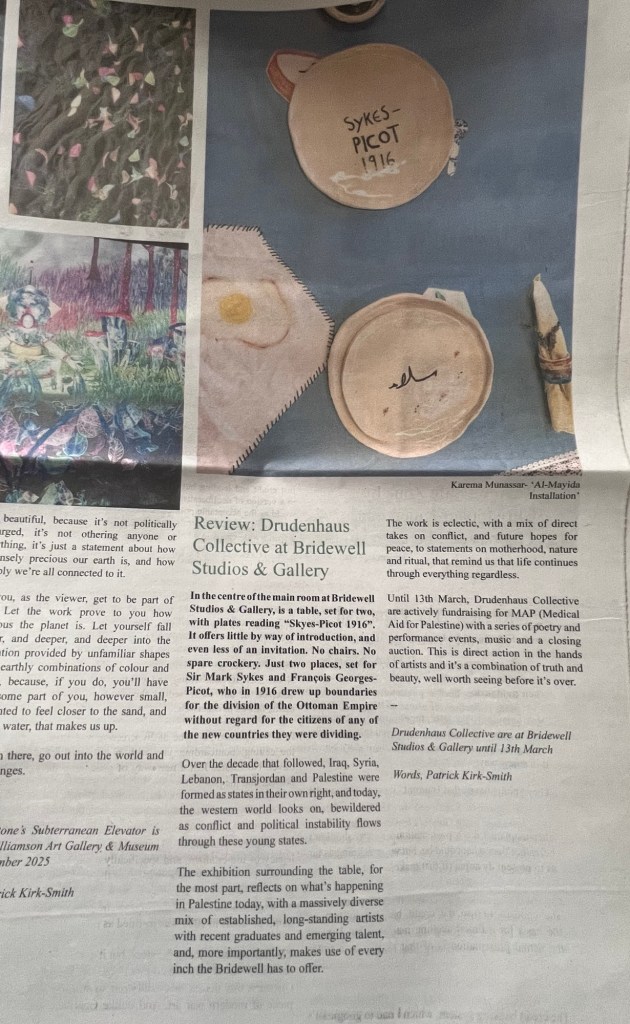
I recently received my first review (which I see as feedback) in Art in Liverpool, written by Patrick Kirk-Smith, about my Al-Mayida installation as part of the Drudenhaus Collective at Bridewell Studios & Gallery. Seeing my work in print, positioned within a broader reflection on history, conflict, and artistic response—has given me space to consider how this moment connects with my ongoing practice.
He writes:
“In the centre of the main room at Bridewell Studios & Gallery is a table, set for two, with plates reading ‘Sykes-Picot 1916’. It offers little by way of introduction, and even less of an invitation. No chairs. No spare crockery. Just two places, set for Sir Mark Sykes and François Georges-Picot, who in 1916 drew up boundaries for the division of the Ottoman Empire without regard for the citizens of any of the new countries they were dividing…”
This review captures the essence of Al-Mayida, how history’s decisions linger in the present, shaping lives and political realities.
As I navigate my MA, this review serves as both encouragement and reflection. It affirms that my work is engaging with complex socio-political themes in a way that resonates beyond the gallery. It also challenges me to refine my approach, how can I sharpen these conversations while maintaining the poetic, unsettling subtlety that Al-Mayida holds?
The Drudenhaus Collective’s fundraising for Medical Aid for Palestine (MAP) adds another layer to this. Art, for me, has always been a site of action as much as expression. This project reinforces my belief that creative practice can exist in solidarity, bringing history into the present not just for reflection, but for tangible impact.
Learning Outcome 1: Formulate, describe and implement a challenging and self-directed programme of study, relating to your Study Statement. (Assessment Criteria: Enquiry):
Learning Outcome 2: Implement appropriate working methods for building an independent and effective self-organisation that enables the critical engagement with practice-based research. (Assessment Criteria: Process):
In projects such as Al-Mayida, I experiment with diverse curatorial approaches, but in Letters to the Moon, I prioritise participant interaction. My process-driven approach accepts ambiguity and improvisation, which is consistent with Jonathan’s reflection in action research. The final session of Art for Earth’s Sake was especially powerful, as we discussed how artists can practise sustainability, set a good example, and utilise art as a tool for social and environmental change.
Learning Outcome 3: Communicate a critical understanding of your developing practice. (Assessment Criteria: Knowledge, Communication):
My work is a type of social sculpture, an ever-changing discussion that connects personal and collective experiences. Projects such as Al-Mayida focus on unity and history, whereas Letters to the Moon promotes communication and community involvement. My efforts with asemic writing and childlike drawing disrupt art’s traditional hierarchies, emphasising authenticity and accessibility.
I would appreciate feedback on two experiments I’m currently working on: Asemic writing with translation and childlike drawings. Both approaches are new and quite different from one another.
I missed the last lecture on professionalism and unprofessionalism due to family circumstances. Ironically, missing out on topics that interest me most. But watching the recording was still a rich experience, listening to the discussions and the different perspectives people brought to the conversation.
I read the article How to Be an Unprofessional Artist by Andrew Berardini, which Jonathan shared in the lecture. And, I think the word “unprofessional” carries a certain weight, often with negative connotations. It reminds me of how the word “steal” is used provocatively in Steal Like An Artist by Austin Kleon, or how “disabled” can be perceived in different ways, negative for some, yet embraced by others as a form of identity and empowerment. Language is powerful; it doesn’t just describe the world, it shapes it. It influences how we see ourselves, how others perceive us, and what opportunities are available to us.
A key point in the discussion was how professionalism is often framed by rigid, exclusionary standards, ones that can erase individuality, lived experience, or even care. But does professionalism have to mean conforming to a narrow, predetermined image? Many so-called unprofessional traits: honesty, vulnerability, and unconventional approaches are actually strengths. They challenge existing systems, create space for new ways of thinking, and foster deeper engagement.
The tension between professional and unprofessional seems to lie in whether professionalism is dictated by external standards or defined through integrity, care, and dedication to one’s practice. If professionalism means respect for oneself, for others, and for the work, then it doesn’t have to mean suppressing individuality or creativity. I see professionalism not as following a strict rulebook, but as a commitment to craft, ethics, and meaningful engagement.
As a mother of a child with special needs, I’m particularly aware of how language shapes perception. In different contexts, the term “disabled” can be either empowering or limiting. Could “unprofessional” also be reclaimed? Maybe, but only if doing so truly empowers rather than undermines.
My own art practice naturally resists traditional notions of professionalism. Coming from multiple backgrounds, embracing mistakes, and working in multidisciplinary ways, I see value in experimentation and non-traditional approaches. Rejecting conventional professionalism doesn’t mean rejecting care, commitment, or quality. It means refusing to be boxed into a system that wasn’t designed for people with diverse experiences and ways of working. Above all, rejecting traditional professionalism can be an act of resistance, challenging exclusionary structures that dictate who belongs and what is deemed acceptable work.
I navigate between institutional and freelance work, moving fluidly between structured and independent spaces. Working with institutions while maintaining my own perspective allows me to challenge the system from within while also creating alternative ways of working. It’s about understanding the rules but choosing when and how to break them in ways that are meaningful.
This ability to shift between spaces sometimes fitting in, sometimes disrupting gives me agency. It also allows me to act as a bridge for others who feel like they don’t fit into traditional structures. This is something I see in my work, whether through Moon Letters, Creative Peers, or other social sculpture projects.
Rather than seeing professionalism and unprofessionalism as rigid opposites, I see them as fluid. True professionalism, to me, is about care, respect, and meaningful engagement, qualities that don’t require conforming to outdated norms, but rather, reimagining them.
Our last session of Art for Earth’s Sake Peer Learning, was a powerful experience exploring the intersection of creativity, sustainability, and community action.
Key Highlights:
1- Leading by Example: We discussed how artists can practise sustainably, acting as role models for others by reducing their carbon footprint and promoting eco-friendly approaches. This includes minimising the use of fossil fuels and exploring innovative tools such as digital carbon offset initiatives like Ecology.
2- Art as a Vehicle for Transition: Art has the power to shape people’s decisions and inspire social and environmental change. We explored how slow, mindful processes can create space for reflection and dialogue about the future we want to build.
3- The Role of Heart and Mind: It’s not just about being an artist but about raising awareness and fostering learning. We emphasised the importance of balancing rational thinking with heartfelt creativity to address environmental.
We took inspiration from artists such as Rebecca Chesney and Anthony Hall, and projects like the Soil Exhibition in Somerset. Additionally, ideas from thinkers like Stephen Covey’s “Three Spheres of Influence” helped us focus on what we can control, what we can influence, and what we need to let go of as individuals and as a collective.
We are encouraged to continue organising events, engaging the community, and taking part in initiatives like the Engage. By working together, we can use art as a catalyst for positive change in the world.
Stephen Covey’s concept of the Three Spheres of Influence is a framework that helps individuals focus their energy on what they can truly affect. This idea is derived from his book, The 7 Habits of Highly Effective People. The three spheres, also known as the Circles of Concern, Influence, and Control, are a way to prioritise actions and efforts effectively. The Three Spheres Explained:
1. Circle of Concern:
This represents everything you care about, including external issues such as climate change, world events, and things you have no direct control over. While it’s important to be aware of these issues, focusing too much energy here can lead to feelings of helplessness.
2. Circle of Influence:
This sphere includes aspects you can influence, such as your local community, workplace, and people around you. By focusing efforts here, you can make a meaningful impact even if you can’t solve global issues. This is where actions like raising awareness, inspiring others, and leading by example can make a difference.
3. Circle of Control:
This is the smallest sphere, encompassing only what you can directly control, your own actions, decisions, mindset, and responses. By focusing on this sphere, you ensure that your efforts are grounded in what you can actually change.
By prioritising your focus on the Circle of Control and the Circle of Influence rather than the Circle of Concern, you can channel your energy more productively, avoid burnout, and create more positive impact. This approach is particularly valuable in projects related to sustainability and social change, where large-scale problems can feel overwhelming.
In the context of “Art for Earth’s Sake” understanding these spheres can help artists and activists focus on what they can do, such as creating art that inspires action, practising sustainability in their own work, and building local community initiatives that promote change.
Yesterday, I had a 1-1 tutorial with Jonathan, and it was a great opportunity to think aloud about my practice and research. It helped me reflect on where I’m, what comes next, and how I want to present my work in the interim show. More importantly, it allowed me to articulate the intentions behind my work—what I’m truly trying to communicate through it.
At the moment, I’m working on collecting all the moon letters people have submitted into a book, which I see as a sculpture—not just because of the process involved, but also due to the layers I’ve applied throughout its creation. Here, I wanted to make a book—not just a representation of one, but a real, physical book as a sculptural form. I wasn’t trying to turn a book into a sculpture; rather, I wanted to sculpt a book itself. This distinction has been crucial for me, and I feel I’ve achieved a lot through this approach.
The process remains ongoing—collecting letters, designing the book, and considering communication in both content and form. The creative process has pushed me in new ways and opening many doors.
Jonathan shared some useful links to researchers and artists, including Donna Haraway, Claire Bishop and Lucy & Jorge Orta. He also gave valuable advice on selecting the right paper type for the book, its cover, and how different inks could react on specific papers.
We also discussed different ways the book could be displayed, which made me think more deeply about its presence in a space and how the audience will engage with it—what I could add or take away. This reaffirmed that my work is not just about making an object; it’s about layering meaning, process, and interaction.
Watching Jonathan’s lecture A Messy Introduction for the second time was a completely different experience from the first. Three months ago, it felt like a relief—as though I had finally been given permission to embrace the uncertainty and messiness of my practice. I realised that nothing was wrong with how I work or feel about the creative process. Rather than viewing my approach as chaotic or unfocused, I began to see it as a form of action research—a way of learning embedded in the act of doing!
I returned to this lecture with a question that arose after last week session How to Be an Explorer: How is my practice guiding me, rather than me controlling it? Watching the lecture again allowed me to refine my thinking and embrace my process as an ongoing cycle of reflection and experimentation.
I learnt that action research isn’t about gathering knowledge and then applying it in a controlled way. Instead, it’s about researching through practice, learning as you go, and allowing discoveries to emerge through action.
The lecture reminded me of how I’ve found my most valuable insights through interaction—whether with people, materials, or space. For example, I realised that my time spent working and engaging with people in the library was far more effective than simply sitting and reading. That moment of recognition was, in itself, action research.
Jonathan introduces four key characteristics of action research:
1. Cyclical: The process is not linear; it loops back on itself, following a rhythm of planning, acting, observing, and reflecting.
2. Collaborative: Research is not done in isolation; it involves engaging with people and/or materials.
3. Qualitative: Not quantitative.
4. Reflective: The practitioner is constantly questioning, not just the work, but their own position within it.
The idea that research is cyclical resonated with me deeply. I often feel like I’m going in circles—revisiting ideas, reworking concepts, and questioning everything. But what if this isn’t a flaw, but rather the natural rhythm of research? Instead of seeing it as going backwards, I now view it as deepening my understanding.
This brings to mind the concept of social sculpture, which, like action research, does not aim for fixed outcomes. It is a living process, shaped by dialogue, participation, and continuous enquiry.
My socially engaged work as a creative producer at The Library is an example of how action research operates in real-world settings. Rather than following a rigid structure, my approach is fluid and responsive.
For instance, I’ve observed that:
• Engaging with people in the library is more valuable than just reading there.
• Learning happens through doing, not just planning.
• Reflection is not just a retrospective process, it happens in real-time.
This aligns with Jonathan’s reflection-in-action model, where the practitioner allows uncertainty and improvisation to guide their decisions. My sessions at the library are not about delivering a pre-determined programme; they are about co-creating an experience with the participants, allowing the outcomes to emerge organically.
One of the slides in the lecture included a quote by Martin A. Schwartz:
“The more comfortable we become with being stupid, the deeper we will wade into the unknown and the more likely we are to make big discoveries.”
This really stuck with me. In artistic practice, there’s often pressure to have everything figured out, to justify every decision, and to present a polished narrative. But this quote suggests that true discovery happens when we allow ourselves to feel lost and unsure.
This resonates with my experience as a member of Ghost Art School, where I always allow myself to experiment with materials freely, without the fear of losing anything or being judged. Most of the work I present at Ghost Art School exhibitions is experimental and joyful.
Instead of feeling like I have to map everything out in advance, I am learning to trust that my research is unfolding in its own way. This lecture reinforced the idea that my artistic process isn’t about arriving at answers, but about learning how to ask better questions.



 Karema