Posted in 2025-2026, collaboration, curation, Experiments, Motivations, Research, Social Sculpture, Visit

Free Workshops

Last Sunday, I spent a rewarding day with Ghost Art School and creatives from October Salon (a new collective in Preston led byHannah Browne). My aim was to organise a free workshops day, focused on sharing knowledge and skills without the need for materials or money. I offered an introductory session in British Sign Language (BSL), while Liverpool-based artists Tom Kelly and Tom Doubtfire generously shared aspects of their practices. Hannah provided the space in Preston, making the event possible through collaboration rather than institutional support.

The day had several clear intentions. Firstly, I wanted to gather with peers and begin the year in a meaningful, collaborative way, learning together and exchanging knowledge. Secondly, the event allowed us to engage with October Salon, an emerging creative group, and to demonstrate what can happen through collective artistic practice.

The programme began with Tom Doubtfire leading a discussion on the role of the artist and the relationship between art and activism. His reflections centred on disturbance, sustainability, sacrifice, and focus. The group discussed what it means for art to be disturbing, what sustainable practice might look like, how much we are willing to sacrifice and the importance of setting limits, also how to remain focused on our aims.

This was followed by my one-hour introduction to BSL. My motivation for teaching BSL stems from both personal conviction and historical awareness. The language was banned in the United Kingdom between 1880 and 1970, and despite its cultural and social importance, it still receives limited funding in education. BSL was officially recognised as a language in 2003 and granted legal status in 2022, yet it is still not included in the GCSE curriculum. In this context, teaching BSL freely can be understood as a quiet form of activism! Challenging ableism, questioning unequal access to culture, and sharing knowledge rather than gatekeeping it.

BSL is also highly visual and expressive, connecting strongly with creative disciplines. It can influence performance, filmmaking, choreography, and storytelling, functioning not only as a language but also as an artistic medium. More broadly, offering knowledge without payment can be seen as a response to the increasing commercialisation of the arts. It reminds us that generosity and collective growth still hold value.

The day concluded with a workshop led by Tom Kelly, which provided a joyful ending. His approach to clowning demonstrated that it’s not simply about being silly, but about exploring human emotions through humour and vulnerability. Through simple games and spontaneous interaction, the group communicated naturally, without preparation. There was a strong sense of care, kindness, and mutual respect among participants.

The structure of the day loosely echoed Joseph Beuys’ idea of the Free International University, an artist-led model of education independent from institutions and grounded in dialogue and shared learning. By offering knowledge freely and prioritising exchange over production, the gathering became less about outcomes and more about shaping a temporary community through participation.

For me, the impact of this day was more meaningful than any individual artwork I’ve made recently. It highlighted the importance of shared time, laughter, and informal learning within creative communities. It felt like an encouraging and significant beginning for the group, grounded in connection rather than productivity alone

Posted in 2025-2026, collaboration, Motivations, Reflection, Research, Uncategorized, Writing

Feedback!

What can I say… this experience has reminded me why I love working collectively and why it is so important not to rely on a single resource or only on self-knowledge.

Giving feedback as a group is such a powerful idea and such a beautiful way to enrich one another’s reflection on our practice. I genuinely loved sharing my thoughts with each of my peers and reading theirs in return. The work is amazing, it expresses human experience in such diverse ways, full of richness, honesty and genuine emotion. I felt truly honoured to be among them and lucky to witness their progress over time.

It was emotional to reflect on how we are growing together, holding each other’s hands virtually on this journey with such care and generosity. It reminded me of Jonathan’s first session in October 2024, when he spoke about kindness and compassion and how these could become the strength of our collective and our cohort. Throughout the course, he has guided us with constant care and kindness, so it is no surprise that he created this opportunity: for each of us to write short feedback for one another on a shared Miro board dedicated to every artist.

My peers’ feedback has genuinely boosted my confidence and trust in my practice. Of course, there are always things missing, intentionally or not, due to circumstances and the challenges of process. But receiving feedback that recognises your efforts is deeply energising, especially as a socially engaged artist, where the social aspect is the heart of the work.

I will definitely return to this Miro board whenever I need to. It has become a beautiful space, full of thoughts floating in this quiet corner of cyberspace.

Posted in 2024/2025, Exhibitions, Motivations, Reflection, Writing

First Review in Art in Liverpool

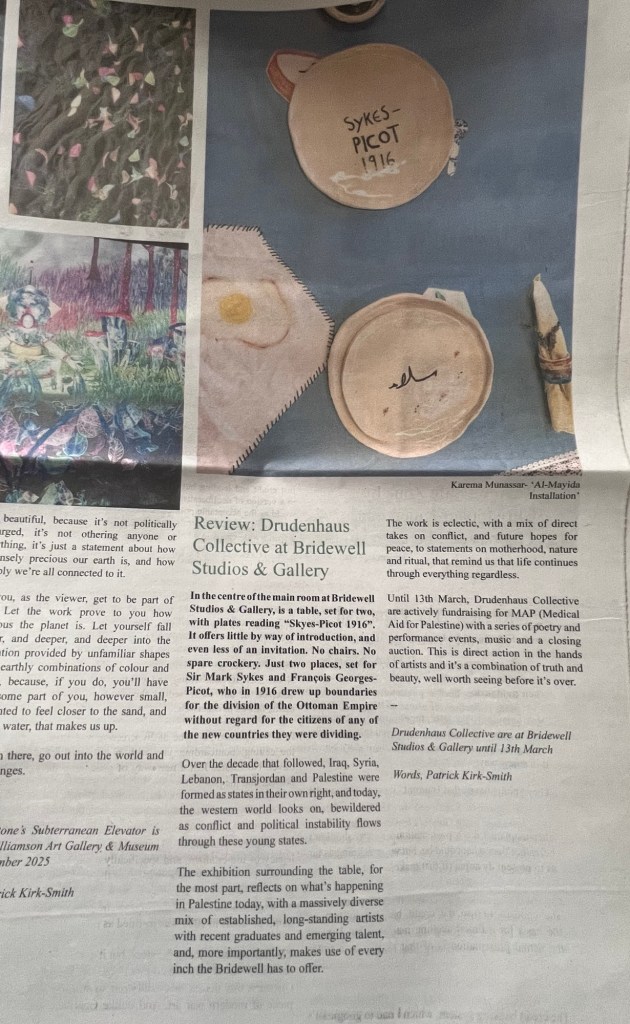
I recently received my first review (which I see as feedback) in Art in Liverpool, written by Patrick Kirk-Smith, about my Al-Mayida installation as part of the Drudenhaus Collective at Bridewell Studios & Gallery. Seeing my work in print, positioned within a broader reflection on history, conflict, and artistic response—has given me space to consider how this moment connects with my ongoing practice.

He writes:

“In the centre of the main room at Bridewell Studios & Gallery is a table, set for two, with plates reading ‘Sykes-Picot 1916’. It offers little by way of introduction, and even less of an invitation. No chairs. No spare crockery. Just two places, set for Sir Mark Sykes and François Georges-Picot, who in 1916 drew up boundaries for the division of the Ottoman Empire without regard for the citizens of any of the new countries they were dividing…”

This review captures the essence of Al-Mayida, how history’s decisions linger in the present, shaping lives and political realities.

As I navigate my MA, this review serves as both encouragement and reflection. It affirms that my work is engaging with complex socio-political themes in a way that resonates beyond the gallery. It also challenges me to refine my approach, how can I sharpen these conversations while maintaining the poetic, unsettling subtlety that Al-Mayida holds?

The Drudenhaus Collective’s fundraising for Medical Aid for Palestine (MAP) adds another layer to this. Art, for me, has always been a site of action as much as expression. This project reinforces my belief that creative practice can exist in solidarity, bringing history into the present not just for reflection, but for tangible impact.

Posted in Exhibitions, Motivations, Research, Visit

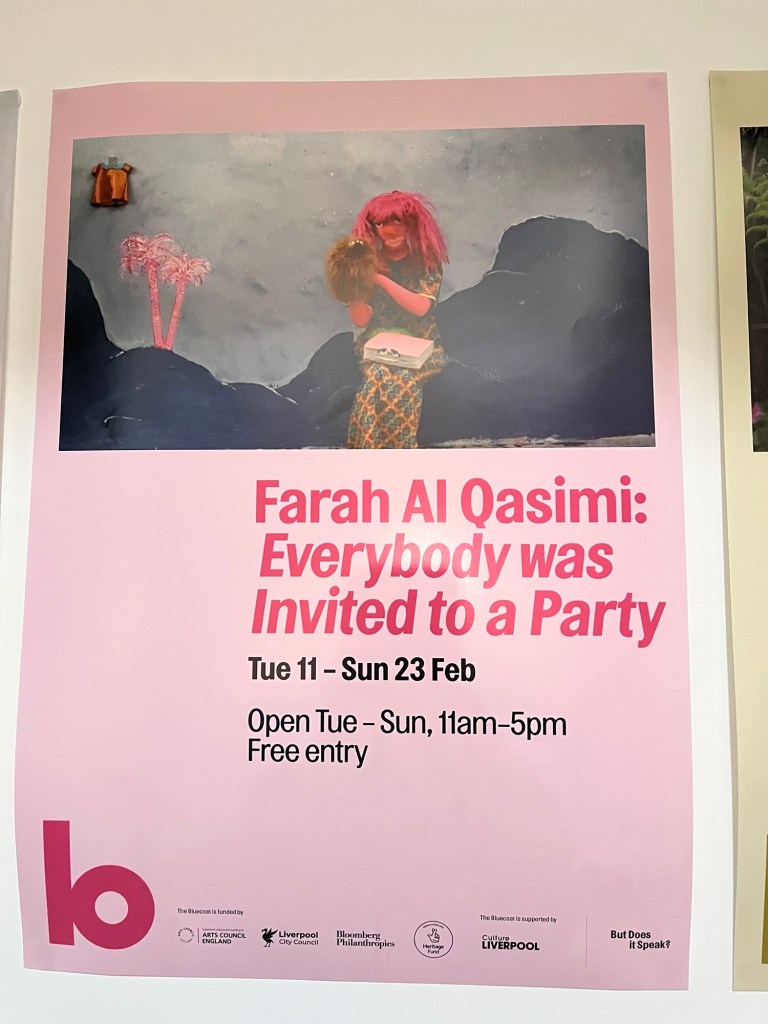
Farah Al Qasimi’s Everybody was Invited to a Party

Yesterday, I stepped into The Bluecoat and found myself transported back to my childhood in Dubai. Farah Al Qasimi’s work immediately struck a chord, filling the space with images, sounds, and moments that felt intimately familiar. In this exhibition, I wasn’t just observing, I was reliving something personal, something nostalgic. I laughed, paused, and travelled back home through her lens.

Al Qasimi, an artist from the UAE, weaves humour, memory, and language into a beautifully immersive world. Her film, Everybody was Invited to a Party, takes inspiration from Iftah Ya Simsim, the 1980s Arabic adaptation of Sesame Street. Using hand-sewn puppets and a playful approach to translation, the film highlights the fluidity , and at times, the struggles of communication.

One of the moments that resonated most with me was the pink Arabic-speaking monster struggling to order food in English. The monster’s eventual decision to learn English felt both humorous and deeply familiar. Another example was the book puppet with  text saying “I made a book to help me say the right things”. That line lingered with me. It felt so aligned with my own practice. Using language as both a tool and an obstacle, playing with its structures while trying to express something truthful.

Her use of puppetry and humour in dealing with linguistic struggles felt particularly relevant to me. I have always been interested in how objects and visual storytelling can reveal the nuances of human communication. Seeing her work has sparked new ideas about how I might further explore these themes, especially in my MA research and upcoming projects.

This exhibition reminded me that language is never just about words, it’s about memory, culture, and the ways we find (and sometimes lose) ourselves in translation. And in those moments of uncertainty, there is humour, resilience, and the power to create new meaning.

Posted in Lectures 2024/2025, Motivations, Reflection, Research

Reflections on Professionalism and Unprofessionalism

I missed the last lecture on professionalism and unprofessionalism due to family circumstances. Ironically, missing out on topics that interest me most. But watching the recording was still a rich experience, listening to the discussions and the different perspectives people brought to the conversation. 

I read the article How to Be an Unprofessional Artist by Andrew Berardini, which Jonathan shared in the lecture. And, I think the word “unprofessional” carries a certain weight, often with negative connotations. It reminds me of how the word “steal” is used provocatively in Steal Like An Artist by Austin Kleon, or how “disabled” can be perceived in different ways, negative for some, yet embraced by others as a form of identity and empowerment. Language is powerful; it doesn’t just describe the world, it shapes it. It influences how we see ourselves, how others perceive us, and what opportunities are available to us.

A key point in the discussion was how professionalism is often framed by rigid, exclusionary standards, ones that can erase individuality, lived experience, or even care. But does professionalism have to mean conforming to a narrow, predetermined image? Many so-called unprofessional traits: honesty, vulnerability, and unconventional approaches are actually strengths. They challenge existing systems, create space for new ways of thinking, and foster deeper engagement.

The tension between professional and unprofessional seems to lie in whether professionalism is dictated by external standards or defined through integrity, care, and dedication to one’s practice. If professionalism means respect for oneself, for others, and for the work, then it doesn’t have to mean suppressing individuality or creativity. I see professionalism not as following a strict rulebook, but as a commitment to craft, ethics, and meaningful engagement.

As a mother of a child with special needs, I’m particularly aware of how language shapes perception. In different contexts, the term “disabled” can be either empowering or limiting. Could “unprofessional” also be reclaimed? Maybe, but only if doing so truly empowers rather than undermines.

My own art practice naturally resists traditional notions of professionalism. Coming from multiple backgrounds, embracing mistakes, and working in multidisciplinary ways, I see value in experimentation and non-traditional approaches. Rejecting conventional professionalism doesn’t mean rejecting care, commitment, or quality. It means refusing to be boxed into a system that wasn’t designed for people with diverse experiences and ways of working. Above all, rejecting traditional professionalism can be an act of resistance, challenging exclusionary structures that dictate who belongs and what is deemed acceptable work.

I navigate between institutional and freelance work, moving fluidly between structured and independent spaces. Working with institutions while maintaining my own perspective allows me to challenge the system from within while also creating alternative ways of working. It’s about understanding the rules but choosing when and how to break them in ways that are meaningful.

This ability to shift between spaces sometimes fitting in, sometimes disrupting gives me agency. It also allows me to act as a bridge for others who feel like they don’t fit into traditional structures. This is something I see in my work, whether through Moon Letters, Creative Peers, or other social sculpture projects.

Rather than seeing professionalism and unprofessionalism as rigid opposites, I see them as fluid. True professionalism, to me, is about care, respect, and meaningful engagement, qualities that don’t require conforming to outdated norms, but rather, reimagining them.

Somewhere in Oxford…

Posted in 2024/2025, Motivations, Project, Reflection, Research

Final Session: Art for the Earth’s Sake

Our last session of Art for Earth’s Sake Peer Learning, was a powerful experience exploring the intersection of creativity, sustainability, and community action.

Key Highlights:

1- Leading by Example: We discussed how artists can practise sustainably, acting as role models for others by reducing their carbon footprint and promoting eco-friendly approaches. This includes minimising the use of fossil fuels and exploring innovative tools such as digital carbon offset initiatives like Ecology.

2- Art as a Vehicle for Transition: Art has the power to shape people’s decisions and inspire social and environmental change. We explored how slow, mindful processes can create space for reflection and dialogue about the future we want to build.

3- The Role of Heart and Mind: It’s not just about being an artist but about raising awareness and fostering learning. We emphasised the importance of balancing rational thinking with heartfelt creativity to address environmental.

We took inspiration from artists such as Rebecca Chesney and Anthony Hall, and projects like the Soil Exhibition in Somerset. Additionally, ideas from thinkers like Stephen Covey’s “Three Spheres of Influence” helped us focus on what we can control, what we can influence, and what we need to let go of as individuals and as a collective.

We are encouraged to continue organising events, engaging the community, and taking part in initiatives like the Engage. By working together, we can use art as a catalyst for positive change in the world.

Stephen Covey’s concept of the Three Spheres of Influence is a framework that helps individuals focus their energy on what they can truly affect. This idea is derived from his book, The 7 Habits of Highly Effective People. The three spheres, also known as the Circles of Concern, Influence, and Control, are a way to prioritise actions and efforts effectively. The Three Spheres Explained:

1. Circle of Concern:

This represents everything you care about, including external issues such as climate change, world events, and things you have no direct control over. While it’s important to be aware of these issues, focusing too much energy here can lead to feelings of helplessness.

2. Circle of Influence:

This sphere includes aspects you can influence, such as your local community, workplace, and people around you. By focusing efforts here, you can make a meaningful impact even if you can’t solve global issues. This is where actions like raising awareness, inspiring others, and leading by example can make a difference.

3. Circle of Control:

This is the smallest sphere, encompassing only what you can directly control, your own actions, decisions, mindset, and responses. By focusing on this sphere, you ensure that your efforts are grounded in what you can actually change.

By prioritising your focus on the Circle of Control and the Circle of Influence rather than the Circle of Concern, you can channel your energy more productively, avoid burnout, and create more positive impact. This approach is particularly valuable in projects related to sustainability and social change, where large-scale problems can feel overwhelming.

In the context of “Art for Earth’s Sake” understanding these spheres can help artists and activists focus on what they can do, such as creating art that inspires action, practising sustainability in their own work, and building local community initiatives that promote change.

Posted in Motivations, Reflection, Writing

Artist or Writer?

Recently, I tuned into Artists That Write, a fascinating session hosted by We Are Axis, featuring Roy Claire Potter, Roo Dhissou, and Madinah Farhannah. Listening to them discuss their practices and read their work was both inspiring and thought-provoking. It’s always exciting to hear how other artists navigate the overlap between visual art and writing—a space I feel I occupy but have never fully claimed.

I’ve always loved writing, but I hesitate to call myself a “proper writer.” Writing feels more like another medium to me, something I play with and manipulate, much like clay or paint. I resist the constraints of inherited rules about “how” one should write, preferring instead to follow my intuition. As an artist, I’m not aiming for polished prose or perfect grammar; I’m exploring, experimenting, and communicating without borders.

Roy Claire Potter’s reflections particularly resonated with me. They spoke about being more interested in methods and how you make things rather than what you make, which aligns so closely with my own approach. Roy shared insights into a piece they created ten years ago, Mental Furniture, which involved a broken manual typewriter. I’m intrigued to read the book tied to that work and to delve deeper into their methods.

Another standout moment was when Roy talked about The Wastes—how they felt they contained a book within themselves, not one born of studying creative writing but one emerging directly from studio practice. This struck a chord with me. It affirmed the idea that writing, for some artists, is an extension of making rather than an entirely separate discipline.

Roy said something I’ll carry with me: “Text is a cultural thing. Films are text. Fashion is text. Images are text.” It reframed my understanding of writing and language, validating the idea that words are just one form of communication among many. As someone who constantly plays with meaning and form, this was a liberating thought.

For me, writing will always be a tool of exploration—an extension of my practice, unbound by conventions. I’m not a writer who writes like a writer. I’m an artist who writes like an artist.