

In the summer, I coated large pieces of fabric (a single bed sheet) with a light sensitive solution and left them to dry in a dark room. After a few days, I invited participants from a group of women and children to a cyanotype workshop. We used plants and flowers collected during the library’s foraging sessions led by Kitchen Library artists George Herbert and Niamh Riordan, and artist in residence Hannah Fincham, linking our work directly to the local environment.


When the fabric was laid out under the sun, the women and children carefully arranged the plants, holding them down with stones and found objects. Leaves, stems and other gathered items became areas of negative space, and the sunlight painted around them. After rinsing the fabric in water, deep blues emerged, revealing the delicate silhouettes of each plant. For many in the group, particularly those who had recently arrived in the UK, this process offered something simple and grounding. Cyanotype is slow and gentle. It does not require previous artistic training or a shared language… The sun does most of the work!


In a second workshop, we returned to the dried and cured cyanotype cloth, now covered with ghostly plant impressions. The women and volunteers stitched messages into the fabric, simple words that carried enormous emotional weight such as Love, Welcome, Root, We Are Here, along with others that expressed hope and belonging. These stitched messages felt like offerings, small acts of care placed directly into the surface of a communal object that would later host a shared meal. For many of the refugee participants, displacement, uncertainty and cultural disconnection are part of daily life. Embroidery, however, is familiar across so many cultures. Hands know how to hold fabric, how to push a needle through, how to make a mark that lasts.


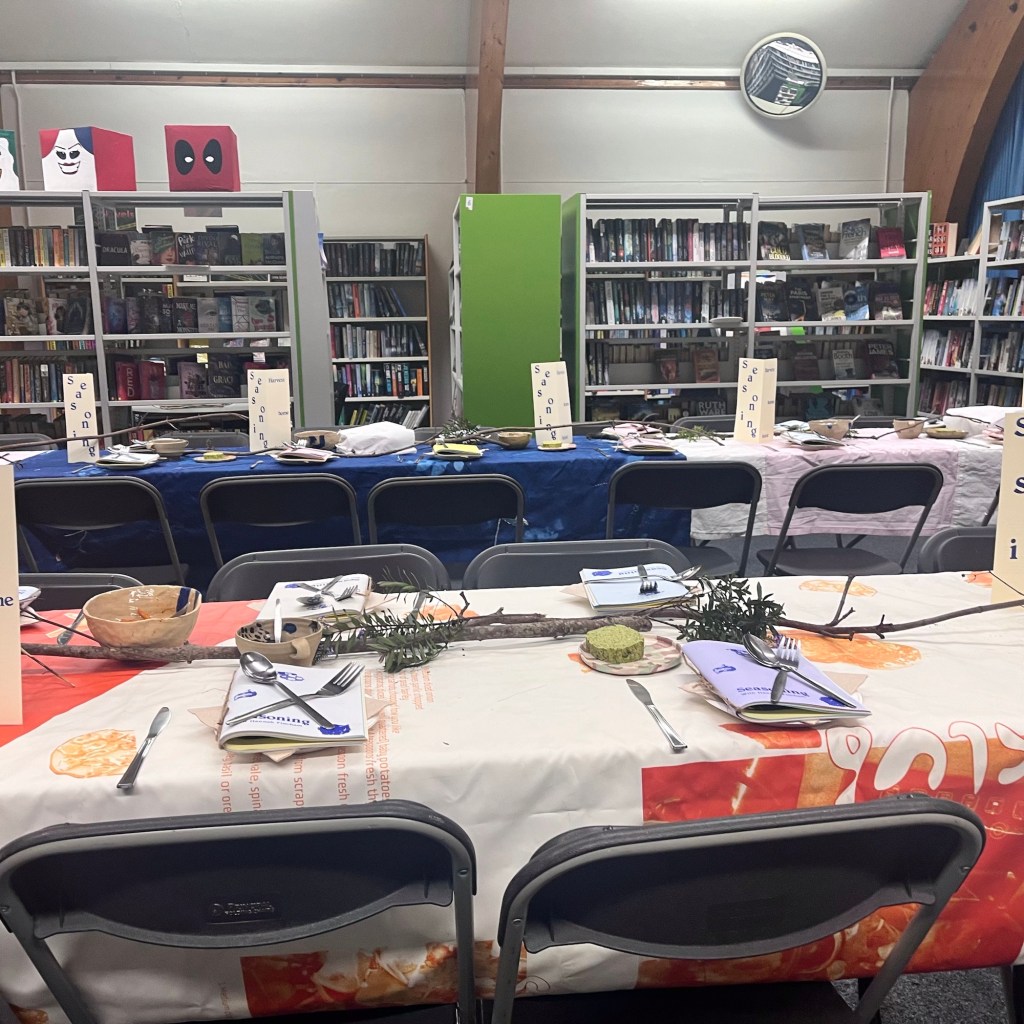

Finally, last week on Friday night we had a feast in Bootle Library. The tablecloth ran along the length of one of the tables reserved for my group. It carried the plants of Sefton, the light of our summer workshops, and the stitched words of women and children who are rebuilding their lives. Seeing it in place, surrounded by food, conversation and the warm buzz of At the Library’s artists and team, was profoundly moving. I wanted to reflect on it because it is so connected to my social sculpture research and my own practice. I felt it reflected much of what we do at the library and echoed what Jonathan taught us last week about Contact Zones. The library is, for me, the clearest physical Contact Zone.
Working alongside colleagues, each contributing their own talent and care, reminded me how these projects are held in harmony by many hands. The feast was not about showcasing artwork, it was about celebrating community, connection and the slow work of building trust through creativity. The feast project by the Kitchen Library feels to me like a multilayered social sculpture. It unfolded across different times, places and relationships. Each layer held a different group of people including colleagues, refugee women, children and artists in residence, and each contributed something unique such as their labour, their stories, their presence and their materials.
The tablecloth project deepened my understanding of social sculpture and care through art. More importantly, in a time when many communities are fractured, the involvement of refugee women and children revealed how creativity can bring us together, even if only for a moment. The tablecloth is only one visible layer. Beneath it lies the invisible sculpture of conversations, gestures, learning, trust building, cultural exchange and the shared act of preparing for a communal feast. All of these intangible elements shaped the social form just as much as the physical cloth.

 Karema