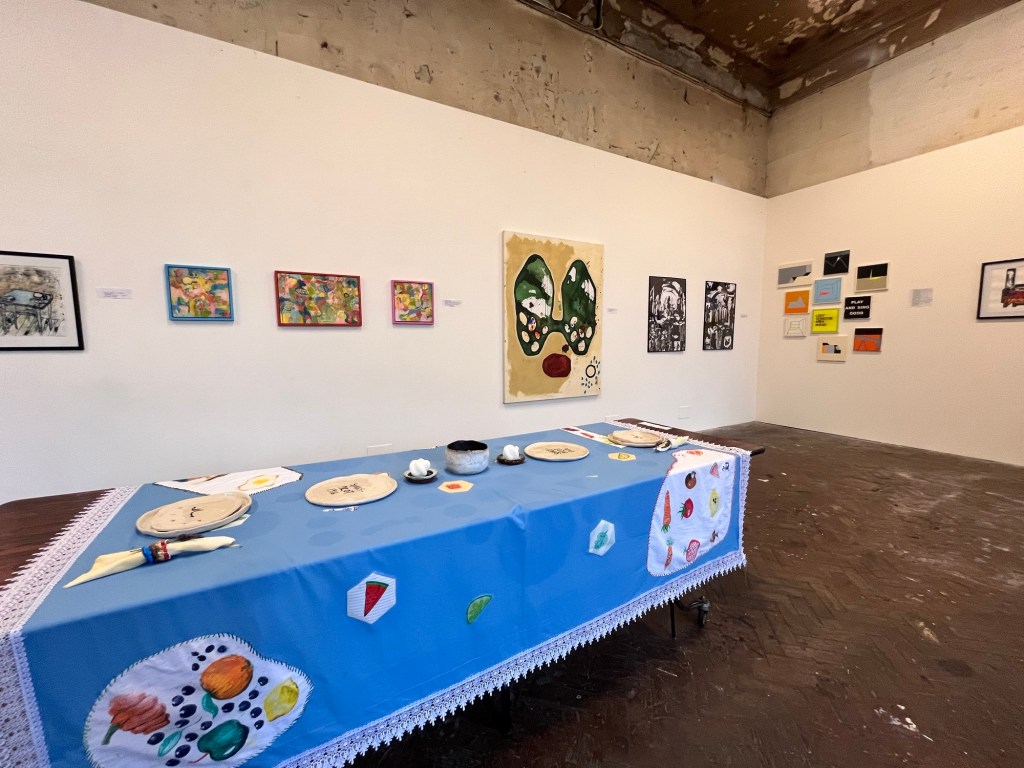
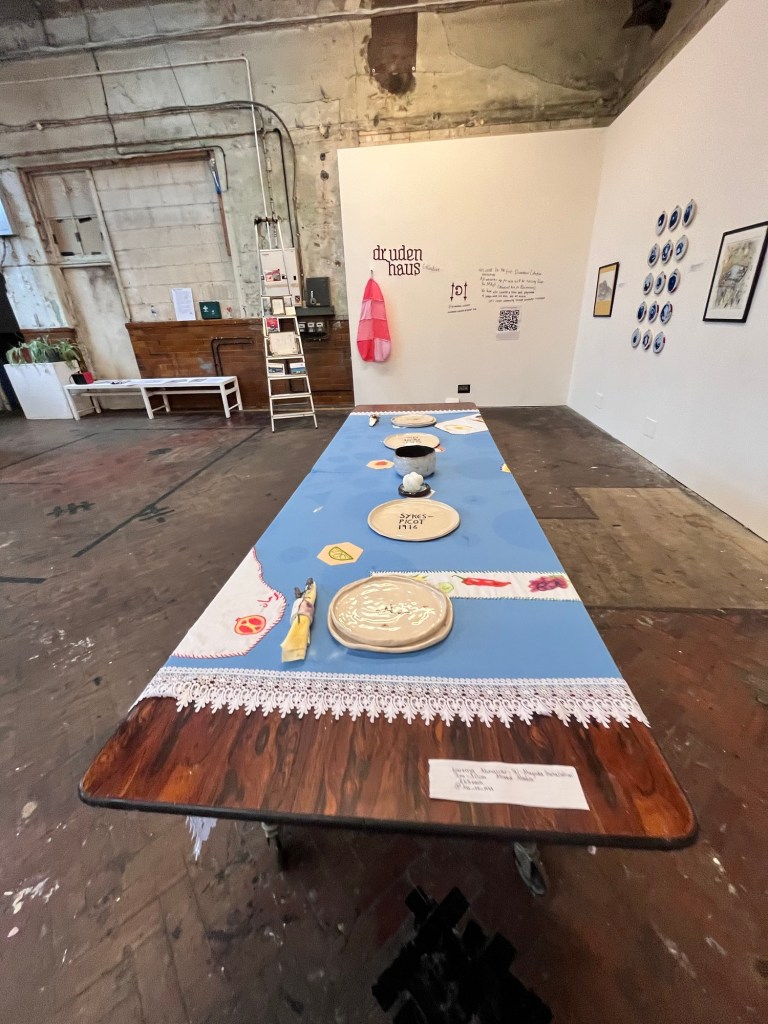
Again, Al-Mayida! The dining table is part of the DRUDENHAUS collective’s exhibition at Bridewell Gallery and Studios, Liverpool. This event includes a fundraiser for Medical Aid for Palestinians, adding a meaningful purpose to the show.
For this iteration, the work was set on a larger table than planned, shifting its dynamic. Though designed for two people, with fewer plates, and the tablecloth still bears marks left behind from previous exhibitions. The exhibition features both new and familiar artists, creating an interesting mix of perspectives.
Every curator brings a unique vision. The DRUDENHAUS collective’s decision to give the table more room to breathe was a contrast to previous presentations of Al-Mayida. This shift made me realise how flexible the work is, how it can adapt to different environments and be shaped by different interpretations.
One of the most meaningful aspects of this exhibition is its purpose as a fundraiser for Medical Aid for Palestinians. This adds weight and significance to the show. The dinner table, a place traditionally associated with hospitality, care, and conversation, becomes a symbol of solidarity. It reminds me that art doesn’t exist in isolation, it has the power to engage with real-world issues and bring people together in support of urgent causes.
Our last session of Art for Earth’s Sake Peer Learning, was a powerful experience exploring the intersection of creativity, sustainability, and community action.
Key Highlights:
1- Leading by Example: We discussed how artists can practise sustainably, acting as role models for others by reducing their carbon footprint and promoting eco-friendly approaches. This includes minimising the use of fossil fuels and exploring innovative tools such as digital carbon offset initiatives like Ecology.
2- Art as a Vehicle for Transition: Art has the power to shape people’s decisions and inspire social and environmental change. We explored how slow, mindful processes can create space for reflection and dialogue about the future we want to build.
3- The Role of Heart and Mind: It’s not just about being an artist but about raising awareness and fostering learning. We emphasised the importance of balancing rational thinking with heartfelt creativity to address environmental.
We took inspiration from artists such as Rebecca Chesney and Anthony Hall, and projects like the Soil Exhibition in Somerset. Additionally, ideas from thinkers like Stephen Covey’s “Three Spheres of Influence” helped us focus on what we can control, what we can influence, and what we need to let go of as individuals and as a collective.
We are encouraged to continue organising events, engaging the community, and taking part in initiatives like the Engage. By working together, we can use art as a catalyst for positive change in the world.
Stephen Covey’s concept of the Three Spheres of Influence is a framework that helps individuals focus their energy on what they can truly affect. This idea is derived from his book, The 7 Habits of Highly Effective People. The three spheres, also known as the Circles of Concern, Influence, and Control, are a way to prioritise actions and efforts effectively. The Three Spheres Explained:
1. Circle of Concern:
This represents everything you care about, including external issues such as climate change, world events, and things you have no direct control over. While it’s important to be aware of these issues, focusing too much energy here can lead to feelings of helplessness.
2. Circle of Influence:
This sphere includes aspects you can influence, such as your local community, workplace, and people around you. By focusing efforts here, you can make a meaningful impact even if you can’t solve global issues. This is where actions like raising awareness, inspiring others, and leading by example can make a difference.
3. Circle of Control:
This is the smallest sphere, encompassing only what you can directly control, your own actions, decisions, mindset, and responses. By focusing on this sphere, you ensure that your efforts are grounded in what you can actually change.
By prioritising your focus on the Circle of Control and the Circle of Influence rather than the Circle of Concern, you can channel your energy more productively, avoid burnout, and create more positive impact. This approach is particularly valuable in projects related to sustainability and social change, where large-scale problems can feel overwhelming.
In the context of “Art for Earth’s Sake” understanding these spheres can help artists and activists focus on what they can do, such as creating art that inspires action, practising sustainability in their own work, and building local community initiatives that promote change.
This summer, I had the opportunity to showcase Al-Mayida (The Dining Table) at Birkenhead Central Library, an installation exploring the universal and symbolic significance of the dining table. And recently, the work was selected for Hypha Studios and Dispensary Gallery’s group show in Wrexham, adding a new layer of meaning by placing it in dialogue with other multidisciplinary pieces in a 15,000-square-foot exhibition space. With its vibrant, community-centered focus, Al-Mayida became a platform for discussing culture, peace, and the shared human experience of gathering. Moving the installation from Birkenhead Library to the larger venue in Wrexham taught me to consider how an artwork’s message and impact evolve with changes in environment and scale.
The dining table holds a unique, cross-cultural significance, serving as a setting for family meals, heartfelt conversations, and shared memories. With Al-Mayida, I aimed to capture these moments by creating an immersive, interactive experience that emphasises gathering, storytelling, and unity. Drawing from a blend of artistic mediums—ceramics, textiles, and Arabic calligraphy—the installation celebrates the act of coming together, inviting audiences to reflect on what it means to share a meal, both literally and symbolically.
On the final day of Al-Mayida, I introduced a dinner set, with each item inscribed with the Arabic word for peace—سلام (Salam). “Peace,” as a concept and a word, transcends borders, symbolising our shared humanity and fostering dialogue around unity and understanding. This white ceramic set, with its minimalist design, carries a calm, contemplative energy, resonating with the installation’s message of harmony.
As a closing touch to the exhibition, I crafted three large plates inscribed with references to the Sykes-Picot Agreement, the 1916 colonial pact that divided the Middle East into spheres of influence and reshaped its geopolitical landscape. This historical reference acknowledged the dining table not only as a place for personal stories but also as a platform for global reflection. These plates became symbols of resilience, encouraging visitors to consider how history shapes our identities, our relationships, and our ongoing quest for self-determination.
The presence of these plates alongside the Salam ceramic set introduces a compelling tension—a juxtaposition between the ideals of peace and unity and the complex legacies of political history. I hope these pieces spark conversations about the ways past injustices continue to impact the present, inspiring a shared commitment to a more peaceful future.
Reflecting on Al-Mayida, I see a pathway forward that embraces community involvement, broadens cultural exploration, and deepens historical reflection. This work has laid the foundation for a practice rooted in dialogue, shared experience, and the powerful simplicity of gathering around a table.



 Karema