Posted in 2025-2026, collaboration, curation, Project, Social Sculpture

Iftar as Social Sculpture

Last year I was invited to organise a community iftar a few months after the Southport attack and the rise of far right protests. I accepted immediately, but I kept the first event simple. It felt important to move carefully. After it went well, we decided to make it a regular gathering that people in the community could expect and look forward to.

This year the project developed in three connected parts. The first was a shared reading session on the second day of Ramadan ( check previous post). The second was an anti racism cooking workshop. The third was a collective iftar meal at the library where around forty people gathered to break the fast together.

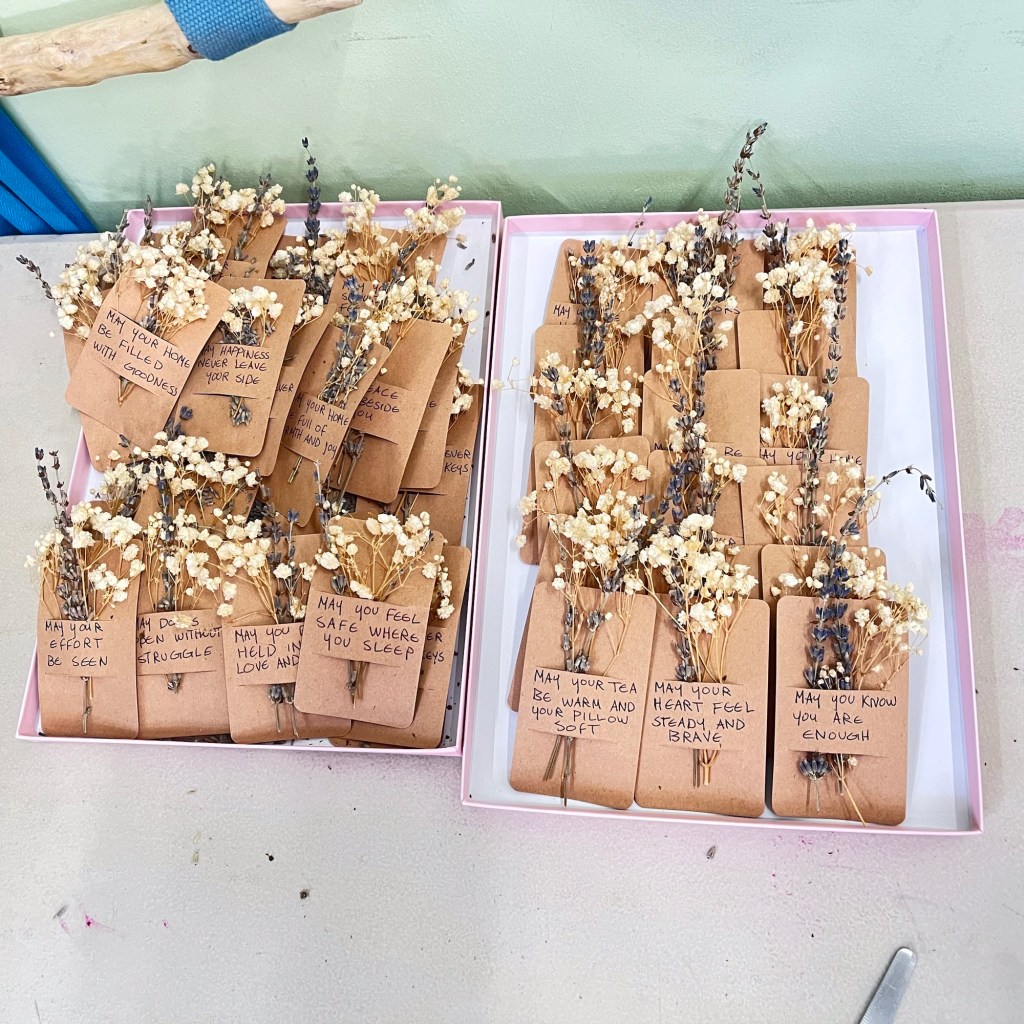
For the cooking session I invited an Iranian chef to lead a workshop where we prepared a vegetable curry. Participants from the Kitchen Library, mostly local English speaking volunteers, joined colleagues and other volunteers. People cooked together, shared food, and stayed to talk before leaving. Later that day I prepared small blessing cards for the following evening.

The next day my colleague Niamh, artist and producer for the Kitchen Library, and I went shopping for ingredients and refreshments. Back at the library we started preparing the meal. Niamh made stuffed dates for dessert. I cooked a vegan curry and bulgur while Greg and Joe helped with preparation and logistics. At the same time we rearranged the library space so it felt less like an institutional environment and more like a shared domestic space.

By the time the guests arrived everything was ready. Before breaking the fast I welcomed everyone and spoke briefly about Ramadan. I also shared this small story:

Recently I called my sister to ask how the first day of Ramadan had gone. She told me that her youngest daughter 4 yrs old  saw the dinner table prepared and suddenly asked “Where is he?” They asked, “Who?”.. She replied, “Ramadan! Everything is ready.. Why hasn’t he arrived?” 

For my niece, Ramadan was not an abstract period of time..it was a guest expected at the table!

In many ways this reflects how the month is often experienced. People prepare for it, welcome it, and look forward to its arrival. In Arabic we say Ahlan Ramadan. The phrase comes from Ahlan wa sahlan ( أهلا وسهلاً) which has been used to welcome guests in Arabic culture for centuries.

It is often translated as “welcome”, but the meaning is deeper. Ahlan comes from ahl (أهل) meaning family. It suggests that the guest is not a stranger but someone among their own people. Sahlan comes from (سهل)sahl, meaning ease or smooth ground. It suggests that the path between host and guest should be easy and open. Together the phrase expresses a form of hospitality that goes beyond politeness. It means you belong here and this space is open to you. Another common greeting is (مرحبا)marhaban. The word comes from (رحب) rahb, meaning wide or spacious. It also suggests openness and generosity. After sharing this, I invited people to say “welcome” in their own languages. We heard it in Chinese, Dari, Farsi, Urdu, German, Norwegian, and Portuguese. This small moment helped set the tone for the evening.

Ramadan is the ninth month of the Islamic lunar calendar, and fasting during this month is one of the five pillars of Islam. From before sunrise until sunset, Muslims do not eat or drink.. They also avoid smoking and intimacy. Not everyone fasts, children, people who are ill, elderly people, pregnant or breastfeeding women, women during menstruation, and travellers are exempt.

The fast is usually broken with dates and water. After a long day without food or drink the body returns to eating slowly. But fasting is not only about the body. It is also about awareness. It interrupts habits of consumption and invites reflection about what we need and what shapes our desires. Hunger changes how we feel and how we see the world. It makes the body more present, but it also reminds us of people who live with food insecurity every day. For a moment the difference between abundance and scarcity becomes more visible.. This can open space for empathy!

The project worked with the fragile conditions through which community is formed. Cooking, waiting, and breaking the fast together created a pause in everyday life. For a short time the library changed from an institutional space into a shared domestic space shaped by the people who were there. The iftar was not only an event. It became a temporary social form created through shared work, food, and conversation. Even small acts of welcome can change how a public space feels, even if only for a short time.

Posted in Research, Reflection, 2025-2026, Reading

Assimilation and Accommodation

On Tuesday, during a strong presentation session, while listening to the last talk about dérive and virtual spaces as alternatives by Pritish, I found my mind returning to a learning theory I had studied many years ago. I could not immediately recall whether it was Vygotsky or Piaget, and this hesitation made me unsure about sharing the thought at the time. Afterwards, I searched…and yes! It was Piaget’s theory of assimilation and accommodation, the idea that learning happens either by fitting new information into existing schemas or by adjusting those schemas when new information does not fit.

Reflecting on this, I began to think about how virtual spaces function in a similar way. Even when people experience digital or alternative environments, their feelings and reactions are still shaped by accumulated past experiences and knowledge. Any first encounter within a virtual space is built upon pre-existing cognitive and emotional structures. So, virtual spaces act more as a mimic or extension of reality rather than a replacement. This process can apply not only to places, but also to human relationships, attachments, and the way knowledge itself is formed. For artists in particular, engaging with new media or environments becomes less about abandoning reality and more about negotiating between what is already known and what is newly encountered.

Artists can be understood through Piaget’s concepts of assimilation and accommodation, where creative practice becomes a continuous process of negotiating between existing internal frameworks and new experiences. In assimilation, artists adopt new media, theories, or environments while maintaining their established emotional language and conceptual concerns. The tools or platforms may change but the underlying schemas remain consistent.

On the other hand, accommodation occurs when new encounters challenge existing schemas and require deeper transformation. This is often where significant artistic shifts emerge, when identity or the understanding of presence itself is reconsidered. This change is not merely stylistic but structural and art education environments sometimes encourage this level of critical adjustment.

Virtual space also reveals how artistic perception is shaped by memory and embodiment. In digital environments, artists still rely on bodily memory, cultural conditioning and early play patterns, while also borrowing physical metaphors such as walking, entering, meeting, or distancing. Virtual space often mirrors or exaggerates reality rather than escaping it entirely, showing that cognition and imagination remain grounded in lived experience.

Play therefore persists as a fundamental mechanism within artistic practice. What begins as childhood experimentation evolves into adult creative inquiry, where testing rules, breaking structures, and negotiating imagination against reality become methods of continuous learning and re-formation.

Below is a short child observation, with an image and a video, which for me explains the theory mentioned above:

The child is my nephew, my brother’s son. In the first image he was two years old, in August 2024. We were at a farmhouse with cousins and aunties. I introduced him to drawing with charcoal that we found the day after a barbecue. We made a few marks on the ground together, and he didn’t stop playing with it, continuing to draw small circles and lines.

Last summer, in August 2025, in the second video, we returned to the same farmhouse with the same family gathering. The next day my nephew found small pieces of charcoal and began making circles again. When the charcoal finished, he picked up a small stone and continued drawing on the floor. This happened without my involvement or guidance, I was simply nearby watching him play outside. What amazed me, and what I could not resist recording, was the moment he began showing his cousins what to do and teaching them. They were all having fun, and I was quietly enjoying this very human moment at a child’s level.

2025

This observation functions as a small case study of assimilation and accommodation in everyday life. The first encounter with charcoal represents assimilation, where the child integrates a new material into existing playful behaviours such as drawing circles and lines. The second encounter, one year later, demonstrates accommodation, when the charcoal is no longer available, the child searches for an alternative and selects a stone, adjusting both the tool and the physical effort required while maintaining the same intention to draw. The act of later teaching other children reinforces this learning socially, showing how knowledge becomes shared rather than individual.

In an artistic context, this example illustrates how creative practice is not only about materials but about cognitive continuity. The surface, gesture, and intention remain consistent while the medium changes. This mirrors how artists adapt to new technologies or environments without abandoning their internal motivations. The child’s behaviour reveals that creativity operates through repetition, substitution, and social exchange, suggesting that artistic development, much like childhood learning, is a cycle of experimentation rather than a linear progression… which this also can relate to the cyclicality that mentioned in Eleanor’s presentation.

Posted in 2025-2026, Books, Reading, Reflection, Research, Translation, Writing

Translation #2

After reading Translation, I found myself asking what I would add if I were given the chance to contribute more pages to the book. Three came to mind: Omar Bahabri the translator, Arnaud Balard’s Deaf Flag, Adriano Celentano’s Prisencolinensinainciusol, and Wanderer by Rory Macbeth particularly after What Is a Minor Literature?//1986 by Deleuze and Guattari page.

The first story is a Yemeni tale set during the period of British occupation in southern Yemen. Omar Bahabri was a Yemeni tea merchant who spoke English through his work with foreign traders. At a time when the British struggled to communicate with the local population due to the lack of Arabic translators, Omar was called upon to help. The British asked him to translate pamphlets intended to win the trust and loyalty of the Yemeni people. Omar translated their demands into Arabic, and pamphlets were printed and distributed by aircraft across the country.

Some time later, a British general visited Aden to inspect the situation. He was familiar with Arabic, so he picked up a handful of the pamphlets and read them. He asked the officer in charge about their purpose and was told they were meant to encourage public support for British rule. The officer explained that the pamphlets called on people to join the Allies and support them. The general replied that the pamphlets read “Buy the finest tea from Omar Bahabri” . And here only reference I found in English: https://www.jstor.org/stable/48752006

Whether the story is true or not is hardly important here. What matters is how brilliantly it portrays the fate of outsiders who believe they can exploit local language and people for their own ends, only to find those intentions quietly undermined in favour of distinctly Yemeni interests. It also led me to reflect on the fact that the British occupied Aden for 128 years, from 1839 to 1967, yet hardly any of them learned Arabic. From this, it becomes easier to understand why the French aggressively imposed their language in colonised territories, and how English was forced upon Indigenous populations in North America, Australia, and New Zealand. This reinforces my belief that language is essential to the survival of culture and heritage.

Thinking about this story alongside Translation, I realised that what draws me in is not accuracy, but refusal. Translation here is not a neutral act. It becomes a space of misalignment, humour, survival, and agency. Language appears to serve power, while quietly redirecting it elsewhere.

So yes, I already know what my next ceramic piece will be.. A tea set! A familiar site of hospitality, negotiation, and politeness. Cups that sit between people, holding conversation, holding silence or things that are never quite said…

Posted in 2024/2025, Assignments, Reflection

Unit 1 Assessment

Learning Outcome 1:
Formulate, describe and implement a challenging and self-directed programme of study, relating to your Study Statement. (Assessment Criteria: Enquiry):

My work explores topics of communication, connection, and collective experience through projects such as Al-Mayida, Letters to the Moon, asemic writing, and childlike drawings. Each project looks at how art fosters debate, narrative, and inclusivity. Interviews with Pedro Reyes about social sculpture, White Pube’s new book, and Axis’ Artists That Write have all inspired me. Furthermore, the Art for the Earth’s Sake initiative stressed the importance of adopting an ecocentric perspective to social practice. All of these influences have shaped my self-directed method, in which I investigate and learn from literature and artists, as well as my own artworks.

Learning Outcome 2:
Implement appropriate working methods for building an independent and effective self-organisation that enables the critical engagement with practice-based research.
(Assessment Criteria: Process):

In projects such as Al-Mayida, I experiment with diverse curatorial approaches, but in Letters to the Moon, I prioritise participant interaction. My process-driven approach accepts ambiguity and improvisation, which is consistent with Jonathan’s reflection in action research. The final session of Art for Earth’s Sake was especially powerful, as we discussed how artists can practise sustainability, set a good example, and utilise art as a tool for social and environmental change. 

Learning Outcome 3:
Communicate a critical understanding of your developing practice.
(Assessment Criteria: Knowledge, Communication):

My work is a type of social sculpture, an ever-changing discussion that connects personal and collective experiences. Projects such as Al-Mayida focus on unity and history, whereas Letters to the Moon promotes communication and community involvement. My efforts with asemic writing and childlike drawing disrupt art’s traditional hierarchies, emphasising authenticity and accessibility.

At last, I want to utilise art to promote social interactions and spark meaningful discourse about sociopolitical and environmental challenges. Through documentation, reflections, short courses, and visits, I hope to create work that promotes connection, dialogue, and communal action.

Feedback requests:

I would appreciate feedback on two experiments I’m currently working on: Asemic writing with translation and childlike drawings. Both approaches are new and quite different from one another.

Posted in Exhibitions, Motivations, Research, Visit

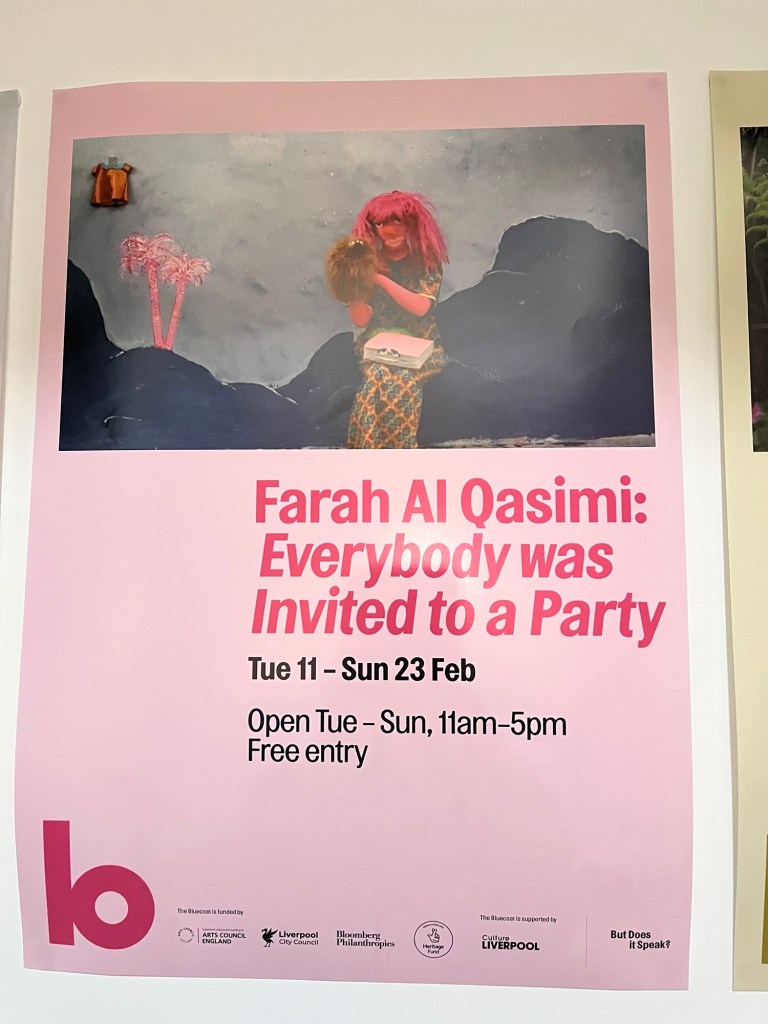
Farah Al Qasimi’s Everybody was Invited to a Party

Yesterday, I stepped into The Bluecoat and found myself transported back to my childhood in Dubai. Farah Al Qasimi’s work immediately struck a chord, filling the space with images, sounds, and moments that felt intimately familiar. In this exhibition, I wasn’t just observing, I was reliving something personal, something nostalgic. I laughed, paused, and travelled back home through her lens.

Al Qasimi, an artist from the UAE, weaves humour, memory, and language into a beautifully immersive world. Her film, Everybody was Invited to a Party, takes inspiration from Iftah Ya Simsim, the 1980s Arabic adaptation of Sesame Street. Using hand-sewn puppets and a playful approach to translation, the film highlights the fluidity , and at times, the struggles of communication.

One of the moments that resonated most with me was the pink Arabic-speaking monster struggling to order food in English. The monster’s eventual decision to learn English felt both humorous and deeply familiar. Another example was the book puppet with  text saying “I made a book to help me say the right things”. That line lingered with me. It felt so aligned with my own practice. Using language as both a tool and an obstacle, playing with its structures while trying to express something truthful.

Her use of puppetry and humour in dealing with linguistic struggles felt particularly relevant to me. I have always been interested in how objects and visual storytelling can reveal the nuances of human communication. Seeing her work has sparked new ideas about how I might further explore these themes, especially in my MA research and upcoming projects.

This exhibition reminded me that language is never just about words, it’s about memory, culture, and the ways we find (and sometimes lose) ourselves in translation. And in those moments of uncertainty, there is humour, resilience, and the power to create new meaning.

Posted in 2024/2025, Motivations, Project, Reflection, Research

Final Session: Art for the Earth’s Sake

Our last session of Art for Earth’s Sake Peer Learning, was a powerful experience exploring the intersection of creativity, sustainability, and community action.

Key Highlights:

1- Leading by Example: We discussed how artists can practise sustainably, acting as role models for others by reducing their carbon footprint and promoting eco-friendly approaches. This includes minimising the use of fossil fuels and exploring innovative tools such as digital carbon offset initiatives like Ecology.

2- Art as a Vehicle for Transition: Art has the power to shape people’s decisions and inspire social and environmental change. We explored how slow, mindful processes can create space for reflection and dialogue about the future we want to build.

3- The Role of Heart and Mind: It’s not just about being an artist but about raising awareness and fostering learning. We emphasised the importance of balancing rational thinking with heartfelt creativity to address environmental.

We took inspiration from artists such as Rebecca Chesney and Anthony Hall, and projects like the Soil Exhibition in Somerset. Additionally, ideas from thinkers like Stephen Covey’s “Three Spheres of Influence” helped us focus on what we can control, what we can influence, and what we need to let go of as individuals and as a collective.

We are encouraged to continue organising events, engaging the community, and taking part in initiatives like the Engage. By working together, we can use art as a catalyst for positive change in the world.

Stephen Covey’s concept of the Three Spheres of Influence is a framework that helps individuals focus their energy on what they can truly affect. This idea is derived from his book, The 7 Habits of Highly Effective People. The three spheres, also known as the Circles of Concern, Influence, and Control, are a way to prioritise actions and efforts effectively. The Three Spheres Explained:

1. Circle of Concern:

This represents everything you care about, including external issues such as climate change, world events, and things you have no direct control over. While it’s important to be aware of these issues, focusing too much energy here can lead to feelings of helplessness.

2. Circle of Influence:

This sphere includes aspects you can influence, such as your local community, workplace, and people around you. By focusing efforts here, you can make a meaningful impact even if you can’t solve global issues. This is where actions like raising awareness, inspiring others, and leading by example can make a difference.

3. Circle of Control:

This is the smallest sphere, encompassing only what you can directly control, your own actions, decisions, mindset, and responses. By focusing on this sphere, you ensure that your efforts are grounded in what you can actually change.

By prioritising your focus on the Circle of Control and the Circle of Influence rather than the Circle of Concern, you can channel your energy more productively, avoid burnout, and create more positive impact. This approach is particularly valuable in projects related to sustainability and social change, where large-scale problems can feel overwhelming.

In the context of “Art for Earth’s Sake” understanding these spheres can help artists and activists focus on what they can do, such as creating art that inspires action, practising sustainability in their own work, and building local community initiatives that promote change.

Posted in Exhibitions, Reflection

A Reflection on Culture, Unity, and Peace

This summer, I had the opportunity to showcase Al-Mayida (The Dining Table) at Birkenhead Central Library, an installation exploring the universal and symbolic significance of the dining table. And recently, the work was selected for Hypha Studios and Dispensary Gallery’s group show in Wrexham, adding a new layer of meaning by placing it in dialogue with other multidisciplinary pieces in a 15,000-square-foot exhibition space. With its vibrant, community-centered focus, Al-Mayida became a platform for discussing culture, peace, and the shared human experience of gathering. Moving the installation from Birkenhead Library to the larger venue in Wrexham taught me to consider how an artwork’s message and impact evolve with changes in environment and scale.

The dining table holds a unique, cross-cultural significance, serving as a setting for family meals, heartfelt conversations, and shared memories. With Al-Mayida, I aimed to capture these moments by creating an immersive, interactive experience that emphasises gathering, storytelling, and unity. Drawing from a blend of artistic mediums—ceramics, textiles, and Arabic calligraphy—the installation celebrates the act of coming together, inviting audiences to reflect on what it means to share a meal, both literally and symbolically.

On the final day of Al-Mayida, I introduced a dinner set, with each item inscribed with the Arabic word for peace—سلام (Salam). “Peace,” as a concept and a word, transcends borders, symbolising our shared humanity and fostering dialogue around unity and understanding. This white ceramic set, with its minimalist design, carries a calm, contemplative energy, resonating with the installation’s message of harmony.

As a closing touch to the exhibition, I crafted three large plates inscribed with references to the Sykes-Picot Agreement, the 1916 colonial pact that divided the Middle East into spheres of influence and reshaped its geopolitical landscape. This historical reference acknowledged the dining table not only as a place for personal stories but also as a platform for global reflection. These plates became symbols of resilience, encouraging visitors to consider how history shapes our identities, our relationships, and our ongoing quest for self-determination.

The presence of these plates alongside the Salam ceramic set introduces a compelling tension—a juxtaposition between the ideals of peace and unity and the complex legacies of political history. I hope these pieces spark conversations about the ways past injustices continue to impact the present, inspiring a shared commitment to a more peaceful future.

Reflecting on Al-Mayida, I see a pathway forward that embraces community involvement, broadens cultural exploration, and deepens historical reflection. This work has laid the foundation for a practice rooted in dialogue, shared experience, and the powerful simplicity of gathering around a table.