Posted in 2024/2025, Exhibitions, Motivations, Reflection, Writing

First Review in Art in Liverpool

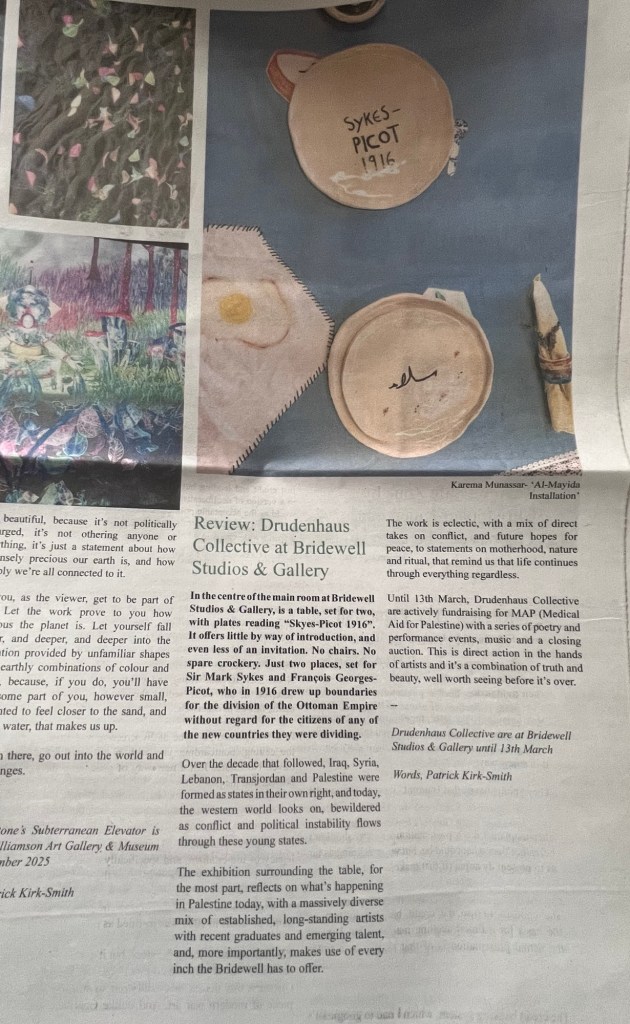
I recently received my first review (which I see as feedback) in Art in Liverpool, written by Patrick Kirk-Smith, about my Al-Mayida installation as part of the Drudenhaus Collective at Bridewell Studios & Gallery. Seeing my work in print, positioned within a broader reflection on history, conflict, and artistic response—has given me space to consider how this moment connects with my ongoing practice.

He writes:

“In the centre of the main room at Bridewell Studios & Gallery is a table, set for two, with plates reading ‘Sykes-Picot 1916’. It offers little by way of introduction, and even less of an invitation. No chairs. No spare crockery. Just two places, set for Sir Mark Sykes and François Georges-Picot, who in 1916 drew up boundaries for the division of the Ottoman Empire without regard for the citizens of any of the new countries they were dividing…”

This review captures the essence of Al-Mayida, how history’s decisions linger in the present, shaping lives and political realities.

As I navigate my MA, this review serves as both encouragement and reflection. It affirms that my work is engaging with complex socio-political themes in a way that resonates beyond the gallery. It also challenges me to refine my approach, how can I sharpen these conversations while maintaining the poetic, unsettling subtlety that Al-Mayida holds?

The Drudenhaus Collective’s fundraising for Medical Aid for Palestine (MAP) adds another layer to this. Art, for me, has always been a site of action as much as expression. This project reinforces my belief that creative practice can exist in solidarity, bringing history into the present not just for reflection, but for tangible impact.

Posted in 2024/2025, Exhibitions, Experiments, Visit, Writing

Childlike Drawing

Book cover

As part of my ongoing exploration of communication, I recently created a series of childlike drawings for an upcoming exhibition in Glasgow, documenting my journey to Auchingarrich Park for the Pitch 2024 Ghost Art School exhibition.

Childlike drawings carry a unique authenticity and emotional impact. They are often raw, unfiltered, and filled with a sense of honesty. By using this approach, I aim to challenge traditional notions of what serious art should look like. 

My practice has always focused on breaking down barriers and fostering meaningful connections, and this childlike style is a way to make art more accessible to a wider audience. 

One of the key aspects of my practice is questioning hierarchies within the art world. By choosing a childlike style, I’m challenging the idea that only refined, technically skilled works are valuable. Instead, I’m highlighting that artistic value lies in the ideas, emotions, and dialogue that the work generates.

The simplicity and playful nature of these drawings highlight themes of innocence and exploration. In the context of my journey to Auchingarrich Park, this approach allowed me to convey a sense of wonder and curiosity, encouraging viewers to reflect on their own memories of childhood and play.

As I continue to explore this style, I look forward to seeing the book in the exhibition and observing how people will interact with it next week.

Posted in 2024/2025, Exhibitions, Experiments

Al-Mayida at Bridewell Gallery & Studios

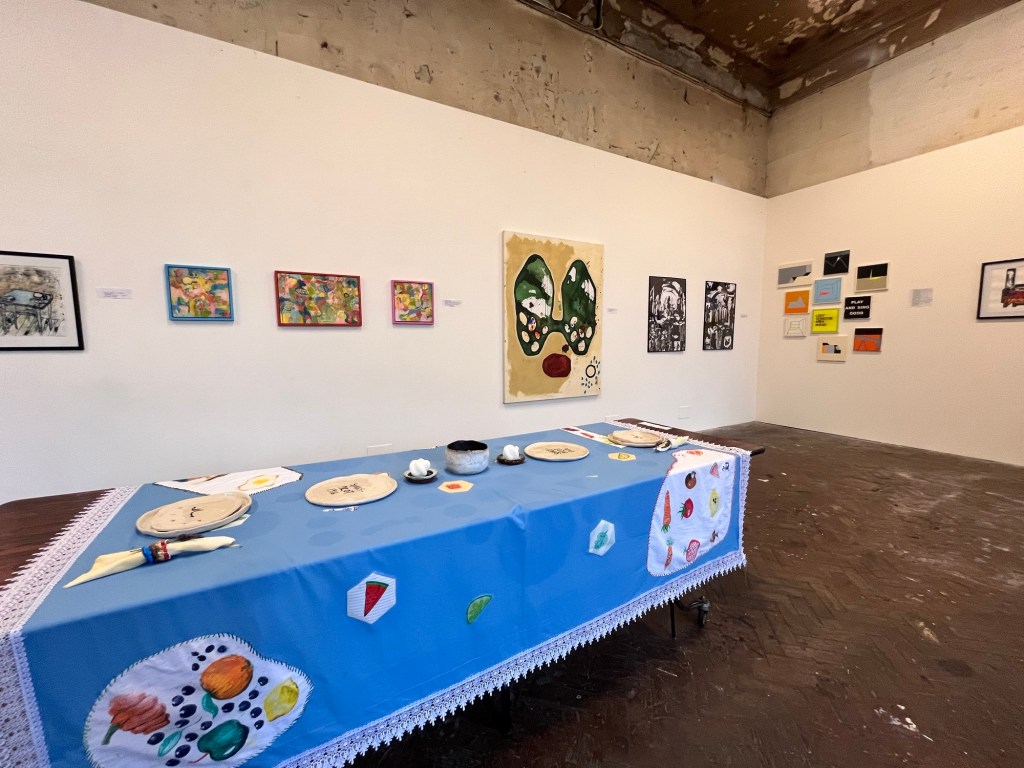
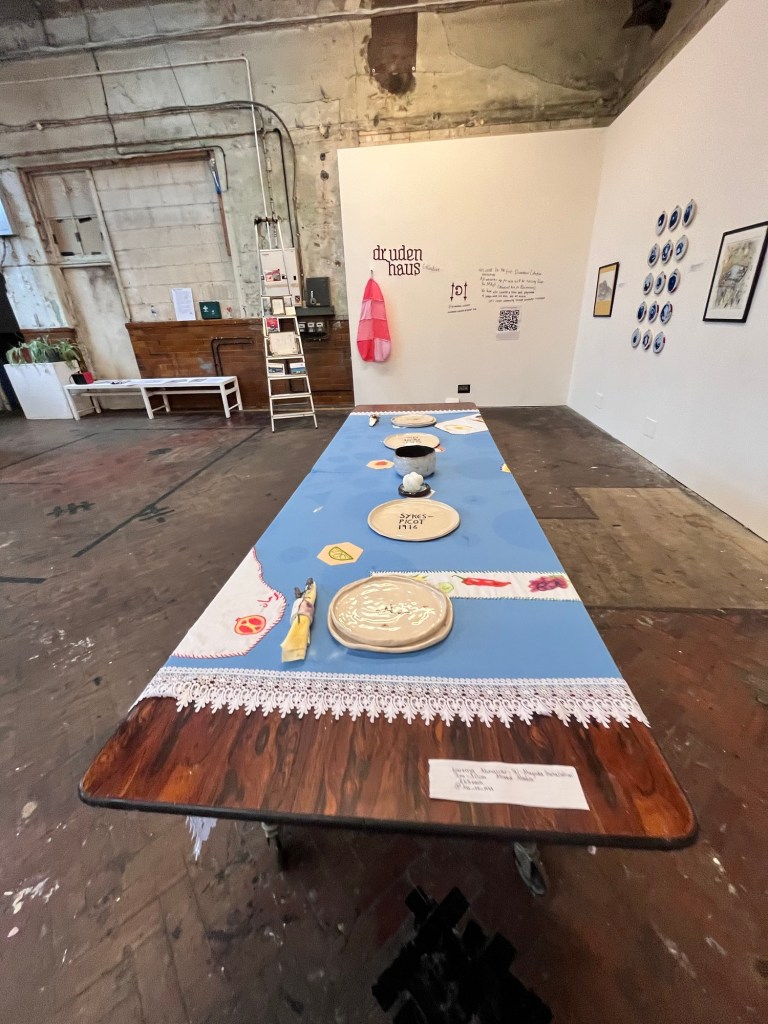
Again, Al-Mayida! The dining table is part of the DRUDENHAUS collective’s exhibition at Bridewell Gallery and Studios, Liverpool. This event includes a fundraiser for Medical Aid for Palestinians, adding a meaningful purpose to the show.

For this iteration, the work was set on a larger table than planned, shifting its dynamic. Though designed for two people, with fewer plates, and the tablecloth still bears marks left behind from previous exhibitions. The exhibition features both new and familiar artists, creating an interesting mix of perspectives.

Every curator brings a unique vision. The DRUDENHAUS collective’s decision to give the table more room to breathe was a contrast to previous presentations of Al-Mayida. This shift made me realise how flexible the work is, how it can adapt to different environments and be shaped by different interpretations.

One of the most meaningful aspects of this exhibition is its purpose as a fundraiser for Medical Aid for Palestinians. This adds weight and significance to the show. The dinner table, a place traditionally associated with hospitality, care, and conversation, becomes a symbol of solidarity. It reminds me that art doesn’t exist in isolation, it has the power to engage with real-world issues and bring people together in support of urgent causes.

Posted in Exhibitions, Motivations, Research, Visit

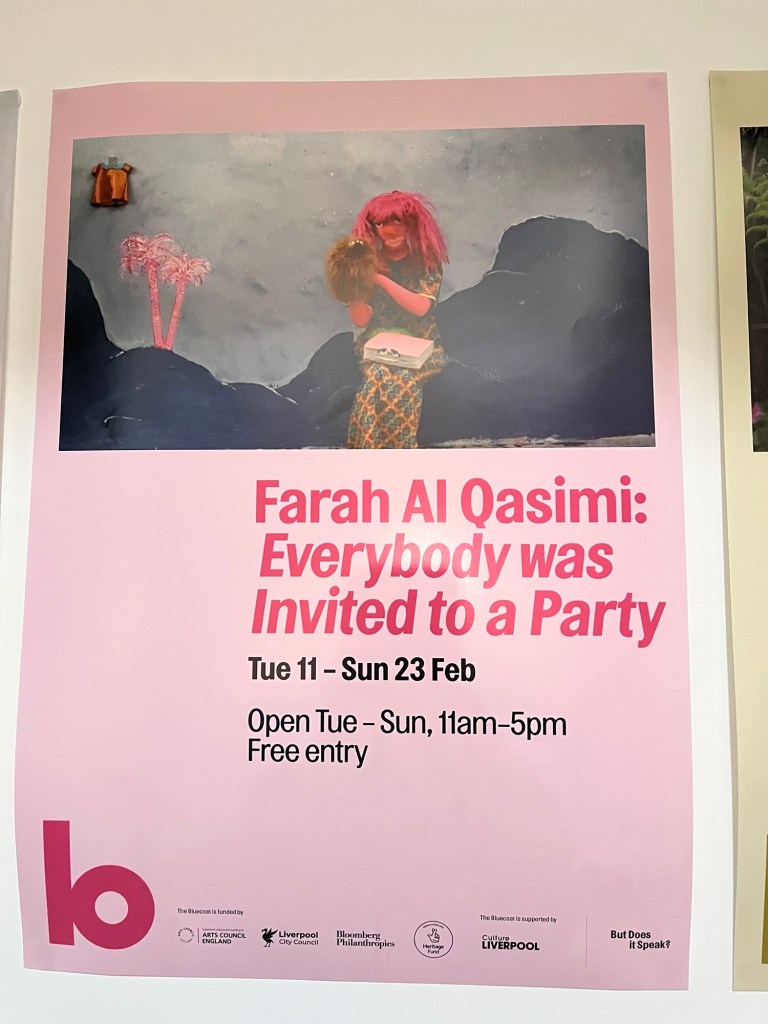
Farah Al Qasimi’s Everybody was Invited to a Party

Yesterday, I stepped into The Bluecoat and found myself transported back to my childhood in Dubai. Farah Al Qasimi’s work immediately struck a chord, filling the space with images, sounds, and moments that felt intimately familiar. In this exhibition, I wasn’t just observing, I was reliving something personal, something nostalgic. I laughed, paused, and travelled back home through her lens.

Al Qasimi, an artist from the UAE, weaves humour, memory, and language into a beautifully immersive world. Her film, Everybody was Invited to a Party, takes inspiration from Iftah Ya Simsim, the 1980s Arabic adaptation of Sesame Street. Using hand-sewn puppets and a playful approach to translation, the film highlights the fluidity , and at times, the struggles of communication.

One of the moments that resonated most with me was the pink Arabic-speaking monster struggling to order food in English. The monster’s eventual decision to learn English felt both humorous and deeply familiar. Another example was the book puppet with  text saying “I made a book to help me say the right things”. That line lingered with me. It felt so aligned with my own practice. Using language as both a tool and an obstacle, playing with its structures while trying to express something truthful.

Her use of puppetry and humour in dealing with linguistic struggles felt particularly relevant to me. I have always been interested in how objects and visual storytelling can reveal the nuances of human communication. Seeing her work has sparked new ideas about how I might further explore these themes, especially in my MA research and upcoming projects.

This exhibition reminded me that language is never just about words, it’s about memory, culture, and the ways we find (and sometimes lose) ourselves in translation. And in those moments of uncertainty, there is humour, resilience, and the power to create new meaning.

Posted in Exhibitions, Reflection

A Reflection on Culture, Unity, and Peace

This summer, I had the opportunity to showcase Al-Mayida (The Dining Table) at Birkenhead Central Library, an installation exploring the universal and symbolic significance of the dining table. And recently, the work was selected for Hypha Studios and Dispensary Gallery’s group show in Wrexham, adding a new layer of meaning by placing it in dialogue with other multidisciplinary pieces in a 15,000-square-foot exhibition space. With its vibrant, community-centered focus, Al-Mayida became a platform for discussing culture, peace, and the shared human experience of gathering. Moving the installation from Birkenhead Library to the larger venue in Wrexham taught me to consider how an artwork’s message and impact evolve with changes in environment and scale.

The dining table holds a unique, cross-cultural significance, serving as a setting for family meals, heartfelt conversations, and shared memories. With Al-Mayida, I aimed to capture these moments by creating an immersive, interactive experience that emphasises gathering, storytelling, and unity. Drawing from a blend of artistic mediums—ceramics, textiles, and Arabic calligraphy—the installation celebrates the act of coming together, inviting audiences to reflect on what it means to share a meal, both literally and symbolically.

On the final day of Al-Mayida, I introduced a dinner set, with each item inscribed with the Arabic word for peace—سلام (Salam). “Peace,” as a concept and a word, transcends borders, symbolising our shared humanity and fostering dialogue around unity and understanding. This white ceramic set, with its minimalist design, carries a calm, contemplative energy, resonating with the installation’s message of harmony.

As a closing touch to the exhibition, I crafted three large plates inscribed with references to the Sykes-Picot Agreement, the 1916 colonial pact that divided the Middle East into spheres of influence and reshaped its geopolitical landscape. This historical reference acknowledged the dining table not only as a place for personal stories but also as a platform for global reflection. These plates became symbols of resilience, encouraging visitors to consider how history shapes our identities, our relationships, and our ongoing quest for self-determination.

The presence of these plates alongside the Salam ceramic set introduces a compelling tension—a juxtaposition between the ideals of peace and unity and the complex legacies of political history. I hope these pieces spark conversations about the ways past injustices continue to impact the present, inspiring a shared commitment to a more peaceful future.

Reflecting on Al-Mayida, I see a pathway forward that embraces community involvement, broadens cultural exploration, and deepens historical reflection. This work has laid the foundation for a practice rooted in dialogue, shared experience, and the powerful simplicity of gathering around a table.