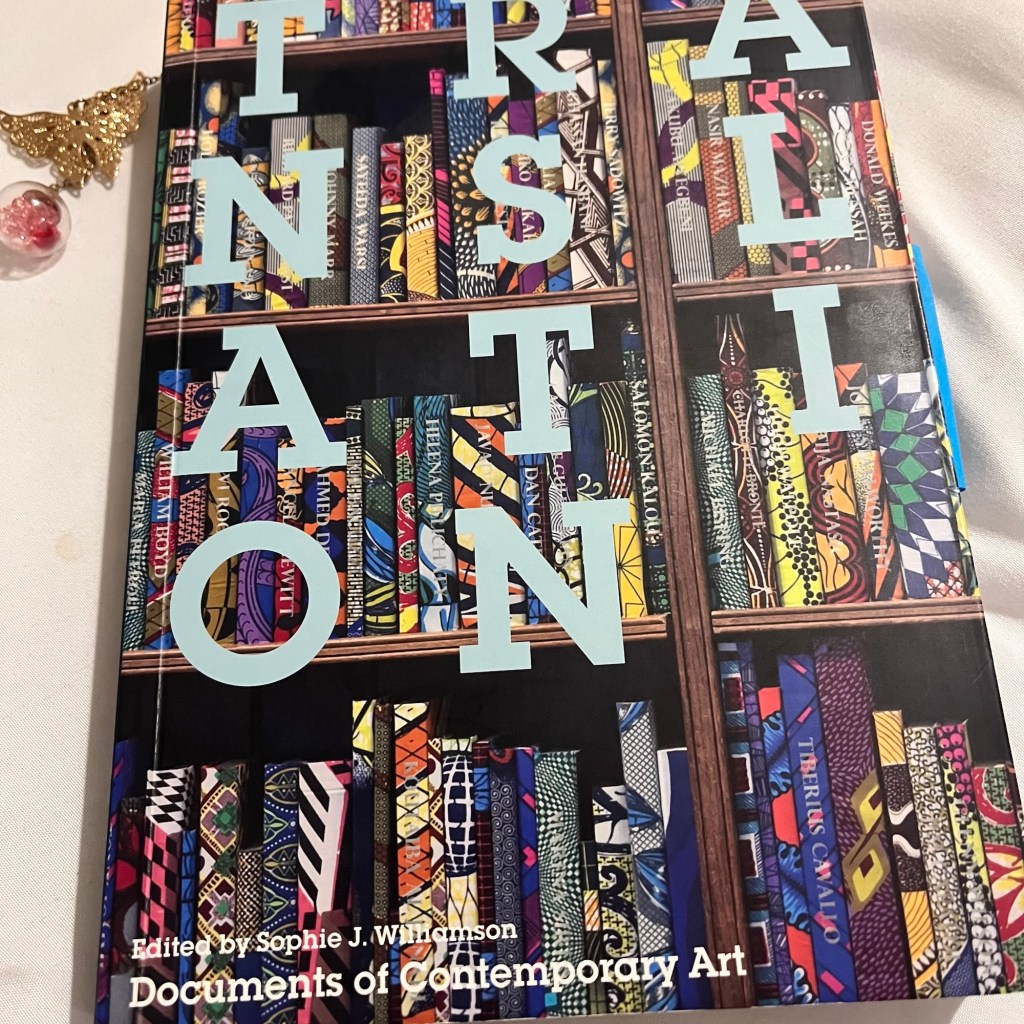
After reading Translation, I found myself asking what I would add if I were given the chance to contribute more pages to the book. Three came to mind: Omar Bahabri the translator, Arnaud Balard’s Deaf Flag, Adriano Celentano’s Prisencolinensinainciusol, and Wanderer by Rory Macbeth particularly after What Is a Minor Literature?//1986 by Deleuze and Guattari page.
The first story is a Yemeni tale set during the period of British occupation in southern Yemen. Omar Bahabri was a Yemeni tea merchant who spoke English through his work with foreign traders. At a time when the British struggled to communicate with the local population due to the lack of Arabic translators, Omar was called upon to help. The British asked him to translate pamphlets intended to win the trust and loyalty of the Yemeni people. Omar translated their demands into Arabic, and pamphlets were printed and distributed by aircraft across the country.
Some time later, a British general visited Aden to inspect the situation. He was familiar with Arabic, so he picked up a handful of the pamphlets and read them. He asked the officer in charge about their purpose and was told they were meant to encourage public support for British rule. The officer explained that the pamphlets called on people to join the Allies and support them. The general replied that the pamphlets read “Buy the finest tea from Omar Bahabri” . And here only reference I found in English: https://www.jstor.org/stable/48752006
Whether the story is true or not is hardly important here. What matters is how brilliantly it portrays the fate of outsiders who believe they can exploit local language and people for their own ends, only to find those intentions quietly undermined in favour of distinctly Yemeni interests. It also led me to reflect on the fact that the British occupied Aden for 128 years, from 1839 to 1967, yet hardly any of them learned Arabic. From this, it becomes easier to understand why the French aggressively imposed their language in colonised territories, and how English was forced upon Indigenous populations in North America, Australia, and New Zealand. This reinforces my belief that language is essential to the survival of culture and heritage.
Thinking about this story alongside Translation, I realised that what draws me in is not accuracy, but refusal. Translation here is not a neutral act. It becomes a space of misalignment, humour, survival, and agency. Language appears to serve power, while quietly redirecting it elsewhere.
So yes, I already know what my next ceramic piece will be.. A tea set! A familiar site of hospitality, negotiation, and politeness. Cups that sit between people, holding conversation, holding silence or things that are never quite said…
Jonathan recommended this book to me twice. Before I ordered it, I assumed it might be similar to Against Expression by Kenneth Goldsmith and Craig Dworkin, a great book in its own right on conceptual writing. But I found myself loving Williamson’s Translation much more. It feels like a fruit salad, a wide variety of flavours, each sweet or sour in its own way, yet deeply enjoyable together. While Against Expression is larger in size, Translation feels more balanced and brings together a broader range of international voices.
Before even reading the Translation introduction, I couldn’t resist starting with Frantz Fanon and James Baldwin. I love both of their styles, it’s heavy, yet smooth in motion and settling deep in the soul. The anthology brings together an impressive mix of writers and artists, including Shirin Neshat, Jess Darling, Yinka Shonibare, Stephen Morton, Susan Hiller, Walid Raad, Walter Benjamin, and many others.
There were several moments where I had to pause, wanting to comment or reflect. Although the contributors come from very different backgrounds and perspectives, you still feel that they share something. Language is not just words or signs; it reflects how far the human mind can reach in understanding its surroundings what is seen and unseen. It is about comprehension, and about noticing what might otherwise remain incomprehensible.
Shirin Neshat’s page took me back to my childhood in Dubai. Growing up across different cultures, I’ve come to see communication as a vast ocean. It can feel overwhelming and frightening at times, but it also has a magical quality: moments where connection happens without you fully understanding how.
Where I grew up, our neighbours formed a small, diverse world. To the right was an Iranian Shia family; to the left, a Yemeni one. After our Emirati neighbours moved away, we had Palestinian, Pakistani and Omani neighbours opposite us. They were all kind and friendly, with children who played together on the sandy street before the area became very posh and built up. Our relationships were friendly, formal, and respectful, shaped by care and sharing.
I formed a close bond with our Iranian neighbours, and their daughter became my best friend. We grew into each other’s families, spending time playing and eating together, getting into trouble, being told off, and sharing fun (she’s the one I mentioned in the Dear Moon preface). Her parents did not speak Arabic well, and in their home they spoke Farsi. I loved listening to them, I couldn’t understand but I relied on facial expressions and tone of voice, especially when we were in trouble and her translations were completely inaccurate..
I didn’t learn about Sunni and Shia differences until middle school. I once asked my friend to join my prayer, She refused, because I was Sunni and she was Shia..terms I had never heard before, and which were never discussed in my family. When I asked my father, he simply said: they are Shia, we are Sunni, and their prayer is slightly different. My response was simple “i thought we are just Muslims”.
I became more curious.. my religion teacher with patience and care became the target of my endless questions, until I moved to secondary school, where I continued my research. So did my library teachers, who would quietly prepare books for me to borrow. Reading history gave me joy and deeper understanding. I began to realise how many of our problems come from judging events without understanding their roots or contexts.
Prayer might seem like a diversion here, but it still feels connected to languages. I began practising prayer at around 11 or 12 years old, not through parental guidance but after being dared by a cousin, I was the youngest in my extended family to do so and he mocked my attempts.
What I’ll never forget, my very very first attempt. I was almost 5 years old. My second sister had been born ill, and when she was one month old, my father took her to hospital one evening while my mother was unwell. No one explained anything to me.. and I was scared seeing my mum crying… I took a prayer mat, faced a random direction, put one of my mother’s headscarves on and stood there silently. I didn’t know what to say.. No one had taught me how to speak to God. I only knew that we believe in Allah our creator (Allah is the Arabic word for God, used by Arab Christians too)… So I just cried and simply said “please don’t let my baby sister die”. She came home the next day and grew up to become my moody sister!
Later, I understood why my parents were soo panicked. Back in Yemen, they had lost their first child, a baby boy… I was born after him, small and sick. My grandmother took responsibility for caring for me, and five women from her family and circle breastfed me until my mother recovered. I grew up with five “milk mothers” and milk siblings. In my village, some babies had one or two. I had five! Perhaps that explains why I grew up with the smallest body, it might have been that extra dose😂
This came back to me while reading Gayatri Spivak’s The Politics of Translation page. She mentioned Mahasweta Devi’s story Stanadayini’s translations. One English translation is titled Breast-Giver, another The Wet Nurse. Spivak notes that when you read both translations side by side, the loss of rhetorical silence from one translation to the other becomes clear. This reminded me of Rory Macbeth’s Wanderer the translation of Kafka’s Metamorphosis translated from German into English without him being able to read or speak German. Years ago, he told me: “I don’t believe there is such a thing as an accurate translation”.
This thought led me to the Qur’an. As Muslims, we believe the Arabic Qur’an to be the direct word of God, linguistically, structurally, and even mathematically unique. No Arabic writer has ever matched its form. Translations exist, but they are treated as interpretations, not replacements. The Arabic text itself is carried and protected by Muslims across languages and cultures, unchanged and only recited in Arabic.
Perhaps that, is part of what this anthology keeps circling back to: the beauty, limits, and responsibility of language and everything that slips through when we try to carry meaning from one place to another. I do believe that a translator can’t separate their life experience and feelings from their work; these inevitably shape their understanding. In this way, the translator and the original writer become new collaborators.



 Karema