Posted in Research

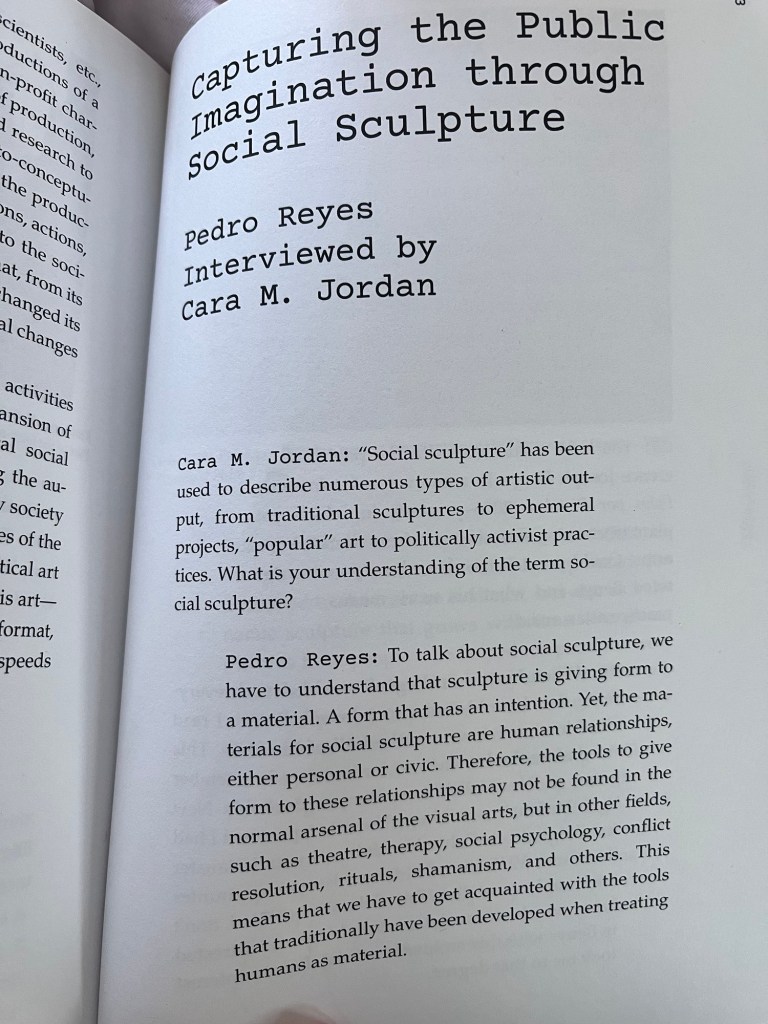
Inspiring Text: Pedro Reyes on Social Sculpture

The interview between Pedro Reyes and Cara M. Jordan is a fascinating exploration of social sculpture and its potential for societal impact. Reyes presents a compelling perspective on social sculpture as a medium where human relationships become the material, transcending traditional artistic boundaries and incorporating tools from diverse fields such as theatre, therapy, and rituals.

Reyes’ reflection on Joseph Beuys as a foundational influence further enriches the discussion, particularly through his project Palas por Pistolas, which transforms weapons into tools for reforestation—a direct homage to Beuys’ 7,000 Oaks. This project exemplifies dynamic, living art that evolves over time, reflecting the transformative power of human collaboration. His appreciation for Beuys’ humour and dedication to socialism underscores an optimistic yet critical vision of art’s role in addressing complex social issues.

Reyes’ commitment to accessibility is especially notable, as he advocates for art that transcends traditional audiences and creates transformative experiences regardless of participants’ familiarity with the art world. Collaborative projects like Sanatorium and People’s United Nations (pUN) highlight his dedication to co-creation and role-play, fostering a sense of ownership and shared authorship among participants.

His belief in the transformative power of materials is equally inspiring. The act of turning rifles into flutes, for example, embodies his philosophy of relational objects—artifacts that catalyse social encounters and spark psychological shifts. This approach strongly resonates with my interest in social sculpture and the symbolic potential of everyday materials.

This interview has deeply influenced my practice, offering inspiration for integrating participatory frameworks, addressing sociopolitical themes, and ensuring inclusivity. Reyes’ approach aligns with my focus on creating art that bridges communication gaps and meaningfully engages audiences, providing valuable strategies to advance my work.

Posted in Motivations, Reflection, Writing

Artist or Writer?

Recently, I tuned into Artists That Write, a fascinating session hosted by We Are Axis, featuring Roy Claire Potter, Roo Dhissou, and Madinah Farhannah. Listening to them discuss their practices and read their work was both inspiring and thought-provoking. It’s always exciting to hear how other artists navigate the overlap between visual art and writing—a space I feel I occupy but have never fully claimed.

I’ve always loved writing, but I hesitate to call myself a “proper writer.” Writing feels more like another medium to me, something I play with and manipulate, much like clay or paint. I resist the constraints of inherited rules about “how” one should write, preferring instead to follow my intuition. As an artist, I’m not aiming for polished prose or perfect grammar; I’m exploring, experimenting, and communicating without borders.

Roy Claire Potter’s reflections particularly resonated with me. They spoke about being more interested in methods and how you make things rather than what you make, which aligns so closely with my own approach. Roy shared insights into a piece they created ten years ago, Mental Furniture, which involved a broken manual typewriter. I’m intrigued to read the book tied to that work and to delve deeper into their methods.

Another standout moment was when Roy talked about The Wastes—how they felt they contained a book within themselves, not one born of studying creative writing but one emerging directly from studio practice. This struck a chord with me. It affirmed the idea that writing, for some artists, is an extension of making rather than an entirely separate discipline.

Roy said something I’ll carry with me: “Text is a cultural thing. Films are text. Fashion is text. Images are text.” It reframed my understanding of writing and language, validating the idea that words are just one form of communication among many. As someone who constantly plays with meaning and form, this was a liberating thought.

For me, writing will always be a tool of exploration—an extension of my practice, unbound by conventions. I’m not a writer who writes like a writer. I’m an artist who writes like an artist.

Posted in Reflection, Visit, Writing

Finding Focus: The Wastes

Last week, I attended the book launch for The Wastes, a novella by Roy Claire Potter. Potter was joined by guest artists David Jacques, Roo Dhissou, and Harriet Morley at Dead Ink Books in Liverpool. It was a wonderful evening celebrating the work of an artist and writer whose practice profoundly influenced my own during my BA studies. I liked Roy Claire’s ability to weave humour and insight into their reflections on everyday working-class life. In The Wastes, this approach shines through as memories ripple across the narrative, creating a vivid and relatable journey for the reader.

Experiencing the book and the discussions around it gave me a renewed sense of direction for my MA in Fine Art. I’ve realised that writing and participatory art are central to my practice, and I want to explore these areas with greater intention. Roy Claire’s work reminded me how powerful text can be—not just as a medium for communication but as a way to build connections.

Moving forward, I’m determined to channel more energy into developing my writing alongside my participatory projects. This means refining my approach to storytelling and reflection while exploring ways to integrate these elements into interactive art-making. I want to experiment, learn by doing, and create a structured plan to support my growth in both areas.

Attending the book launch wasn’t just about celebrating a great piece of writing—it was a reminder of my purpose and aspirations. Writing and participatory art are more than tools in my practice; they are at the core of how I want to connect with others and create art that resonates.

Posted in Reflection

Asemic

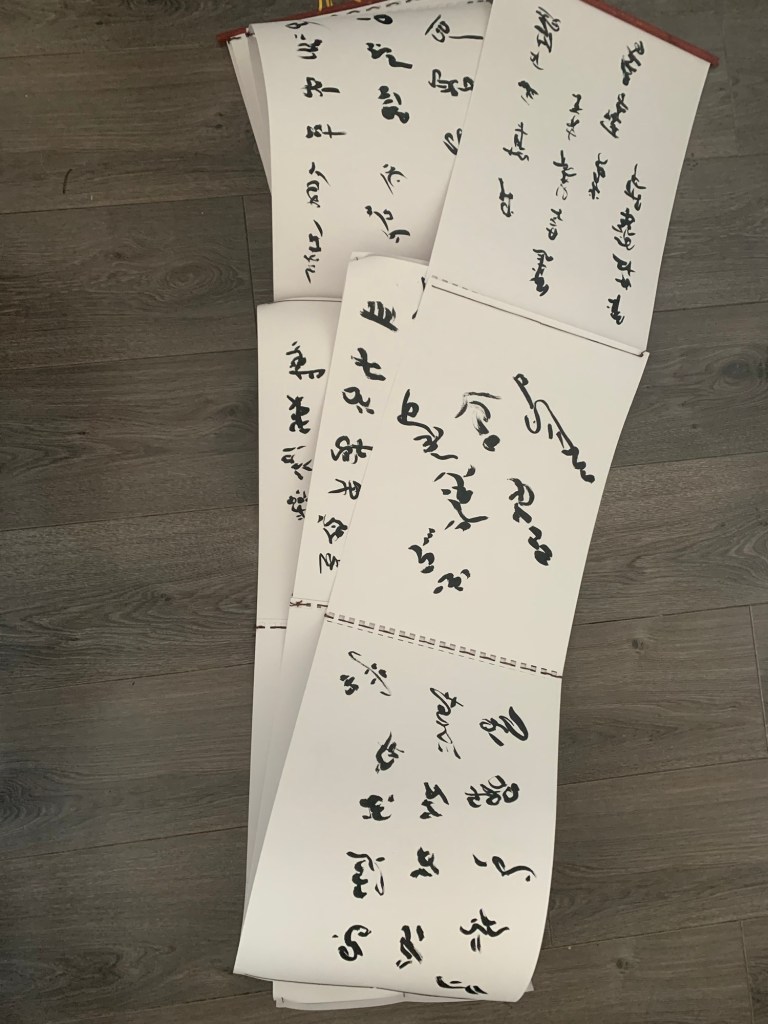
After an inspiring conversation with my MA coursemate, Josh Well, on asemic writing, I felt compelled to revisit a research project I undertook three years ago. This project delved into the intriguing realms of semic and asemic writing, semiotics theory, and examples of art that explore these ideas. My 2021 project, Blah Blah Blah Banner, sits within this dialogue, exploring the relationship between form and meaning in text and language. Through tutorials, workshops, and experiments with different materials, I examined how artists use text within art and the rich distinctions between semic and asemic writing.

Semiotics, the study of signs, opens up the boundless potential for experimenting with words and symbols. Art historian Anne D’Alleva reminds us that “signs can take many different forms” (D’Alleva, 2012, p.26), showing that meaning is both created and perceived. Here, semic writing refers to symbols or representations that carry meaning, while asemic writing is purely visual, existing outside formal language or communication.

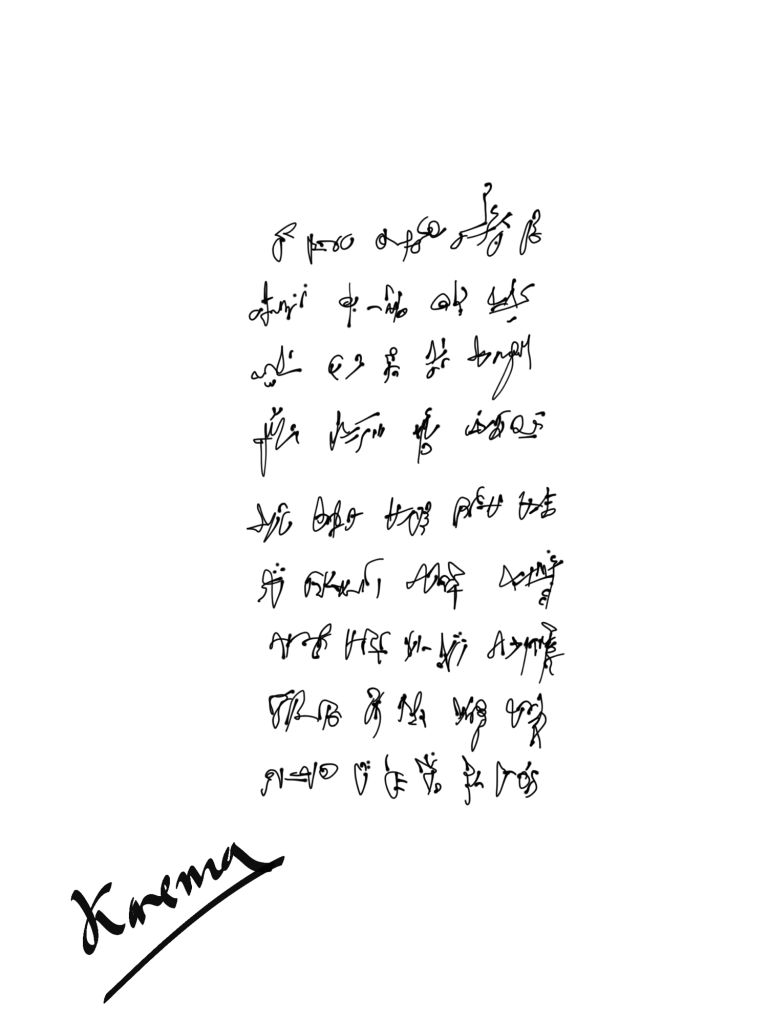
The power of asemic writing lies in its ability to transcend direct interpretation. Research by Tim Gaze describes asemic writing as any form resembling writing but unreadable to viewers, often evoking primal marks like children’s scribbles or ancient cave art. My initial encounters with asemic forms reminded me of the unfamiliarity of a foreign language—an idea I explored deeply in Blah Blah Blah Banner. Here, asemic “poems” embrace visuality without linguistic meaning, inviting viewers to interpret solely through form.

From this project, I came to realise that asemic text can convey a universal sense of expression, allowing the imagination to interpret across languages and cultures. Language may ground us, but asemic writing frees us… Each brushstroke a wordless, universal rhythm.

Posted in Exhibitions, Reflection

A Reflection on Culture, Unity, and Peace

This summer, I had the opportunity to showcase Al-Mayida (The Dining Table) at Birkenhead Central Library, an installation exploring the universal and symbolic significance of the dining table. And recently, the work was selected for Hypha Studios and Dispensary Gallery’s group show in Wrexham, adding a new layer of meaning by placing it in dialogue with other multidisciplinary pieces in a 15,000-square-foot exhibition space. With its vibrant, community-centered focus, Al-Mayida became a platform for discussing culture, peace, and the shared human experience of gathering. Moving the installation from Birkenhead Library to the larger venue in Wrexham taught me to consider how an artwork’s message and impact evolve with changes in environment and scale.

The dining table holds a unique, cross-cultural significance, serving as a setting for family meals, heartfelt conversations, and shared memories. With Al-Mayida, I aimed to capture these moments by creating an immersive, interactive experience that emphasises gathering, storytelling, and unity. Drawing from a blend of artistic mediums—ceramics, textiles, and Arabic calligraphy—the installation celebrates the act of coming together, inviting audiences to reflect on what it means to share a meal, both literally and symbolically.

On the final day of Al-Mayida, I introduced a dinner set, with each item inscribed with the Arabic word for peace—سلام (Salam). “Peace,” as a concept and a word, transcends borders, symbolising our shared humanity and fostering dialogue around unity and understanding. This white ceramic set, with its minimalist design, carries a calm, contemplative energy, resonating with the installation’s message of harmony.

As a closing touch to the exhibition, I crafted three large plates inscribed with references to the Sykes-Picot Agreement, the 1916 colonial pact that divided the Middle East into spheres of influence and reshaped its geopolitical landscape. This historical reference acknowledged the dining table not only as a place for personal stories but also as a platform for global reflection. These plates became symbols of resilience, encouraging visitors to consider how history shapes our identities, our relationships, and our ongoing quest for self-determination.

The presence of these plates alongside the Salam ceramic set introduces a compelling tension—a juxtaposition between the ideals of peace and unity and the complex legacies of political history. I hope these pieces spark conversations about the ways past injustices continue to impact the present, inspiring a shared commitment to a more peaceful future.

Reflecting on Al-Mayida, I see a pathway forward that embraces community involvement, broadens cultural exploration, and deepens historical reflection. This work has laid the foundation for a practice rooted in dialogue, shared experience, and the powerful simplicity of gathering around a table.